
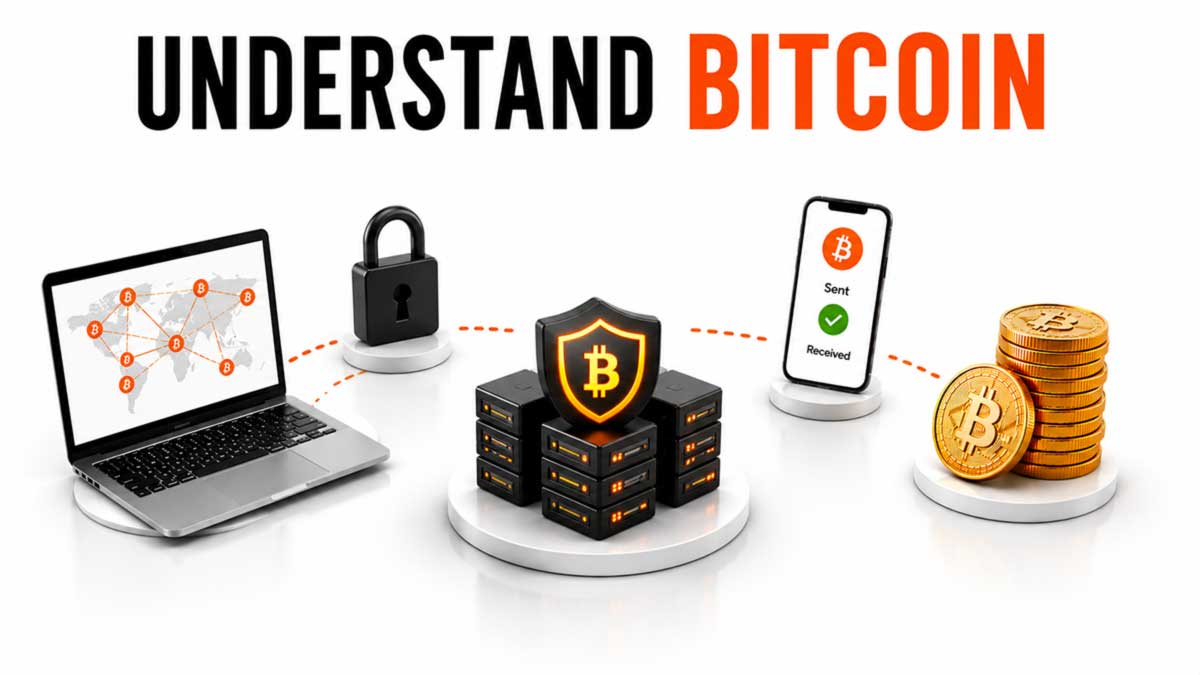
Bitcoin fascinates, intrigues, divides. Nearly 17 years after its creation, it remains the best-known and most resilient cryptocurrency. But for many, it still feels mysterious: what is it really, how does it work, why do so many people believe in it?
This guide lays out the basics clearly. No jargon, no hype, just the concepts that matter. By the end, you'll understand what your neighbour is talking about when they mention Bitcoin, and you'll be able to decide for yourself whether the subject deserves your attention.
Bitcoin in one definition
Bitcoin is a global digital currency, with no bank or central authority, whose maximum supply is capped at 21 million21 millionMaximum number of bitcoins that will ever exist, hard-coded in the protocol. This programmed scarcity is a founding feature. The last sat will be mined around the year 2140.See in the lexicon → units.
Three words sum it all up:
- Digital: it exists only in electronic form, like a computer file.
- Decentralised: no state, no company, no bank controls it. A network of computers spread around the world runs it.
- Scarce: its protocol guarantees there will never be more than 21 million. Compare with euros or dollars, whose supply keeps increasing.
How it works, in 3 key ideas
You don't need to understand everything overnight. Three ideas are enough for an accurate picture.
1. The blockchainBlockchainA public, shared ledger that records every Bitcoin transaction in blocks linked together cryptographically. Each participant in the network keeps a copy.See in the lexicon → is a giant public ledger. Every Bitcoin transaction is written in a huge accounting book, shared between thousands of computers. Anyone can check it, no one can tamper with it. Once recorded, a transaction stays there forever.
2. Miners secure the network. They are companies and individuals running specialised machines to validate new transactions and add them to the ledgerLedger, Trezor, Coldcard, BitBoxMain hardware wallet brands. Ledger Nano S Plus / X (French, the best-seller), Trezor Model T (Czech, open source), Coldcard Mk4 (Canadian, ultra-secure, Bitcoin-only), BitBox02 (Swiss, open source).See in the lexicon →. In exchangeExchangeService that lets you buy, sell and swap cryptocurrencies against fiat money. Examples : Kraken, Coinbase, Bitstamp, Bitvavo. Most are custodial.See in the lexicon →, they receive newly minted bitcoins. This is what prevents cheating: to rewrite history, you would need to spend more electricity than all miners combined, which is economically impossible.
3. You are your own bank. To hold bitcoins, you need a walletWalletSoftware or device that manages your Bitcoin keys and lets you sign transactions. A wallet does not really « hold » your bitcoins, it holds the keys that prove you own them.See in the lexicon →. It's a piece of software or a small device that keeps your keys. If you manage your keys well, no one can freeze your funds or stop you from sending a payment. This is the big difference with a traditional bank.
Why Bitcoin exists
Bitcoin was born on 3 January 2009, in the middle of the global financial crisis. Its creator, who signed under the pseudonym Satoshi NakamotoSatoshi NakamotoPseudonym of the creator (or collective) behind Bitcoin. Active on forums from 2008 to 2011, then vanished without revealing any identity. Holds roughly 1.1 million BTC that have never moved.See in the lexicon →, wanted to build a form of money that did not depend on banks or governments.
Three observations drove him. First, traditional money is printed at will by central banks, eroding its purchasing power over time. Second, classic digital payments rely on intermediaries that can freeze an account or refuse a transaction. Third, until Bitcoin, no one had managed to create a tamper-proof digital currency without relying on a central authority.
Bitcoin offers an alternative: a currency whose rules are written in code, controlled by no one, accessible to anyone with an internet connection.
Satoshi's white paper
It all starts with a text. On 31 October 2008, Satoshi NakamotoSatoshi NakamotoPseudonym of the creator (or collective) behind Bitcoin. Active on forums from 2008 to 2011, then vanished without revealing any identity. Holds roughly 1.1 million BTC that have never moved.See in the lexicon → published the Bitcoin white paper, nine pages laying out the full idea: peer-to-peer electronic cash, with no bank, that solves the double-spending problem through a network and proof-of-work. Not a single line of code, just the principles, and yet all of Bitcoin is already there.
Common questions
Is Bitcoin anonymous? No. All transactions are public. However, Bitcoin addresses don't carry your name, this is called pseudonymous: as long as no one links your identity to your address, you keep a form of discretion.
Does Bitcoin use a lot of energy? Yes, miningMiningProcess of validating blocks through proof of work. Consumes electricity by design : that is what secures the network.See in the lexicon → requires electricity. But a growing share comes from renewable sources or surplus energy that would have been wasted without Bitcoin. The topic deserves real discussion, without caricature.
Can you lose your bitcoins? Yes, if you lose your keys or your seed phraseSeed phraseSequence of 12 or 24 words (usually in English) that encodes your master key. Universal wallet backup : with these words, you can restore your funds on any compatible software.See in the lexicon →, no one can return them to you. That's the flip side of self-sovereignty. Hence the importance of a good walletWalletSoftware or device that manages your Bitcoin keys and lets you sign transactions. A wallet does not really « hold » your bitcoins, it holds the keys that prove you own them.See in the lexicon → and solid backups.
Is it worth investing? It depends on your profile, your horizon, and your risk tolerance. Over 15 years Bitcoin has shown strong appreciation but with extreme volatility. Reading the full guide before deciding is the bare minimum.
Disclaimer
Educational and informational content only: not investment, tax or legal advice. Bitcoin carries significant risks, including high volatility and the possible loss of invested capital. Each reader remains responsible for their decisions; when in doubt, consult a qualified professional in your jurisdiction.
Going further
Each concept introduced here has its own dedicated article. Here's where to start depending on your need:
- What is Bitcoin: the detailed definition and monetary properties.
- How Bitcoin works: blockchainBlockchainA public, shared ledger that records every Bitcoin transaction in blocks linked together cryptographically. Each participant in the network keeps a copy.See in the lexicon →, miners, nodes, jargon-free.
- History of Bitcoin: from Cypherpunks to Satoshi NakamotoSatoshi NakamotoPseudonym of the creator (or collective) behind Bitcoin. Active on forums from 2008 to 2011, then vanished without revealing any identity. Holds roughly 1.1 million BTC that have never moved.See in the lexicon →.
- Bitcoin in numbers: market cap, hashrateHashrateTotal computing power deployed by miners, measured in hashes per second (EH/s, exahashes). The higher the hashrate, the more expensive the network is to attack.See in the lexicon →, energy, price.
- The Bitcoin halving: the mechanism that makes Bitcoin scarce.
- Bitcoin vs fiat money: what sets Bitcoin apart from classic currencies.
- Bitcoin vs gold: two stores of value compared.
- Bitcoin vs altcoins: why Bitcoin stands apart from other cryptos.
- Misconceptions about Bitcoin: the most common myths, debunked.
- Bitcoin vs fiat money: what sets Bitcoin apart from classic currencies.
- Bitcoin vs gold: two stores of value compared.
- Bitcoin vs altcoins: why Bitcoin stands apart from other cryptos.
- Misconceptions about Bitcoin: the most common myths, debunked.
- Buy Bitcoin: practical guide, exchanges, security.