
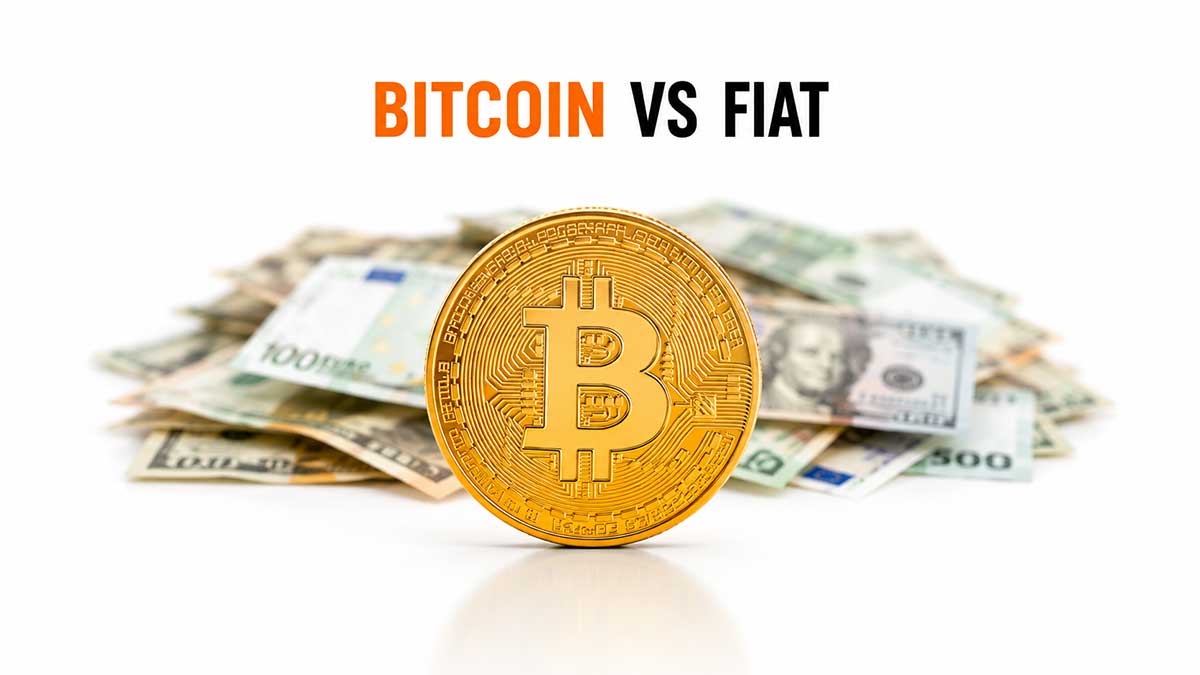
You pay for your bread in euros, your rent in Swiss francs, your Amazon orders in dollars. These currencies share one thing: they're issued by central banks, with no mandatory tangible backing. They're called fiatFiat (fiat currency)State currency with legal tender status (euro, Swiss franc, dollar), issued by a central bank and not backed by a physical asset. By contrast, Bitcoin has an issuance capped at 21 million units, with no central issuer.See in the lexicon → currencies, from the Latin "let it be done". Bitcoin was designed to offer exactly the opposite: a currency whose rules are written in code and that no one can change.
What is a fiat currency
A fiatFiat (fiat currency)State currency with legal tender status (euro, Swiss franc, dollar), issued by a central bank and not backed by a physical asset. By contrast, Bitcoin has an issuance capped at 21 million units, with no central issuer.See in the lexicon → currency is money whose value rests only on the trust placed in the issuer, generally a state through its central bank. There's no obligation to convert it into gold, silver, or anything tangible. Its supply is adjusted based on the monetary policy decided by the authorities.
The entire world has lived under a fiat regime since 1971, when the United States ended dollar convertibility into gold (end of Bretton Woods). Since then, all major currencies have become purely conventional. They work because we agree that they work.
The 3 fundamental differences
1. Issuance: centralised vs algorithmic. Central banks decide, in committee, how much money to create. Bitcoin follows an issuance schedule written in code in 2008, identical for everyone, predictable until 2140.
2. Supply: unlimited vs capped. There is no strict limit on the number of euros or dollars that can exist. Global money supply has only grown for 50 years. Bitcoin is capped at 21 million21 millionMaximum number of bitcoins that will ever exist, hard-coded in the protocol. This programmed scarcity is a founding feature. The last sat will be mined around the year 2140.See in the lexicon → units. Full stop.
3. CustodyCustodyThe custody of funds. See self-custody and custodial in the dedicated section below.See in the lexicon →: third-party vs personal. Your bank money legally belongs to the bank, which owes you an equivalent amount. Your bitcoins, if you manage your own keys, belong to you directly. No one can freeze your account or block your assets.
Inflation: the silent driver of erosion
The most powerful argument for Bitcoin lies in one statistic: since 1971, the euro and the dollar have lost more than 85% of their purchasing power. What cost 1 franc in 1971 costs about 4 today. Inflation, even moderate, silently eats away savings year after year.
Bitcoin proposes the opposite. Its supply decreases over time via halvings, making it a disinflationary asset. If demand holds or grows, the purchasing power of one bitcoin tends to rise, not fall.
Caveat: Bitcoin remains extremely volatile in the short term. Over 1 year you can lose 50%, over 5 years you can lose 80%. But over 10-15 years, its purchasing power has exploded while fiatFiat (fiat currency)State currency with legal tender status (euro, Swiss franc, dollar), issued by a central bank and not backed by a physical asset. By contrast, Bitcoin has an issuance capped at 21 million units, with no central issuer.See in the lexicon → has eroded.
Can Bitcoin replace the euro or the dollar
In the short term, no. For three concrete reasons: volatility too strong to set a daily price, limited throughput (the Bitcoin network validates ~7 transactions per second when Visa processes 1,700), and still marginal adoption among merchants.
In the medium term, Bitcoin positions itself rather as a store of value, like digital gold, and as an international payment rail via the Lightning NetworkLightning NetworkSecond-layer payment network on top of Bitcoin. Enables near-instant and near-free payments through channels opened between users.See in the lexicon →. Not as a universal replacement for the euro to buy bread.
El SalvadorEl SalvadorFirst country to adopt Bitcoin as legal tender, in September 2021 under Nayib Bukele. Its status was amended in 2025 under IMF pressure.See in the lexicon → tried making it legal tender in 2021, with mixed results (low adoption for everyday transactions, but bitcoin accumulation in the state's treasury). In 2025, the country eased the obligation on merchants. This shows that switching to Bitcoin as everyday money is more complex than a simple political decision.
Coexistence rather than replacement
The most credible scenario isn't replacement, it's coexistence. You'll keep using the euro for daily purchases because it's the system that works best for that. And you'll be able to hold part of your savings in Bitcoin to protect yourself from inflation and diversify outside the traditional banking system.
This logic is already being adopted institutionally. In 2024, spot Bitcoin ETFs were approved in the United States and attracted over 100 billion dollars in less than 18 months. In 2025, several US states voted to integrate Bitcoin into their treasuries. The topic is no longer fringe.
Disclaimer
Educational and informational content only: not investment, tax or legal advice. Bitcoin carries significant risks, including high volatility and the possible loss of invested capital. Each reader remains responsible for their decisions; when in doubt, consult a qualified professional in your jurisdiction.