
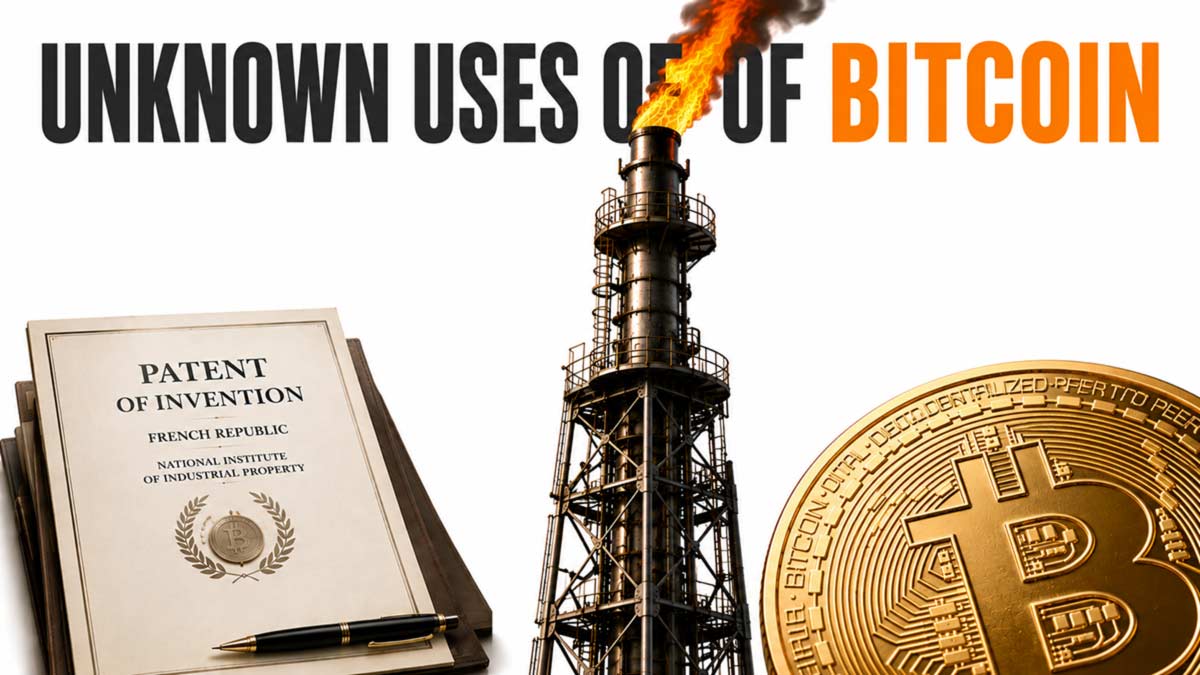
When people talk about Bitcoin, two images come back: the money you spend and the store of value you hold. These are the dominant uses, but they hide a broader reality. Bitcoin is first of all a network, and the mechanism that makes it work, proof-of-work miningMiningProcess of validating blocks through proof of work. Consumes electricity by design : that is what secures the network.See in the lexicon →, has properties that can be repurposed to provide services unrelated to payment.
A minerMinerComputer or farm of computers that solves the cryptographic puzzle required to add a new block to the blockchain, in exchange for a bitcoin reward.See in the lexicon → consumes electricity and can switch on or off within seconds. A transaction can carry, on top of an amount, the fingerprint of a file. Every block produces a number that nobody can predict in advance. These three facts, trivial taken separately, open concrete uses that few people associate with Bitcoin.
This guide presents five of these lesser-known uses, each detailed in a dedicated article. None is a speculative promise: they are applications already deployed, with their limits and their grey areas, which we describe without overselling them.
Balancing the power grid
A power grid must produce at every instant exactly what is asked of it. When demand drops or the wind blows too hard, the surplus electricity has no buyer and risks destabilising the grid. Bitcoin miners offer an unusual outlet: they buy that surplus, and cut off instantly when demand picks up again.
In Texas, the ERCOT operator pays these miningMiningProcess of validating blocks through proof of work. Consumes electricity by design : that is what secures the network.See in the lexicon → farms to power down during peaks. The minerMinerComputer or farm of computers that solves the cryptographic puzzle required to add a new block to the blockchain, in exchange for a bitcoin reward.See in the lexicon → becomes a flexible load, switched on when energy is abundant and cheap, off when it is scarce. This is the subject of the article Bitcoin mining and the power grid.
Timestamping and anchoring documents
Proving that a document existed at a given date, without revealing it, is a common need: filing a patent, establishing priority of an idea, integrity of a contract. Bitcoin can do it. You compute the digital fingerprint of the file, a unique string of characters, and write it into a transaction. Once in a block, that fingerprint is frozen forever.
Nobody can backdate a document anchored this way, nor claim it existed before its registration. The file itself stays private: only its fingerprint is public. The article Anchoring documents in the blockchain details this mechanism and the OpenTimestamps tool.
Producing verifiable randomness
Drawing lots fairly is surprisingly hard as soon as you do not trust the organiser. How do you prove that a lottery or an allocation has not been rigged? Every Bitcoin block ends with a number, its hashHashFunction that turns data of any size into a fixed-size fingerprint. The same input always yields the same output, but you cannot go back from output to input.See in the lexicon →, that nobody knows before the block is mined and that everyone can verifyDon't trust, verifyBitcoiner mantra. Trust no one (bank, government, exchange, influencer), verify on your own through your own node.See in the lexicon → afterwards.
That number serves as a public randomness seed: impossible to predict, impossible to alter after the fact, visible to all. Draws, games and protocols use it as a neutral referee. The article Bitcoin and random numbers explains the use and its limits, because a minerMinerComputer or farm of computers that solves the cryptographic puzzle required to add a new block to the blockchain, in exchange for a bitcoin reward.See in the lexicon → can, at a cost, influence the result.
Putting flared gas to use
Oil wells also produce gas, often far from any pipeline. Unable to sell it, operators burn it off in a flare, a flame visible from space. This flaring turns a strongly warming methane into less harmful CO2, but wastes considerable energy and stays imperfect.
Installing Bitcoin miners on site changes the picture: a generator consumes the gas to produce electricity that runs the machines. Combustion is more complete than a flare, and the wasted gas becomes a resource. The article Bitcoin mining and flared gas explains why gas is flared and what miningMiningProcess of validating blocks through proof of work. Consumes electricity by design : that is what secures the network.See in the lexicon → changes.
Sending money to one's family
Hundreds of millions of people work far from their country and send part of their salary to relatives left behind. These transfers go through operators that charge high fees and impose delays, especially towards regions poorly served by banks.
Bitcoin, in particular via the Lightning NetworkLightning NetworkSecond-layer payment network on top of Bitcoin. Enables near-instant and near-free payments through channels opened between users.See in the lexicon →, makes it possible to send small amounts internationally in seconds, at an often lower cost. The trade-off is real: volatility, conversion into local currency, internet access. The article Bitcoin and money transfers weighs the pros and cons, with examples.
Disclaimer
Educational and informational content only: not investment, tax or legal advice. Bitcoin carries significant risks, including high volatility and the possible loss of invested capital. Each reader remains responsible for their decisions; when in doubt, consult a qualified professional in your jurisdiction.
To go further
To place these uses in the context of Bitcoin:
- Bitcoin mining and the power grid: the flexible load that balances the grid (Texas).
- Anchoring documents: timestamping and proof of priority via OpenTimestamps.
- Bitcoin and random numbers: public, verifiable randomness.
- Bitcoin mining and flared gas: putting oil-well methane to use.
- Bitcoin and money transfers: sending to family via Lightning.
- Bitcoin mining and the power grid: the flexible load that balances the grid (Texas).
- Anchoring documents: timestamping and proof of priority via OpenTimestamps.
- Bitcoin and random numbers: public, verifiable randomness.
- Bitcoin mining and flared gas: putting oil-well methane to use.
- Bitcoin and money transfers: sending to family via Lightning.
- Bitcoin mining and the power grid: the flexible load that balances the grid (Texas).
- Anchoring documents: timestamping and proof of priority via OpenTimestamps.
- Bitcoin and random numbers: public, verifiable randomness.
- Bitcoin mining and flared gas: putting oil-well methane to use.
- Bitcoin and money transfers: sending to family via Lightning.
- Misconceptions about Bitcoin: the pollution myth is covered in detail there, useful before judging energy uses.
- Understanding Bitcoin: the fundamentals guide, to grasp miningMiningProcess of validating blocks through proof of work. Consumes electricity by design : that is what secures the network.See in the lexicon →, blocks and hashes.
- Using Bitcoin day to day: paying, receiving and accepting, alongside international transfers.