
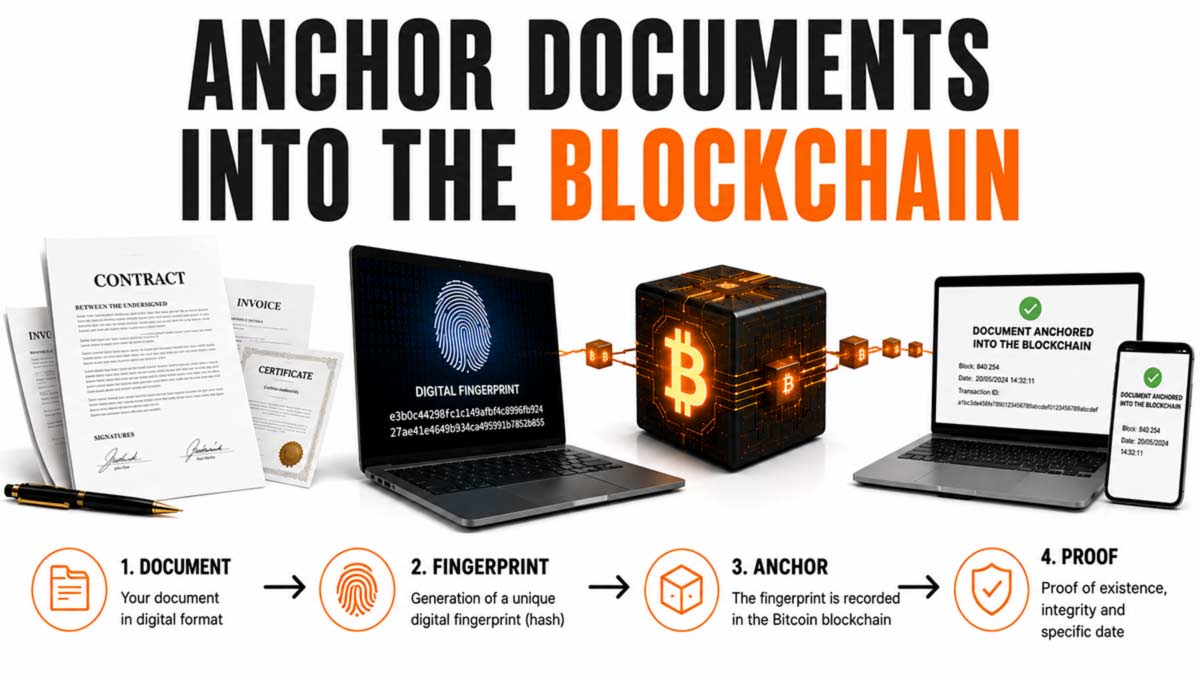
Imagine having to prove, in five years, that a contract, a manuscript or a technical diagram really existed on today's date. A handwritten signature says nothing about the date. A computer file carries a modification date, but that can be faked in two clicks. Classic certification services exist, but they rest on the trust placed in a third party that can disappear, err or be corrupted.
Bitcoin offers a different answer. Each block is dated and linked to the previous one, forming a chain that nobody can rewrite without redoing colossal work. If one manages to slip a document's fingerprint into this chain, it inherits that inviolability: the document is proven to predate the block that contains it, forever.
This article explains what a digital fingerprint is, how it is anchored into the blockchainBlockchainA public, shared ledger that records every Bitcoin transaction in blocks linked together cryptographically. Each participant in the network keeps a copy.See in the lexicon →, how the OpenTimestamps tool makes the operation free and massive, what it is concretely useful for, and above all what timestamping does not prove.
The digital fingerprint, a unique summary of a file
At the heart of timestamping lies an operation called a hashHashFunction that turns data of any size into a fixed-size fingerprint. The same input always yields the same output, but you cannot go back from output to input.See in the lexicon → function. You give it a file, any file, and the function returns a fixed-length string of characters, its fingerprint. The same file always yields the same fingerprint. But changing a comma, a pixel or a byte produces an entirely different fingerprint.
This fingerprint has two essential properties. On one hand, it is in practice impossible to craft two different files sharing the same fingerprint. On the other, from the fingerprint alone, the original file cannot be reconstructed. The fingerprint is therefore a faithful and irreversible summary: it identifies the document without disclosing it.
This is exactly what is needed to timestamp without revealing. You never write the document itself into the blockchainBlockchainA public, shared ledger that records every Bitcoin transaction in blocks linked together cryptographically. Each participant in the network keeps a copy.See in the lexicon →, only its fingerprint. The file stays on your disk, confidential. The day you must prove its priority, you recompute the fingerprint and show that it does appear in a dated block.
How Bitcoin becomes a notary
A Bitcoin transaction can carry a small amount of arbitrary data on top of the value transfer. It is this tiny space that is used to inscribe a fingerprint. Once the transaction is confirmed and included in a block, the fingerprint is engraved into the chain, together with the block's date.
From that instant, modifying or deleting this inscription would require rewriting the block concerned and all the following ones. Yet redoing that work means mobilising a computing power that nobody owns. The very security that protects hundreds of billions in value also protects, for free as a bonus, your document fingerprint.
You thus obtain a timestamped proof of existence: this document existed at the latest by the date of this block. Nobody can backdate it, because the fingerprint would have to be inserted into a past block, which is impossible. Nobody can claim it appeared later, because the fingerprint is already there. The network plays the role of a neutral, permanent and unforgeable witness.
OpenTimestamps, free and massive timestamping
Inscribing a transaction on Bitcoin costs fees and takes up space. Timestamping each document through a dedicated transaction would be costly and would clog the network. The elegant solution is called OpenTimestamps, an open and free standard that solves this problem through aggregation.
The principle: a server collects thousands of fingerprints sent by users, combines them into a single master fingerprint by means of a hashHashFunction that turns data of any size into a fixed-size fingerprint. The same input always yields the same output, but you cannot go back from output to input.See in the lexicon → tree, then anchors only that single fingerprint into the blockchainBlockchainA public, shared ledger that records every Bitcoin transaction in blocks linked together cryptographically. Each participant in the network keeps a copy.See in the lexicon →. Each user receives in return a small proof file linking their document to the common inscription. Millions of documents can thus be timestamped through a single transaction.
The operation is free for the user, reveals nothing of the content, and the proof remains independently verifiable, even if the server disappears, as long as the Bitcoin blockchain exists. Software such as Sparrow WalletWalletSoftware or device that manages your Bitcoin keys and lets you sign transactions. A wallet does not really « hold » your bitcoins, it holds the keys that prove you own them.See in the lexicon → or free libraries integrate OpenTimestamps, and some backup or archiving projects use it by default.
What timestamping is used for
The first use is proof of priority. An inventor can timestamp the description of an idea before filing a patent, an author the manuscript of a work, a researcher a dataset. In case of dispute, they hold a dated and independent proof, which does not replace legal filing but usefully complements it.
The second use is proof of integrity. A company timestamps the version of a signed contract, a journalist a photo or a video, an administration a register. Later, recomputing the fingerprint and comparing it to the anchored one proves the file has not been altered since. This is valuable against fakes and falsifications.
Other applications are emerging: verifiable certificates and diplomas, tamper-proof audit logs, archiving proofs for regulatory compliance. The common point is always the same: you do not trust a third party, you trust a public chain that nobody controls.
What timestamping does not prove
Timestamping proves one thing and one thing only: that a file existed at the latest by a given date, and that it has not changed since. It does not prove who authored it, nor who holds its rights, nor that its content is true. A timestamped piece of false information remains false information, simply dated.
Nor does it replace a legal signature or an official filing when the law requires one. Before a court, a timestamp proof is one more element, whose value depends on the applicable law and the judge's appreciation. It is a solid complement, not a universal substitute.
Finally, the proof only makes sense if you keep both the original file and the small proof file. Lose either of the two, and the anchoring becomes unusable. Timestamping is a powerful and cheap tool, provided you understand precisely what it guarantees and what it leaves outside its scope.
Disclaimer
Educational and informational content only: not investment, tax or legal advice. Bitcoin carries significant risks, including high volatility and the possible loss of invested capital. Each reader remains responsible for their decisions; when in doubt, consult a qualified professional in your jurisdiction.
To go further
To understand the building blocks used here:
- How Bitcoin works: blocks, chain and hashes, the foundations of timestamping.
- Lesser-known uses of Bitcoin: the guide of the five uses.
- Understanding Bitcoin: the fundamentals base.