
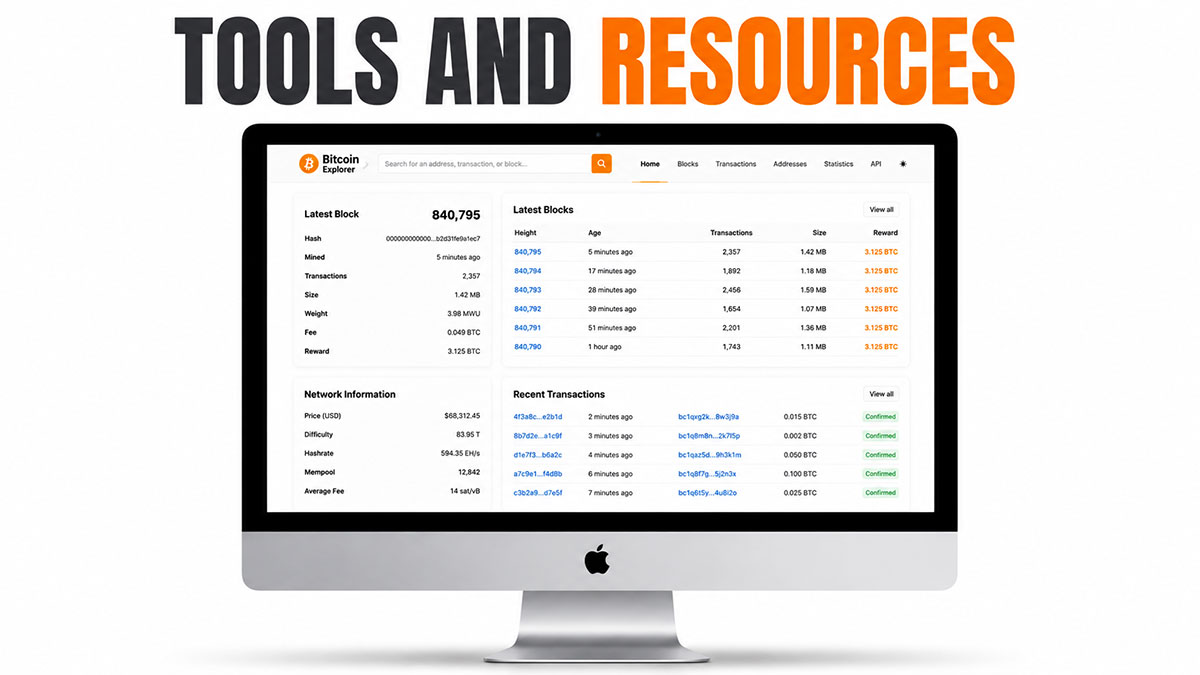
The Bitcoin tools ecosystem matured during the 2016-2026 decade. In the early days, few decent wallets, explorers reselling user queries to analysts, and no mainstream tool for tax or commerce. In 2026, the situation is radically different : Sparrow and Specter for advanced custodyCustodyThe custody of funds. See self-custody and custodial in the dedicated section below.See in the lexicon →, mempool.space as the reference neutral explorer, BTCPay Server for merchants without intermediary, Waltio and Koinly for automated tax filing.
Six tool categories structure the daily life of a serious European bitcoinerBitcoinerPerson interested in Bitcoin, who holds some and adheres more or less to its values (individual sovereignty, sound money, decentralisation).See in the lexicon →. Explorers (read the chain and mempoolMempoolWaiting area where Bitcoin transactions sit before being included in a block. The fuller the mempool, the higher the fees required.See in the lexicon → without depending on a third-party service). Advanced desktop wallets (multisigMultisig (multi-signature)Configuration where a transaction must be signed by several independent keys to be valid (for example 2 of 3). Reduces the risk that a single key theft causes loss of funds.See in the lexicon →, PSBTPSBT (Partially Signed Bitcoin Transaction)Standard format (BIP 174) that lets you build a transaction on one device, sign it on another and broadcast it from a third. Backbone of the modern multisig workflow.See in the lexicon →, hardware integration). Merchant solutions (BTCPay and alternatives). Privacy-respecting portfolio trackers. Tax tools (capital gains computation, multi-jurisdiction filings). Dev tools for those who want to dig (Bitcoin CoreBitcoin CoreReference implementation of the Bitcoin software, written in C++ and maintained by an open-source community. This is the software that most nodes run.See in the lexicon → dev tools, regtest, electrs).
This guide opens the Tools topic. Seven articles then detail each category with specific tools, their configuration, their alternatives, their limits. Reading for those who want to equip their 2026 Bitcoin setup without depending on a single service or giving in to fashion.
Category 1 : explorers and chain reading
A Bitcoin explorer reads the blockchainBlockchainA public, shared ledger that records every Bitcoin transaction in blocks linked together cryptographically. Each participant in the network keeps a copy.See in the lexicon → and presents blocks, transactions, addresses and UTXOs in a humanly readable way. It is the daily reflex to verifyDon't trust, verifyBitcoiner mantra. Trust no one (bank, government, exchange, influencer), verify on your own through your own node.See in the lexicon → a transaction was broadcast, follow confirmations, read the mempoolMempoolWaiting area where Bitcoin transactions sit before being included in a block. The fuller the mempool, the higher the fees required.See in the lexicon →, watch fees. The explorer choice matters more than it seems : an explorer made by a chain analysis company (like BTC.com from Bitmain, or the old Blockchain.com) sees every query you make and can correlate them with other data.
The 2026 neutral reference is mempool.spacemempool.spaceReference open-source Bitcoin explorer in 2026. Visualisation of blocks, fees and the mempool. Launched by Wiz and the mempool.space team.See in the lexicon →, an open-source project led by Wiz and his team, funded by donations and partnerships. It offers a fee-coloured mempool map, the next-blocks fee histogram, search by transaction/address/block, public APIAPI (Application Programming Interface)Interface that lets one program query another program or service. mempool.space exposes a public API for querying the chain.See in the lexicon →, and even a self-hosted version (to connect to your own Bitcoin CoreBitcoin CoreReference implementation of the Bitcoin software, written in C++ and maintained by an open-source community. This is the software that most nodes run.See in the lexicon →, for total privacy). Serious alternatives : blockstream.info (from Blockstream, also open sourceOpen sourceSoftware whose source code is public and modifiable by anyone. A fundamental auditability guarantee in Bitcoin.See in the lexicon →), mempool.observer (community variant), and the minimal explorer built into Bitcoin Core itself via bitcoin-cli commands.
2026 hygiene : for quick checks, mempool.space on a regular browser is fine. For sensitive checks (large moves, specific address surveillance), go through Tor or use a self-hosted mempool.space connected to your own nodeNodeComputer that runs the Bitcoin software and takes part in the network by validating blocks and transactions. A « full node » keeps a complete copy of the blockchain.See in the lexicon →. The next article details mempool.space and its ecosystem.
Category 2 : advanced desktop wallets
Above mainstream mobile wallets (covered in the CustodyCustodyThe custody of funds. See self-custody and custodial in the dedicated section below.See in the lexicon → topic), there is a category of advanced desktop wallets for those who want to manage multisigMultisig (multi-signature)Configuration where a transaction must be signed by several independent keys to be valid (for example 2 of 3). Reduces the risk that a single key theft causes loss of funds.See in the lexicon →, sign PSBTs across several hardware, watch an xpubxpub (extended public key)Extended public key. Lets a read-only wallet see addresses and balances without being able to sign. Used for tracking and observation.See in the lexicon → without holding keys, or connect to their own Bitcoin CoreBitcoin CoreReference implementation of the Bitcoin software, written in C++ and maintained by an open-source community. This is the software that most nodes run.See in the lexicon → nodeNodeComputer that runs the Bitcoin software and takes part in the network by validating blocks and transactions. A « full node » keeps a complete copy of the blockchain.See in the lexicon →. Three solutions dominate in 2026.
Sparrow WalletWalletSoftware or device that manages your Bitcoin keys and lets you sign transactions. A wallet does not really « hold » your bitcoins, it holds the keys that prove you own them.See in the lexicon → (Craig Raw, 2020-2026) has become the de facto standard for advanced users. Open sourceOpen sourceSoftware whose source code is public and modifiable by anyone. A fundamental auditability guarantee in Bitcoin.See in the lexicon →, multi-platform (Linux, macOS, Windows), supports all hardware wallets (LedgerLedger, Trezor, Coldcard, BitBoxMain hardware wallet brands. Ledger Nano S Plus / X (French, the best-seller), Trezor Model T (Czech, open source), Coldcard Mk4 (Canadian, ultra-secure, Bitcoin-only), BitBox02 (Swiss, open source).See in the lexicon →, TrezorLedger, Trezor, Coldcard, BitBoxMain hardware wallet brands. Ledger Nano S Plus / X (French, the best-seller), Trezor Model T (Czech, open source), Coldcard Mk4 (Canadian, ultra-secure, Bitcoin-only), BitBox02 (Swiss, open source).See in the lexicon →, ColdcardLedger, Trezor, Coldcard, BitBoxMain hardware wallet brands. Ledger Nano S Plus / X (French, the best-seller), Trezor Model T (Czech, open source), Coldcard Mk4 (Canadian, ultra-secure, Bitcoin-only), BitBox02 (Swiss, open source).See in the lexicon →, BitBox02), all address formats (Legacy, SegWitSegWit (Segregated Witness)Upgrade activated in 2017 that separates signature data from the rest of the transaction. Lowered fees and paved the way for Lightning Network.See in the lexicon →, TaprootTaprootMajor Bitcoin upgrade activated in November 2021 (BIP 341). Brings more privacy, scripting flexibility and the efficiency of Schnorr signatures.See in the lexicon →), classic multisig and MuSig2MuSig2Schnorr signature aggregation protocol (BIP 327). Lets multiple signers produce a single signature indistinguishable from a single-signer one.See in the lexicon →, PSBTs, connection to your own node via RPCRPC (Remote Procedure Call)Standard protocol for calling functions on a remote program. Bitcoin Core exposes more than 200 RPC commands.See in the lexicon → or Electrum. Sparrow Server can act as an Electrum personal server for mobile wallets.
Specter Desktop (Stepan Snigirev, 2020-2026) covers similar use cases with emphasis on institutional multisig. Bitcoin Core under the hood, integration with Specter DIY (an open-source DIY hardware walletHardware walletSmall dedicated device (Ledger, Trezor, Coldcard, BitBox, etc.) that keeps the private key away from a potentially compromised computer. Signs transactions inside the device itself.See in the lexicon →), web interface. Rougher but more powerful for complex multisigs. Electrum (since 2011) remains the open-source elder, more minimalist but battle-tested. The next article details Sparrow Wallet, the most-used desktop wallet in 2026 in the European community.
Category 3 : merchant solutions
Accepting Bitcoin on the merchant side long required either technical tinkering or a centralised acquirer taking a commission and holding the funds. The situation changed with BTCPay Server, launched in 2017 by Nicolas Dorier, becoming in 2026 the standard self-hosted solution. It is an open-source server that installs on any mini-PCMini-PC (NUC)Small fanless computer such as Intel NUC, Beelink or Minisforum. More powerful than a Raspberry Pi, ideal for a serious node running Lightning and BTCPay.See in the lexicon → or VPSVPS (Virtual Private Server)Virtual server rented from a hosting provider (Hetzner, DigitalOcean, OVH), accessed via SSH. Typical price 5 to 30 EUR per month.See in the lexicon →, generates on-chain and Lightning invoices, natively integrates Magento/WooCommerce/Shopify, and stores received funds in a walletWalletSoftware or device that manages your Bitcoin keys and lets you sign transactions. A wallet does not really « hold » your bitcoins, it holds the keys that prove you own them.See in the lexicon → controlled by the merchant.
For those not wanting to self-host, several third-party services offer BTCPay-as-a-service or alternatives. OpenNode (US, custodialCustodialModel in which a third party (exchange, broker, neobank) holds your private keys for you. You have a claim, not a bitcoin. « Not your keys, not your coins ».See in the lexicon →, auto-converts to USD/EUR), Strike (US, more mainstream and Lightning AddressLightning AddressEmail-style address (alice@strike.me) that lets you receive Lightning payments without generating an invoice each time.See in the lexicon → focused), IBEX Pay (Latin America and Europe focus), Voltage (Lightning-focused). On the European retail side, physical terminals for stores exist (Sats Terminal, Bitcoin POS), connected to BTCPay or to a self-hosted Lightning wallet.
Merchant decisions in 2026 : self-hosted (BTCPay) or third party (OpenNode, Strike) ? Automatic EUR conversion or BTC retention (depending on treasury policy) ? On-chain only (for large amounts) or Lightning only (for fast retail) or both ? The next article details BTCPay Server, its installation, its integration with e-commerce platforms, and its most-used third-party alternative.
Category 4 : privacy-respecting portfolio trackers
Tracking the value of your Bitcoin portfolio tempts the easy way : let the exchangeExchangeService that lets you buy, sell and swap cryptocurrencies against fiat money. Examples : Kraken, Coinbase, Bitstamp, Bitvavo. Most are custodial.See in the lexicon → display the balance, or let a centralised app (Blockfolio, CoinGecko Portfolio) aggregate all your accounts. The problem : these services see all your positions, your moves, your PnL. That is valuable data for analysts, marketers, or worse in case of a leak.
Privacy-respecting trackers have emerged. Sparrow WalletWalletSoftware or device that manages your Bitcoin keys and lets you sign transactions. A wallet does not really « hold » your bitcoins, it holds the keys that prove you own them.See in the lexicon → has a native portfolio tab computing an xpubxpub (extended public key)Extended public key. Lets a read-only wallet see addresses and balances without being able to sign. Used for tracking and observation.See in the lexicon →'s value in real time without sending that info elsewhere (everything goes through your nodeNodeComputer that runs the Bitcoin software and takes part in the network by validating blocks and transactions. A « full node » keeps a complete copy of the blockchain.See in the lexicon → or Electrum personal server). Specter Desktop offers similar. MempoolMempoolWaiting area where Bitcoin transactions sit before being included in a block. The fuller the mempool, the higher the fees required.See in the lexicon → Goggles (from the same team as mempool.spacemempool.spaceReference open-source Bitcoin explorer in 2026. Visualisation of blocks, fees and the mempool. Launched by Wiz and the mempool.space team.See in the lexicon →, 2024) is a more visual self-hosted dashboard to track several xpubs and their evolution. Liana Wallet tracks transfers in its interface.
For those wanting a mobile tracker without heavy install, two paths. Mempool Accelerator has a basic portfolio view. Otherwise, privately keeping a spreadsheet (LibreOffice, Excel) with your amounts and the day's price remains the most discreet way, provided you encrypt the file (VeraCrypt, GPG). The dedicated trackers article will detail Sparrow and Mempool Goggles configurations.
Category 5 : crypto tax tools
Crypto taxation requires computing capital gains, FIFOFIFO (First In First Out)Capital gains method that treats the first bitcoins bought as the first sold. Used in Germany, Italy and the United States.See in the lexicon →/LIFOLIFO (Last In First Out)Capital gains calculation method: the last units bought are deemed sold first. Italy uses it for crypto, unlike the French weighted average cost or FIFO.See in the lexicon → methods, latent gains, crypto-crypto transactions, miningMiningProcess of validating blocks through proof of work. Consumes electricity by design : that is what secures the network.See in the lexicon →, stakingStakingLocking tokens to secure a proof-of-stake blockchain in exchange for a yield. Does not exist on Bitcoin, which relies on proof of work; tax-wise, staking income follows its own rules.See in the lexicon →, all multi-jurisdiction if you moved. Doing this by hand quickly becomes unmanageable beyond a few dozen transactions. Several tools automate : they import transactions from exchanges (via APIAPI (Application Programming Interface)Interface that lets one program query another program or service. mempool.space exposes a public API for querying the chain.See in the lexicon → or CSV), from wallets (via watch-onlyWatch-onlyMode in which a wallet observes balances and address history without holding the private key. Used to monitor a cold vault from a less secure device.See in the lexicon → xpubxpub (extended public key)Extended public key. Lets a read-only wallet see addresses and balances without being able to sign. Used for tracking and observation.See in the lexicon →), compute capital gains per country method, and generate reports ready to integrate into the return.
Four players dominate in 2026. Waltio (French, ~150 EUR/year, France leader, native Cerfa 2086Cerfa 2086French tax form (Cerfa) used to declare crypto capital gains.See in the lexicon → and 3916-bis3916-bisFrench tax form used to declare crypto accounts held abroad. Omitting it is fined at 750 EUR per undeclared account.See in the lexicon → support). Koinly (international, over 200 exchanges integrated, FR/DE/IT/CH support, from 49 EUR/year depending on volume). CoinTracking (German, oldest since 2013, FIFO/LIFO/HIFO support, large historical volume). Blockpit (Austrian, DACH focus, native Finanzamt Germany integration).
Decisions to make : exchangeExchangeService that lets you buy, sell and swap cryptocurrencies against fiat money. Examples : Kraken, Coinbase, Bitstamp, Bitvavo. Most are custodial.See in the lexicon → API auto-import (fast but exposes your API keys, ask for read-only) or manual CSV import (safe but slow). Include self-custodySelf-custodyModel in which you hold your own private keys. Your bitcoins depend on no third party. This is Bitcoin's founding promise.See in the lexicon → wallets via watch-only xpub or leave out of scope (which skews the computation if you make disposals there). Keep history for at least 5 years (typical tax prescription duration). The dedicated article will compare the 4 tools on price, ergonomics, support quality, and generate a configuration guide.
Categories 6 and 7 : dev tools and monitoring
Dev tools. For those wanting to code or contribute above Bitcoin, the ecosystem offers a solid infrastructure. Bitcoin CoreBitcoin CoreReference implementation of the Bitcoin software, written in C++ and maintained by an open-source community. This is the software that most nodes run.See in the lexicon → itself includes regtest (instant local test network), signet (stable public test network), and the RPCRPC (Remote Procedure Call)Standard protocol for calling functions on a remote program. Bitcoin Core exposes more than 200 RPC commands.See in the lexicon → interface to drive everything. Electrs (Romain Vallée, Rust) is the recommended self-hosted Electrum index to serve desktop wallets. libsecp256k1libsecp256k1Reference cryptographic library for Bitcoin, written in C and maintained by the Bitcoin Core developers. Used by almost every serious wallet.See in the lexicon → is the reference Bitcoin cryptographic library (SchnorrSchnorrMore modern signature algorithm, activated by Taproot in 2021 (BIP 340). More efficient, enables signature aggregation (MuSig2).See in the lexicon →, ECDSAECDSALegacy signature algorithm used by Bitcoin before Taproot. Signs a transaction with a private key to prove ownership.See in the lexicon →, MuSig2MuSig2Schnorr signature aggregation protocol (BIP 327). Lets multiple signers produce a single signature indistinguishable from a single-signer one.See in the lexicon →). BIPBIP (Bitcoin Improvement Proposal)Standard document that describes a proposed improvement to the Bitcoin protocol. Numbered (BIP 32, BIP 39, BIP 174, and so on). Open, public process on GitHub.See in the lexicon → utilities (bx, hwi) let you play with addresses, derivations, signatures.
Monitoring and alerts. For those running a Bitcoin or Lightning nodeNodeComputer that runs the Bitcoin software and takes part in the network by validating blocks and transactions. A « full node » keeps a complete copy of the blockchain.See in the lexicon →, or just watching important positions, several tools exist. MempoolMempoolWaiting area where Bitcoin transactions sit before being included in a block. The fuller the mempool, the higher the fees required.See in the lexicon → Alerts (mempool.spacemempool.spaceReference open-source Bitcoin explorer in 2026. Visualisation of blocks, fees and the mempool. Launched by Wiz and the mempool.space team.See in the lexicon →) send an email when a transaction confirms or fees cross a threshold. Telegram bots (BitInfoCharts, Whale Alert) follow large on-chain moves. Telebit (open sourceOpen sourceSoftware whose source code is public and modifiable by anyone. A fundamental auditability guarantee in Bitcoin.See in the lexicon →) watches a node and alerts on anomalies. For Lightning, watchtowers (see Advanced Lightning article) protect against cheating in the walletWalletSoftware or device that manages your Bitcoin keys and lets you sign transactions. A wallet does not really « hold » your bitcoins, it holds the keys that prove you own them.See in the lexicon →'s absence. For hardware health, smartmontools on Linux watches SSDs.
The whole forms a solid tooling infrastructure compared to 5 years ago. The dedicated articles detail each of these sub-domains, with concrete configurations, alternatives and limits. The general logic : avoid centralised services seeing everything, favour self-hostable open-source tools, accept a bit of technical friction in exchangeExchangeService that lets you buy, sell and swap cryptocurrencies against fiat money. Examples : Kraken, Coinbase, Bitstamp, Bitvavo. Most are custodial.See in the lexicon → for operational independence.
Disclaimer
Educational and informational content only: not investment, tax or legal advice. Bitcoin carries significant risks, including high volatility and the possible loss of invested capital. Each reader remains responsible for their decisions; when in doubt, consult a qualified professional in your jurisdiction.
See also
To run your own Bitcoin CoreBitcoin CoreReference implementation of the Bitcoin software, written in C++ and maintained by an open-source community. This is the software that most nodes run.See in the lexicon → nodeNodeComputer that runs the Bitcoin software and takes part in the network by validating blocks and transactions. A « full node » keeps a complete copy of the blockchain.See in the lexicon → (a prerequisite for several tools), see Running a bare Bitcoin Core node and A Bitcoin node at home. To understand SchnorrSchnorrMore modern signature algorithm, activated by Taproot in 2021 (BIP 340). More efficient, enables signature aggregation (MuSig2).See in the lexicon →/MuSig2MuSig2Schnorr signature aggregation protocol (BIP 327). Lets multiple signers produce a single signature indistinguishable from a single-signer one.See in the lexicon → cryptography used by Sparrow and Specter, see Taproot, Schnorr and MAST. For the topic articles (upcoming) : mempool.spacemempool.spaceReference open-source Bitcoin explorer in 2026. Visualisation of blocks, fees and the mempool. Launched by Wiz and the mempool.space team.See in the lexicon →, Sparrow, BTCPay, portfolio, tax, dev, alerts.
The 7 articles of the Tools topic:
- mempool.space in depth
- Sparrow Wallet
- BTCPay Server for merchants
- Portfolio trackers
- Crypto tax tools
- Developer tools
- Alerts and monitoring
The 7 articles of the Tools topic:
The 7 articles of the Tools topic: