
Buying your first bitcoins has become a routine operation. In 2026, more than 700 million people worldwide hold at least a fraction of bitcoin, traditional banks offer access to spot ETFs, and several countries have added Bitcoin to their strategic reserves. The days when you had to know a developer to get a single satoshiSatoshi (sat)The smallest unit of bitcoin. 1 BTC = 100 million satoshis. Named after the creator. In 2026, talking in sats becomes common as the price of one BTC rises.See in the lexicon → are long gone.
That said, buying Bitcoin properly takes a few precautions: pick a serious platform, understand the real fees, withdraw your bitcoins to your own walletWalletSoftware or device that manages your Bitcoin keys and lets you sign transactions. A wallet does not really « hold » your bitcoins, it holds the keys that prove you own them.See in the lexicon →, and anticipate your country's taxation. This guide gathers all the building blocks. Follow it in order if you're starting out, or jump straight to the section that matches your need.
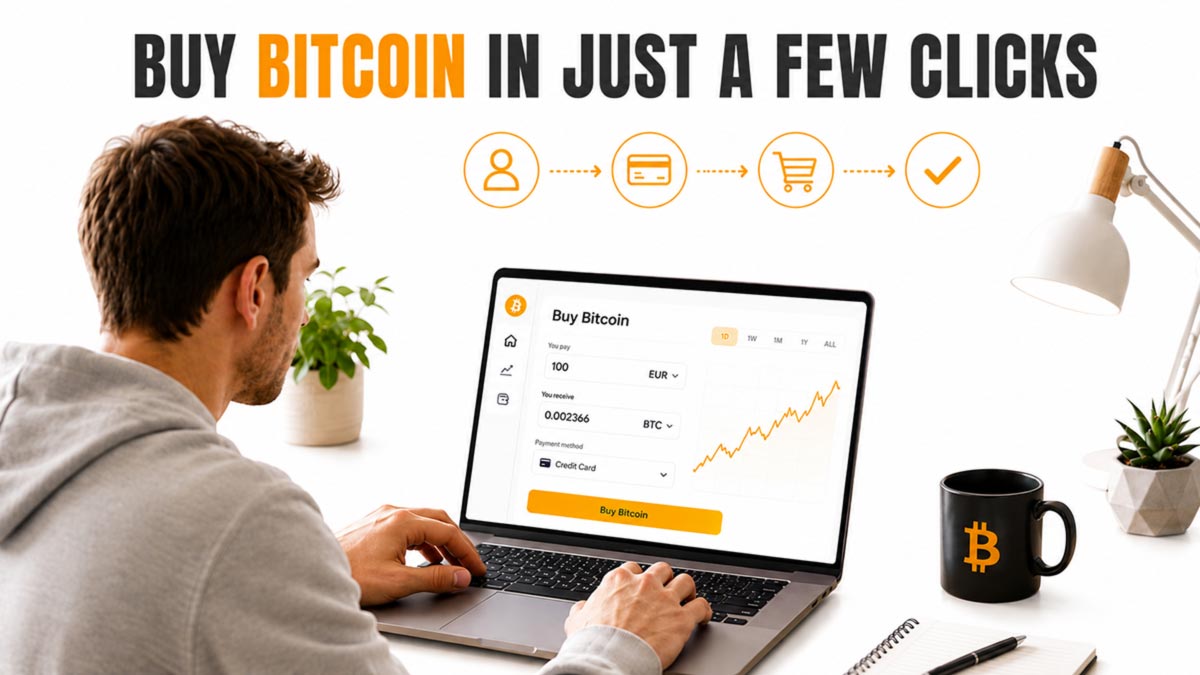
Buy Bitcoin in 4 steps
The journey is the same everywhere, whatever the platform:
- Pick a regulated platform in your country. In Europe, look for the MiCAMiCA (Markets in Crypto-Assets)European regulation 2023/1114 that frames crypto services across the EU since 2024. Creates the CASP status.See in the lexicon → label. In Switzerland, check affiliation with a supervisory body such as VQF or SO-FIT. The mainstream leaders (Kraken, Coinbase, Bitstamp, Bitpanda) cater to English, German, French and Italian speakers.
- Open an account and complete identity verification (KYCKYC (Know Your Customer)Mandatory identification procedure that regulated platforms apply to their users : ID document, proof of address, and so on.See in the lexicon →). You provide an ID document, sometimes proof of address, and a selfie. The process usually takes less than 15 minutes and is approved within the day.
- Deposit funds and place the buy order. SEPASEPA (Single Euro Payments Area)Single euro payments area: standardised bank transfers, free or nearly so, within one business day (a few seconds for the instant version). The cheapest deposit method on European exchanges.See in the lexicon → transfer, debit card, Twint in Switzerland, Apple Pay and Google Pay on some apps. Bank transfer is almost always the cheapest. The order is two clicks: amount, confirm, done.
- Withdraw your bitcoins to your own walletWalletSoftware or device that manages your Bitcoin keys and lets you sign transactions. A wallet does not really « hold » your bitcoins, it holds the keys that prove you own them.See in the lexicon →. This is the step many people skip. As long as your bitcoins sit on the platform, they're not really yours: the platform can be hacked, go bust, or freeze your funds. A hardware walletHardware walletSmall dedicated device (Ledger, Trezor, Coldcard, BitBox, etc.) that keeps the private key away from a potentially compromised computer. Signs transactions inside the device itself.See in the lexicon → (LedgerLedger, Trezor, Coldcard, BitBoxMain hardware wallet brands. Ledger Nano S Plus / X (French, the best-seller), Trezor Model T (Czech, open source), Coldcard Mk4 (Canadian, ultra-secure, Bitcoin-only), BitBox02 (Swiss, open source).See in the lexicon →, TrezorLedger, Trezor, Coldcard, BitBoxMain hardware wallet brands. Ledger Nano S Plus / X (French, the best-seller), Trezor Model T (Czech, open source), Coldcard Mk4 (Canadian, ultra-secure, Bitcoin-only), BitBox02 (Swiss, open source).See in the lexicon →, ColdcardLedger, Trezor, Coldcard, BitBoxMain hardware wallet brands. Ledger Nano S Plus / X (French, the best-seller), Trezor Model T (Czech, open source), Coldcard Mk4 (Canadian, ultra-secure, Bitcoin-only), BitBox02 (Swiss, open source).See in the lexicon →) at 80 to 180 EUR settles the question for a decade.
Step 4 is what separates an informed buyer from an exposed speculator. The bitcoinerBitcoinerPerson interested in Bitcoin, who holds some and adheres more or less to its values (individual sovereignty, sound money, decentralisation).See in the lexicon → saying "not your keysNot your keys, not your coinsMantra. If you do not hold the private keys to your bitcoins, you do not truly own them. Echoes of FTX, Mt. Gox, Celsius, and others.See in the lexicon →, not your coinsNot your keys, not your coinsMantra. If you do not hold the private keys to your bitcoins, you do not truly own them. Echoes of FTX, Mt. Gox, Celsius, and others.See in the lexicon →" sums up this golden rule.
The different ways to buy Bitcoin
One destination, several routes. Here are the 6 main ways to get BTC in 2026:
- Centralised exchange (Kraken, Coinbase, Bitstamp, Bitpanda): the standard route, simple and liquid. Mandatory KYCKYC (Know Your Customer)Mandatory identification procedure that regulated platforms apply to their users : ID document, proof of address, and so on.See in the lexicon →, fees 0.1 % to 1.5 % depending on volume. Recommended for 95 % of buyers.
- National brokerBrokerIntermediary that sells bitcoins to an end customer at a fixed price, with no visible order book. Coinhouse, Bull Bitcoin and Pocket Bitcoin are brokers.See in the lexicon → or fintech app (Bity, Relai in Switzerland, Bison or Trade Republic in Germany, Young Platform in Italy, Coinhouse in France): local-language interface, sometimes simplified taxation, sometimes higher fees. Convenient for beginners who want full service in German, French or Italian.
- Spot Bitcoin ETF (BlackRockBlackRockWorld's largest asset manager. Launched its Bitcoin spot ETF IBIT in January 2024, which accumulated more than 500,000 BTC in 2 years.See in the lexicon →'s IBIT, Fidelity's FBTC, launched early 2024): bought via your regular stock broker, integrated into your securities account. You hold a share of a fund, not bitcoins directly. Convenient for taxation, less so for sovereignty.
- Automated DCA (Relai, Pocket Bitcoin, Bitcoin Reserve): you schedule a weekly or monthly buy of a fixed amount. The platform debits automatically and often sends directly to your walletWalletSoftware or device that manages your Bitcoin keys and lets you sign transactions. A wallet does not really « hold » your bitcoins, it holds the keys that prove you own them.See in the lexicon →. The long-term strategy par excellence.
- Bitcoin ATM: insert cash, scan a wallet address, receive your bitcoins. Fees often high (5 to 12 %), but useful for small cash buys or without a bank account. Strong presence in Switzerland and Germany, rarer in France.
- Peer-to-peer with no KYC (BisqBisq, HodlHodl, AgoraDeskNo-KYC P2P platforms where you buy bitcoin directly from another individual via multisig escrow.See in the lexicon →, HodlHodlBisq, HodlHodl, AgoraDeskNo-KYC P2P platforms where you buy bitcoin directly from another individual via multisig escrow.See in the lexicon →, RoboSats, Peach): direct trade between individuals, no centralised middleman. Preserves privacy, but requires genuine protocol understanding. Reserved for experienced users.
Each option has its own dedicated article in this topic.
Buying by country
Platforms, payment methods and tax rules vary noticeably from one country to another. Here are the essentials for the German, French, Italian and English-speaking parts of Europe.
Switzerland. Strong local players: Bity, Relai, SwissBorg, Bitcoin Suisse AG. Twint payment very common. No tax on private capital gains, but you declare the value of your bitcoins on 31 December as part of your wealth. High density of Bitcoin ATMs (Lamassu, more than 100 machines in 2026).
France. Local players: Coinhouse, Paymium, plus pan-European exchanges registered as PSANPSAN (French crypto registration)French mandatory registration status with the AMF for crypto platforms. Progressively replaced by the European CASP authorisation under MiCA.See in the lexicon → with the AMF. Network of Bitcoin tobacco shops (Keplerk). Taxation: 30 % flat tax on capital gains, yearly 305 EUR exemption threshold, mandatory declaration of foreign crypto accounts.
Germany. Local players: Bison (Stuttgart Stock ExchangeExchangeService that lets you buy, sell and swap cryptocurrencies against fiat money. Examples : Kraken, Coinbase, Bitstamp, Bitvavo. Most are custodial.See in the lexicon →), Trade Republic, Scalable, justTRADE, Bitpanda. Very strong SEPASEPA (Single Euro Payments Area)Single euro payments area: standardised bank transfers, free or nearly so, within one business day (a few seconds for the instant version). The cheapest deposit method on European exchanges.See in the lexicon → adoption. Unique European tax specificity: full exemption on capital gains if you hold your bitcoins for more than 12 months (Spekulationsfrist).
Italy. Local players: Young Platform, Conio, The Rock Trading, Bitpanda. SEPA bank transfer. Taxation: 26 % on capital gains in 2026 (with a planned increase to 33 % yet to be confirmed), declaration on quadro RWQuadro RT, Quadro RWSections of the Italian tax return covering crypto capital gains (RT) and holdings of foreign accounts (RW).See in the lexicon → above 5,000 EUR held.
Each of these 4 countries has its detailed page further down in the "Going further" section.
Frequently asked questions
How much do I need to buy Bitcoin? You can buy from a few euros: one bitcoin is divisible into 100 million satoshis. Most platforms accept buys from 1 EUR / CHF. No reason to aim for a whole bitcoin to start.
Which platform is the safest? None is 100 % safe. The criteria: local regulation (MiCAMiCA (Markets in Crypto-Assets)European regulation 2023/1114 that frames crypto services across the EU since 2024. Creates the CASP status.See in the lexicon → in the EU, FINMAFINMASwiss Financial Market Supervisory Authority. Frames crypto activities in Switzerland.See in the lexicon → / VQF in Switzerland), published proof of reserves, incident-free history, easy access to withdrawal to a personal walletWalletSoftware or device that manages your Bitcoin keys and lets you sign transactions. A wallet does not really « hold » your bitcoins, it holds the keys that prove you own them.See in the lexicon →. Kraken, Coinbase, Bitstamp and Bitpanda are among the most established.
Should I buy in one go or spread out my purchases? Spreading out (DCADCA (Dollar Cost Averaging)Buying a small fixed amount at regular intervals (for example 100 EUR a week), regardless of price. Smooths the average purchase cost and neutralises timing bias.See in the lexicon →) is the recommended strategy for most people, because it smooths out volatility and avoids timing anxiety. Buying all at once only makes sense if you understand the historical market cycles.
Can you really buy without KYCKYC (Know Your Customer)Mandatory identification procedure that regulated platforms apply to their users : ID document, proof of address, and so on.See in the lexicon → in 2026? Yes, via P2PP2P (peer-to-peer)Direct exchange between two people, with no centralised platform in between. Bisq, HodlHodl and AgoraDesk are P2P platforms.See in the lexicon → (BisqBisq, HodlHodl, AgoraDeskNo-KYC P2P platforms where you buy bitcoin directly from another individual via multisig escrow.See in the lexicon →, RoboSats, Peach) or some ATMs below a threshold. For sizeable amounts or regular use, KYC is in practice unavoidable in Europe.
What should I do after the purchase? Three things: withdraw to your wallet, back up your seed phraseSeed phraseSequence of 12 or 24 words (usually in English) that encodes your master key. Universal wallet backup : with these words, you can restore your funds on any compatible software.See in the lexicon → offline, and prepare your tax filing. This discipline is what separates a serious holder from a punter.
Disclaimer
Educational and informational content only: not investment, tax or legal advice. Bitcoin carries significant risks, including high volatility and the possible loss of invested capital. Each reader remains responsible for their decisions; when in doubt, consult a qualified professional in your jurisdiction.
Going further
Each step, each option and each country has its dedicated article in this topic:
- Buy your first Bitcoin: illustrated step-by-step for total beginners.
- Choose a buying platform: comparison of Kraken, Coinbase, Bitstamp, Bitpanda and others.
- Buy Bitcoin in Switzerland: Bity, Relai, Twint, ATM, cantonal taxation.
- Buy Bitcoin in France: Coinhouse, AMF PSANPSAN (French crypto registration)French mandatory registration status with the AMF for crypto platforms. Progressively replaced by the European CASP authorisation under MiCA.See in the lexicon →, flat tax, tobacco shops.
- Buy Bitcoin in Germany: Bison, Trade Republic, Spekulationsfrist.
- Buy Bitcoin in Italy: Young Platform, quadro RWQuadro RT, Quadro RWSections of the Italian tax return covering crypto capital gains (RT) and holdings of foreign accounts (RW).See in the lexicon →, 2026 taxation.
- Spot Bitcoin ETF: IBIT, FBTC, buying via a traditional brokerBrokerIntermediary that sells bitcoins to an end customer at a fixed price, with no visible order book. Coinhouse, Bull Bitcoin and Pocket Bitcoin are brokers.See in the lexicon →.
- Bitcoin DCA: the simplest long-term strategy.
- How much to invest in Bitcoin: prudent allocation rules.
- Bitcoin ATM and cash buys: where, how, at what cost.
- P2P: buy without KYC: BisqBisq, HodlHodl, AgoraDeskNo-KYC P2P platforms where you buy bitcoin directly from another individual via multisig escrow.See in the lexicon →, RoboSats, Peach for advanced users.
- Investing in Bitcoin: weigh the opportunity before getting started.
- Investing in Bitcoin: weigh the opportunity before getting started.
- Investing in Bitcoin: weigh the opportunity before getting started.
- Understand Bitcoin: if you want to lay the foundations before buying.