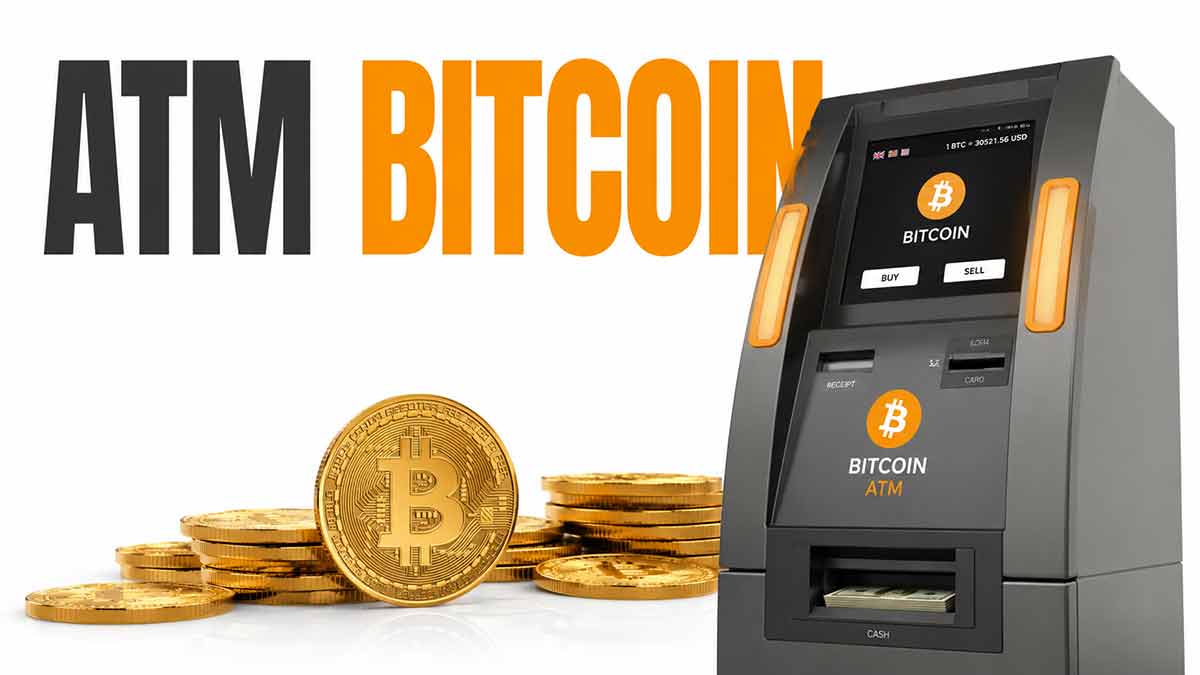
A Bitcoin ATMBitcoin ATM (BTM)Automated teller machine where you can buy (and sometimes sell) bitcoin against cash. Often subject to KYC from 1,000 EUR upwards.See in the lexicon →, or Bitcoin automated teller machine, is a physical kiosk that converts cash into bitcoins and, sometimes, bitcoins into cash, in the manner of a classic banknote dispenser. Found in tobacco shops, coffee shops, shopping arcades or station halls, it is often the very first contact point of a new user with Bitcoin: buying in two or three minutes, without account opening, direct delivery to a personal walletWalletSoftware or device that manages your Bitcoin keys and lets you sign transactions. A wallet does not really « hold » your bitcoins, it holds the keys that prove you own them.See in the lexicon →.
The ATM nevertheless remains a buying method apart: clearly more expensive than an exchangeExchangeService that lets you buy, sell and swap cryptocurrencies against fiat money. Examples : Kraken, Coinbase, Bitstamp, Bitvavo. Most are custodial.See in the lexicon → (5 to 12 % cumulative fees versus 0.2 to 1.5 % at Kraken or Bitstamp), increasingly governed by MiCAMiCA (Markets in Crypto-Assets)European regulation 2023/1114 that frames crypto services across the EU since 2024. Creates the CASP status.See in the lexicon → and national authorities (AMF, BaFin, FinmaFINMASwiss Financial Market Supervisory Authority. Frames crypto activities in Switzerland.See in the lexicon →, OAM), and unfortunately become a favoured target for scammers who mostly aim at elderly people. This guide reviews the global landscape, manufacturers, operators by CapBitcoin perimeter country, the concrete workflow, fees and tiered KYCKYC (Know Your Customer)Mandatory identification procedure that regulated platforms apply to their users : ID document, proof of address, and so on.See in the lexicon →, and above all the good practices to avoid the most common pitfalls.
Global market and main manufacturers
The reference service to map the global fleet is CoinATMRadar: interactive map, search by city and operator, signalling of out-of-service machines. In 2026, it lists about 38,000 Bitcoin ATMs worldwide, in strong growth since the 2022 peak then the post-FTXFTXCentralised exchange that collapsed spectacularly in November 2022. Sam Bankman-Fried was convicted. Dragged Blockfolio and many funds down with it.See in the lexicon → consolidationConsolidation (UTXO batching)Merging several small UTXOs into one during a low-fee period, to avoid paying dearly when spending them later. A common wallet management practice.See in the lexicon →, but with a very unbalanced geography:
- North America: about 80 % of the global fleet, mostly in the United States and Canada. The leader remains the US with over 28,000 machines, followed far behind by Canada.
- Europe: about 3,000 ATMs, concentrated in Spain, the UK, Poland, Germany, Switzerland, Austria. France and Italy are under-equipped relative to their demographic size.
- Asia: about 1,500, dominated by Hong Kong, South Korea, Singapore. Mainland China has no legal ATM since the 2021 ban.
- Latin America, Africa, Oceania: marginal, a few dozen to hundreds of machines per region.
On the manufacturer side (the makers of the machines, to distinguish from operators that run them), four names dominate:
- Lamassu (Switzerland, pioneer since 2013). Historic manufacturer, elegant machines, partial open-source software. Remains a quality reference, especially in Europe.
- General Bytes (Czech Republic). World's largest installed fleet, wide range (standalone ATM, integrated kiosks, mini counter-ATM). Suffered a notable hack in 2023, since hardened.
- Genesis Coin (United States). Very present in North America, little in Europe.
- BitAccess (Canada). Very present in Canada and the US, machines with modern touchscreens.
The manufacturer is not the most important piece of information for the user: what matters more is the operator (the local runner of the machine), its regulatory compliance and its fees. The same Lamassu machine can display 5 % at a serious operator and 12 % at another less demanding one.
Operators by country: CH, FR, DE, IT
Here, by CapBitcoin perimeter country, are the main operators and best-equipped cities in 2026. The exact map evolves: always check on CoinATMRadar before travelling.
Switzerland (~100 ATMs). The best-equipped country in continental Europe relative to its population. Historic Bity-Värdex network operated from Neuchâtel, present in most large cities: Zurich, Geneva, Lausanne, Bern, Basel, LuganoLugano (Plan ₿)Swiss city that launched a Bitcoin adoption programme in 2022 (tax payments, shops, events). The annual Plan B Forum has become a European fixture.See in the lexicon →. A few Bitcoin Suisse machines in Zug and Zurich, independent operators in Lucerne and St. Gallen. Bity has the particularity of also accepting the reverse direction (selling bitcoins for cash) on part of its fleet.
Germany (~200 ATMs). Dense network for Europe. Shitcoins.club (despite the provocative name, a serious Bitcoin-only operator) in Berlin and Cologne. Bity-Värdex via local partnerships. Regional operators in Munich, Stuttgart, Hamburg, Frankfurt. Strong German Bitcoin-only tradition, many machines accept only BTC, no altcoins.
France (~50-80 ATMs). Country under-equipped relative to its population. La Maison du Bitcoin (Paris, 35 rue du Caire, iconic French community venue), Bitcoin Avenue (Paris), Coinhouse Café (Paris). A few machines in Lyon, Marseille, Bordeaux, Toulouse, Strasbourg, Nice via independent operators. AMF regulation (PSANPSAN (French crypto registration)French mandatory registration status with the AMF for crypto platforms. Progressively replaced by the European CASP authorisation under MiCA.See in the lexicon → mandatory since 2019, MiCAMiCA (Markets in Crypto-Assets)European regulation 2023/1114 that frames crypto services across the EU since 2024. Creates the CASP status.See in the lexicon → since 2024) reduced the number of serious operators and chased away informal ones.
Italy (~80 ATMs). Growing network since the mandatory OAM registry registration in 2022. Bitnovo (Spanish operator present in Milan and Rome), Bity via partnerships, Inbitcoin and local operators in tabaccherie in Milan, Rome, Naples, Turin. Strong urban concentration, ATM deserts in the rural south and Puglia.
To accurately find the nearest distributor, two complementary tools: CoinATMRadar (worldwide, updated daily) and BTCMap.org (community-driven, also lists merchants accepting Bitcoin via Lightning). Prefer ATMs listed both on CoinATMRadar and in your country's national registry.
How a Bitcoin ATM works in practice
The concrete flow of an ATM buy is very standardised across manufacturers. Here are the typical steps for a first purchase, on a classic Lamassu or General Bytes machine in Europe:
- Operation selection. Welcome screen with two or three choices: Buy Bitcoin, Sell Bitcoin (only on bidirectional machines), Lightning (on compatible machines).
- Language choice. German, French, Italian, English, sometimes Spanish, Portuguese, Russian depending on the area.
- Tiered KYCKYC (Know Your Customer)Mandatory identification procedure that regulated platforms apply to their users : ID document, proof of address, and so on.See in the lexicon →. Depending on the amount you want to insert, the machine triggers a verification level (see next section). At this stage, either no verification (small tier), or phone number + SMS code, or selfie ID in addition.
- Entering or scanning the walletWalletSoftware or device that manages your Bitcoin keys and lets you sign transactions. A wallet does not really « hold » your bitcoins, it holds the keys that prove you own them.See in the lexicon → address. Crucial step. You must provide a Bitcoin addressBitcoin addressString of characters that identifies a destination for receiving bitcoins. Four main formats, starting with 1..., 3..., bc1q... or bc1p... (Taproot, the recommended format in 2026).See in the lexicon → to receive the funds. Two options: scan a QR codeQR codeTwo-dimensional barcode, ubiquitous in Bitcoin: addresses, Lightning invoices, payment URIs. Always check the decoded amount and address before confirming.See in the lexicon → from your personal wallet app (Phoenix, Muun, BlueWallet, or a receive address generated by a LedgerLedger, Trezor, Coldcard, BitBoxMain hardware wallet brands. Ledger Nano S Plus / X (French, the best-seller), Trezor Model T (Czech, open source), Coldcard Mk4 (Canadian, ultra-secure, Bitcoin-only), BitBox02 (Swiss, open source).See in the lexicon → / TrezorLedger, Trezor, Coldcard, BitBoxMain hardware wallet brands. Ledger Nano S Plus / X (French, the best-seller), Trezor Model T (Czech, open source), Coldcard Mk4 (Canadian, ultra-secure, Bitcoin-only), BitBox02 (Swiss, open source).See in the lexicon → / ColdcardLedger, Trezor, Coldcard, BitBoxMain hardware wallet brands. Ledger Nano S Plus / X (French, the best-seller), Trezor Model T (Czech, open source), Coldcard Mk4 (Canadian, ultra-secure, Bitcoin-only), BitBox02 (Swiss, open source).See in the lexicon →), or manually enter the address (not advised, error-prone). Always scan from your own wallet, never an address provided by a third party.
- Inserting banknotes. The machine accepts usual denominations (5, 10, 20, 50, 100 EUR/CHF). Counts the inserted amount in real time. No change given as a rule, so adapt the denominations to the target amount. Most machines accept up to 500-1,000 EUR per session without new KYC.
- Rate confirmation. The screen displays the applied rate (including all fees), the corresponding bitcoin or satoshiSatoshi (sat)The smallest unit of bitcoin. 1 BTC = 100 million satoshis. Named after the creator. In 2026, talking in sats becomes common as the price of one BTC rises.See in the lexicon → count, and asks for confirmation. Read carefully: this is the only moment when you can see the real cost.
- Receipt issuance and transaction. Printed paper receipt with amount, address, and transaction hashHashFunction that turns data of any size into a fixed-size fingerprint. The same input always yields the same output, but you cannot go back from output to input.See in the lexicon →. The Bitcoin transaction is broadcast immediately. The machine shows a tracking QR code to check the confirmation on mempool.spacemempool.spaceReference open-source Bitcoin explorer in 2026. Visualisation of blocks, fees and the mempool. Launched by Wiz and the mempool.space team.See in the lexicon → or blockstream.info.
- Awaiting blockchainBlockchainA public, shared ledger that records every Bitcoin transaction in blocks linked together cryptographically. Each participant in the network keeps a copy.See in the lexicon → confirmation. Usually 5 to 30 minutes for the first confirmation. Some machines offer instant delivery via Lightning if your wallet supports it: near-immediate transaction, negligible network fees.
The entire process, excluding full KYC, takes 2 to 5 minutes. For a first buy, plan a bit more time to familiarise yourself with the interface and always start with a low-amount test (10-20 EUR) before a larger purchase.
Fees and KYC by amount tier
Two parameters determine what the user actually pays and what level of information they must provide: the cumulative fee grid and the KYCKYC (Know Your Customer)Mandatory identification procedure that regulated platforms apply to their users : ID document, proof of address, and so on.See in the lexicon → tier in force at the operator.
Cumulative fees: 5 to 12 % on average. The total cost of an ATM purchase typically breaks down into:
- Spread on market price: 3 to 5 %. The machine displays a rate above that of a spot exchangeExchangeService that lets you buy, sell and swap cryptocurrencies against fiat money. Examples : Kraken, Coinbase, Bitstamp, Bitvavo. Most are custodial.See in the lexicon →.
- Operator commission: 3 to 7 % visible on the confirmation screen.
- Bitcoin network fees: 0.5 to 2 % depending on momentary congestion, sometimes included in the operator commission.
Order-of-magnitude comparison: a Kraken exchange costs you 0.2 to 0.5 % all-in for a SEPASEPA (Single Euro Payments Area)Single euro payments area: standardised bank transfers, free or nearly so, within one business day (a few seconds for the instant version). The cheapest deposit method on European exchanges.See in the lexicon → buy. An ATM is therefore 10 to 30 times more expensive. This surcharge is the price of speed, cash and the absence of a bank account. Reserve only for cases where these features have real value for you.
KYC tier. In growing use in Europe, under the effect of MiCAMiCA (Markets in Crypto-Assets)European regulation 2023/1114 that frames crypto services across the EU since 2024. Creates the CASP status.See in the lexicon → (2024) and national transpositions. Here is the typical 2026 grid, which can vary slightly from operator to operator:
- 0 to 150 EUR per session: no identity verification at some operators. Phone number sometimes requested. Tends to disappear under MiCA pressure, but still exists in some countries.
- 150 to 1,000 EUR per session: phone number verified via systematic SMS code.
- 1,000 to 5,000 EUR per session: phone number + photo ID (passport, ID card, driver's licence) + real-time selfie for comparison.
- Above 5,000 EUR: full KYC equivalent to that of an exchange (address proof, possibly source-of-funds proof). Many operators cap at this level, and a serious user then prefers an exchange.
Tiers are generally cumulative over 24 hours or 30 days depending on the operator, not per isolated session. Splitting to stay below a tier ("structuring") is explicitly forbidden by anti-money-laundering regulations and exposes you to a TRACFIN, FIU, FINMAFINMASwiss Financial Market Supervisory Authority. Frames crypto activities in Switzerland.See in the lexicon → report depending on the country. Do not do it.
Practical consequence: for a one-off cash purchase of 200 to 800 EUR, a well-identified ATM is coherent. Above 1,000 EUR, the speed advantage fades and the fee difference with an exchange becomes penalising. As an order of magnitude, 5,000 EUR bought via ATM at 10 % fees costs 500 EUR more than via Kraken at 0.4 %, i.e., a 480 EUR pure difference.
Regulation by country: licences and official registries
Since MiCAMiCA (Markets in Crypto-Assets)European regulation 2023/1114 that frames crypto services across the EU since 2024. Creates the CASP status.See in the lexicon →'s application in 2024, any Bitcoin ATMBitcoin ATM (BTM)Automated teller machine where you can buy (and sometimes sell) bitcoin against cash. Often subject to KYC from 1,000 EUR upwards.See in the lexicon → operator in the European Union must be licensed as a CASPCASP (Crypto-Asset Service Provider)Crypto service provider authorised under MiCA. Must obtain a licence in its home country, valid throughout the EU.See in the lexicon → (Crypto Asset Service Provider). On top of that, each country has its national regime with its own public registry, which must be checked before any significant purchase.
Switzerland. Not in the EU, so MiCA does not apply directly. The FinmaFINMASwiss Financial Market Supervisory Authority. Frames crypto activities in Switzerland.See in the lexicon → regulates the activity under the Anti-Money Laundering Act (LBA): any ATM operator must affiliate to a Self-Regulatory Organisation (OAR) or directly to Finma. Bity-Värdex is the historic compliant operator. Informal players present in 2018-2020 have almost all closed or fallen in line.
France. The AMF maintains the registry of PSANPSAN (French crypto registration)French mandatory registration status with the AMF for crypto platforms. Progressively replaced by the European CASP authorisation under MiCA.See in the lexicon → (Digital Asset Service Providers) on amf-france.org. Any ATM operator must appear there. Transition to CASP MiCA status is ongoing for 2025-2026; former PSANs are switching in the majority. Check the public list before using an ATM above 200 EUR. Several informal Parisian operators were closed by authorities between 2022 and 2024.
Germany. The BaFin regulates as a financial service under the Kreditwesengesetz (KWG). Any operator must obtain a dedicated licence. Public registry consultable on bafin.de. The country has been faster than others to expel non-compliant operators (waves of closures 2022-2023). Machines still in service are generally either BaFin-compliant or in CASP MiCA transition.
Italy. The OAM (Organismo Agenti e Mediatori) has held since 2022 the mandatory registry of crypto providers, ATM operators included. The Consob ensures market supervision and maintains a public blacklist of abusive operators. To check on oamcrypto.it and consob.it. Transition to CASP MiCA is ongoing.
Recommended practice: before using an ATM for an amount above 200 EUR, open the official authority website of the country (Finma, AMF, BaFin, OAM/Consob) on your phone, and check that the operator name shown on the machine or on the ticket indeed appears in the public registry. A machine without a visible operator name, without legal information on the front, or with contact details leading only to a generic email address, is a clear signal to walk away.
Security and common scams: what you absolutely must know
Bitcoin ATMs have become, since 2022, a prime target for scams targeting in large majority vulnerable people: seniors, crypto newcomers, people in emergency situations. Knowing the typical patterns is essential before any purchase.
The "fake tax or customs adviser" scam. You receive a call from a person presenting themselves as a tax, customs or police officer, announcing a fine, a debt, a stuck parcel. They state that payment must be made in Bitcoin via an ATM, and stay on the phone throughout the trip to "assist" you. No European public administration ever requests payment in Bitcoin. If someone urgently asks you for a crypto payment, it is a scam, no exception.
The "bank support" scam. A fake adviser calls claiming your account is compromised, that you must "secure your funds" by converting them into Bitcoin via ATM, to a "secure address" they provide. No bank ever requests this type of operation. Hang up and call the official number on the back of your card.
The "guaranteed-return investment" scam. Solicitation via SMS, email, social networks. The target is taken to an ATM to buy bitcoins and send them to a "manager" walletWalletSoftware or device that manages your Bitcoin keys and lets you sign transactions. A wallet does not really « hold » your bitcoins, it holds the keys that prove you own them.See in the lexicon →. Funds disappear immediately. No guaranteed return exists in crypto, nor anywhere beyond the risk-free rate. Any such pitch is a scam.
The "romance scam". Virtual relationship maintained for several weeks, then request to send bitcoins for a "personal" reason (medical, travel, blocking). Again, ATM used for speed. Police and victims' associations have widely documented this pattern since 2020.
The "substituted QR codeQR codeTwo-dimensional barcode, ubiquitous in Bitcoin: addresses, Lightning invoices, payment URIs. Always check the decoded amount and address before confirming.See in the lexicon →" scam. More technical. A fraudster places a sticker with their own QR code over the one on the machine, or asks the victim to scan a "receive address" they provide by message. Always scan from your own wallet, never an address provided by a third party, and visually check that the machine has no added sticker on the screen.
Good defence practices, in order:
- Always use an ATM listed on CoinATMRadar AND in the national registry (FinmaFINMASwiss Financial Market Supervisory Authority. Frames crypto activities in Switzerland.See in the lexicon →, AMF, BaFin, OAM).
- Always scan the address from your own personal wallet, never from a phone provided by a third party, never from a received message.
- Do a low-amount test (10-20 EUR) before any important purchase on a machine you are discovering.
- Never use an ATM under phone pressure from a stranger. Hang up, go out, ask a relative for advice.
- Photograph the receipt and transaction hashHashFunction that turns data of any size into a fixed-size fingerprint. The same input always yields the same output, but you cannot go back from output to input.See in the lexicon →, keep evidence for at least 5 years (useful for taxes and possible recourses).
- For an amount above 1,000 EUR, ask the operator for a proper KYCKYC (Know Your Customer)Mandatory identification procedure that regulated platforms apply to their users : ID document, proof of address, and so on.See in the lexicon → document before any purchase.
- If you accompany an elderly relative, explain these patterns in advance. Serious operators began in 2024 to display multilingual warnings on screen.
Disclaimer
Educational and informational content only: not investment, tax or legal advice. Bitcoin carries significant risks, including high volatility and the possible loss of invested capital. Each reader remains responsible for their decisions; when in doubt, consult a qualified professional in your jurisdiction.
Going further
The Bitcoin ATMBitcoin ATM (BTM)Automated teller machine where you can buy (and sometimes sell) bitcoin against cash. Often subject to KYC from 1,000 EUR upwards.See in the lexicon → is a buying method apart, complementary to the topic's other methods. To go further:
- Buy Bitcoin: overview of methods.
- Buy your first Bitcoin: prerequisite before any ATM buy (notably having a personal walletWalletSoftware or device that manages your Bitcoin keys and lets you sign transactions. A wallet does not really « hold » your bitcoins, it holds the keys that prove you own them.See in the lexicon →).
- Choose a buying platform: cheaper alternative for amounts above 1,000 EUR.
- How much to invest in Bitcoin: to frame the target allocation before going to the ATM.
- In Switzerland, in France, in Germany, in Italy: country focus including the detail of local ATM operators and the best-equipped cities.