
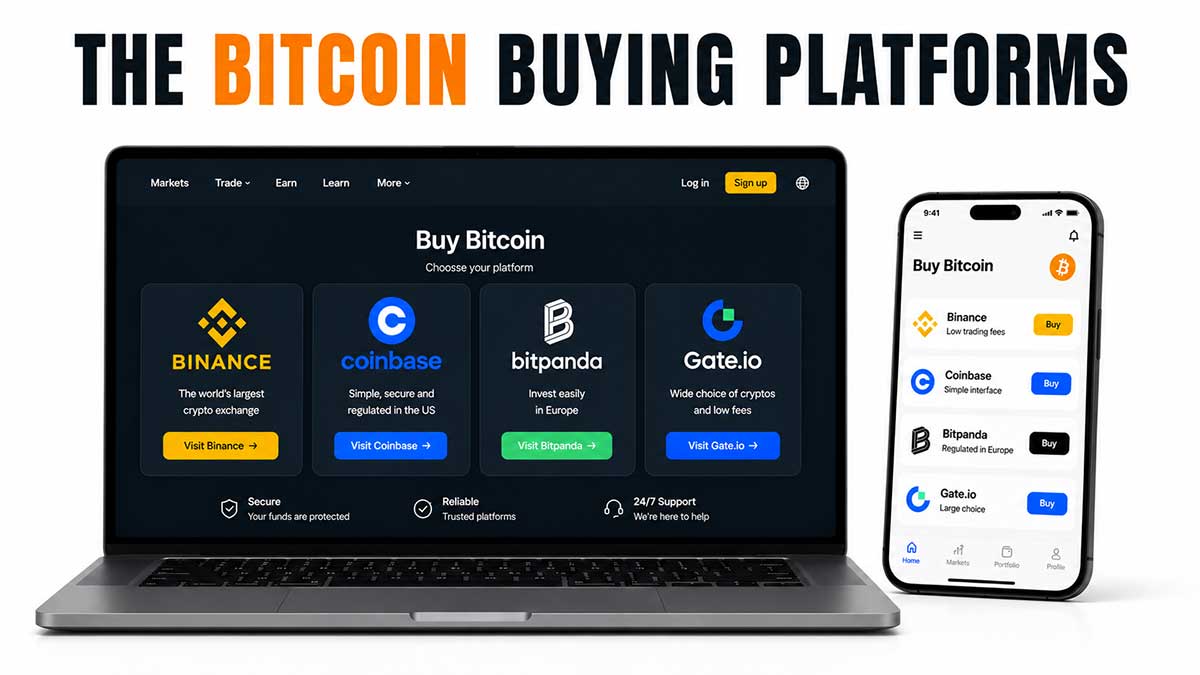
The Bitcoin platform market consolidated after the spectacular 2022 collapses (FTXFTXCentralised exchange that collapsed spectacularly in November 2022. Sam Bankman-Fried was convicted. Dragged Blockfolio and many funds down with it.See in the lexicon →, Celsius, BlockFi). In 2026, the picture is clearer: about twenty serious players share Europe and Switzerland, under MiCAMiCA (Markets in Crypto-Assets)European regulation 2023/1114 that frames crypto services across the EU since 2024. Creates the CASP status.See in the lexicon → regulation on one side and FINMAFINMASwiss Financial Market Supervisory Authority. Frames crypto activities in Switzerland.See in the lexicon →/VQF on the other.
Our goal here isn't to name an "ultimate" platform (there is none) but to give you the criteria to pick the one that fits your profile, your country and your level of autonomy. You'll leave this page with a shortlist of 2 or 3 platforms to try, and the framework to choose between them.
The 7 criteria that really matter
Not all comparisons use the same grid. Here's ours, ranked by importance for a long-term holder:
- Regulation in your country. MiCAMiCA (Markets in Crypto-Assets)European regulation 2023/1114 that frames crypto services across the EU since 2024. Creates the CASP status.See in the lexicon → in the EU, VQF/SO-FIT/FINMAFINMASwiss Financial Market Supervisory Authority. Frames crypto activities in Switzerland.See in the lexicon → in Switzerland. A platform with no local regulation leaves you with no recourse if anything goes wrong. Knockout criterion.
- Published proof of reserves. The platform cryptographically proves it does hold its clients' bitcoins (Merkle tree, auditor attestations). Kraken and Bitstamp have done this for years, Coinbase more recently, Binance too.
- Real ability to withdraw to an external walletWalletSoftware or device that manages your Bitcoin keys and lets you sign transactions. A wallet does not really « hold » your bitcoins, it holds the keys that prove you own them.See in the lexicon →. Some platforms (notably crypto neo-banks) discourage or block on-chain withdrawals. Essential to stay in control of your bitcoins.
- Fee transparency. Beware of "no-fee" platforms: they often hide a margin in the spread. Compare on 100 EUR: you should receive at least 99.5 EUR of Bitcoin (total fees 0.5 % max on the good platforms).
- Suitable payment methods. SEPASEPA (Single Euro Payments Area)Single euro payments area: standardised bank transfers, free or nearly so, within one business day (a few seconds for the instant version). The cheapest deposit method on European exchanges.See in the lexicon → for the EU, Twint for Switzerland, sometimes card. The ideal platform offers at least an instant transfer in your currency.
- Account security. 2FA2FA (Two-Factor Authentication)Two-factor authentication. On top of the password, a second element is required to sign in (TOTP code, SMS, physical key). Standard on every serious platform.See in the lexicon → via app (never SMS), withdrawal notifications, address whitelisting, majority cold storageCold storageStoring bitcoins on an offline wallet that is not connected to the Internet. Maximum security for amounts you are not spending.See in the lexicon → of client funds. Read the security policy on the official site.
- Identifiable customer support. Real postal address, chat support in your language, documented response time. Not just a generic contact form.
A few criteria that sound decisive but really aren't: the number of altcoins available (irrelevant if you're Bitcoin-only), the prettiest mobile app, or the promise of passive yield (often a hidden lending risk).
The global generalists: Kraken, Coinbase, Bitstamp
Kraken (US, founded 2011) remains the security benchmark of the sector. No major hack in 14 years, quarterly proof of reserves, honest stakingStakingLocking tokens to secure a proof-of-stake blockchain in exchange for a yield. Does not exist on Bitcoin, which relies on proof of work; tax-wise, staking income follows its own rules.See in the lexicon → support, fees among the lowest (0.16 % maker / 0.26 % taker on spot, with discounts at volume). Interface in French, German, Italian. The default option for anyone seriously buying more than 500 EUR at a time. Recommendation: create a "pro" account rather than the "instant buy" interface, which is markedly more expensive.
Coinbase (US, NASDAQ-listed since 2021) is the visually most reassuring platform for total beginners. Polished interface, FR/DE/IT support, native integration with a proprietary walletWalletSoftware or device that manages your Bitcoin keys and lets you sign transactions. A wallet does not really « hold » your bitcoins, it holds the keys that prove you own them.See in the lexicon →. Achilles' heel: fees. The classic interface charges up to 1.5 % per order. Workaround: use the "Advanced Trade" interface (free, same pricing as pro), which brings fees down to 0.4-0.6 %. The company is listed, giving superior accounting transparency.
Bitstamp (EU, founded 2011 in Slovenia, acquired by Robinhood in 2024) is the European dean. MiCAMiCA (Markets in Crypto-Assets)European regulation 2023/1114 that frames crypto services across the EU since 2024. Creates the CASP status.See in the lexicon → regulation via Luxembourg, very low fees (0 % up to a certain monthly volume, then 0.2-0.3 %), no commercial aggression, decent email support. Under-covered by the media but very solid. An excellent choice for a long-term buyer wanting a calm, reliable platform.
The regional specialists: Bitpanda, Bity, Bison, Trade Republic, Coinhouse, Young Platform
Bitpanda (Austria) is the pan-European Swiss army knife. Regulated in several EU jurisdictions, immaculate interface in 4 languages (DE/EN/FR/IT), broad catalogue (BTC, precious metals, ETFs). Fees around 1.49 %, sometimes hidden in the spread. Ideal for a beginner who wants a single app for Bitcoin + gold + other assets.
Bity (Fribourg, Switzerland) offers a complete Swiss bank-crypto experience: personal CH IBAN, Twint purchase, automatic withdrawal to your walletWalletSoftware or device that manages your Bitcoin keys and lets you sign transactions. A wallet does not really « hold » your bitcoins, it holds the keys that prove you own them.See in the lexicon →, FR/DE/EN/IT support. Fees 1.4 to 2.5 %, higher than Kraken but with unmatched local integration. Their Lamassu Bitcoin ATMs are deployed across Switzerland.
Bison (Germany), run by the Stuttgart Stock ExchangeExchangeService that lets you buy, sell and swap cryptocurrencies against fiat money. Examples : Kraken, Coinbase, Bitstamp, Bitvavo. Most are custodial.See in the lexicon →, wins on simplicity: no complex KYCKYC (Know Your Customer)Mandatory identification procedure that regulated platforms apply to their users : ID document, proof of address, and so on.See in the lexicon →, buy in a few clicks, integration with savings products. Fees hidden in a roughly 0.75 % spread. Perfect for a German who wants to try Bitcoin without juggling 5 accounts.
Trade Republic (Germany) added Bitcoin to its classic brokerBrokerIntermediary that sells bitcoins to an end customer at a fixed price, with no visible order book. Coinhouse, Bull Bitcoin and Pocket Bitcoin are brokers.See in the lexicon →: 1 EUR commission per trade, custodyCustodyThe custody of funds. See self-custody and custodial in the dedicated section below.See in the lexicon → via BitGo, withdrawal possible to an external wallet. Relevant for an investor already at Trade Republic who wants a fraction of their portfolio in BTC.
Coinhouse (France) is the historic French player, the first PSANPSAN (French crypto registration)French mandatory registration status with the AMF for crypto platforms. Progressively replaced by the European CASP authorisation under MiCA.See in the lexicon → registered with the AMF. 100 % French support, training included, fees 1.49-2.49 % depending on method. Suited to French beginners who want a clear interlocutor for tax questions.
Young Platform (Italy) became the Italian reference with a fully Italian interface, a highly-rated mobile app, support based in Turin, and Italian MiCAMiCA (Markets in Crypto-Assets)European regulation 2023/1114 that frames crypto services across the EU since 2024. Creates the CASP status.See in the lexicon → compliance. Fees 1 to 1.5 %, DCADCA (Dollar Cost Averaging)Buying a small fixed amount at regular intervals (for example 100 EUR a week), regardless of price. Smooths the average purchase cost and neutralises timing bias.See in the lexicon → plans available. Preferred choice in Italy unless you're chasing the absolute lowest cost.
The Bitcoin-only and DCA specialists: Relai, Pocket Bitcoin, Strike
A category of its own, growing fast. These platforms ONLY offer Bitcoin, delivered straight to your walletWalletSoftware or device that manages your Bitcoin keys and lets you sign transactions. A wallet does not really « hold » your bitcoins, it holds the keys that prove you own them.See in the lexicon →, with no altcoinAltcoin (shitcoin, memecoin)Any cryptocurrency other than Bitcoin (Ethereum, Solana, etc.). The pejorative terms shitcoin and memecoin refer to projects with no real utility or purely speculative ones.See in the lexicon → temptation or derivatives. Ideal for those who want to accumulate in the background.
Relai (Zug, Switzerland) became the European leader in Bitcoin-only DCADCA (Dollar Cost Averaging)Buying a small fixed amount at regular intervals (for example 100 EUR a week), regardless of price. Smooths the average purchase cost and neutralises timing bias.See in the lexicon →. You set up a standing SEPASEPA (Single Euro Payments Area)Single euro payments area: standardised bank transfers, free or nearly so, within one business day (a few seconds for the instant version). The cheapest deposit method on European exchanges.See in the lexicon → order from your bank, Relai buys automatically and sends the sats to your wallet (non-custodialNon-custodialCommon synonym for self-custody in marketing communications.See in the lexicon →). Fees 1.5 to 2.5 % depending on monthly volume. Available across the EU and in Switzerland, FR/DE/EN/IT support.
Pocket Bitcoin (Switzerland) offers a similar model with a built-in tutorial approach (educational videos, DCA calculator, fee comparator). Available in EU and CH. Fees around 1.5 %.
Strike (US, available in the EU since 2024) combines Bitcoin buying with native Lightning NetworkLightning NetworkSecond-layer payment network on top of Bitcoin. Enables near-instant and near-free payments through channels opened between users.See in the lexicon →. Very good FX rates, instant buy, built-in Lightning payments. Not yet available in Switzerland. Recommended if you want to experiment with Lightning alongside your spot purchases.
The decisive criterion of Bitcoin-only platforms: zero altcoin pitch, zero risky yield product. This editorial discipline drastically reduces the risk of bad choices from option overload.
How to spot a platform to avoid
For every serious platform, there are ten to avoid. Here are the red flags:
- "Risk-free" 8 to 30 % annual yield on deposited bitcoins. Ponzi scheme almost guaranteed. No genuine yield is risk-free in crypto.
- Fuzzy or absent regulation. No mention of MiCAMiCA (Markets in Crypto-Assets)European regulation 2023/1114 that frames crypto services across the EU since 2024. Creates the CASP status.See in the lexicon →, BaFin, AMF, FINMAFINMASwiss Financial Market Supervisory Authority. Frames crypto activities in Switzerland.See in the lexicon →, FCA in the legal notices = walk away.
- Incorporation in the Seychelles, BVI, Saint Vincent, Bahamas. These offshore jurisdictions offer little recourse if things go wrong.
- Aggressive sales pressure by phone or email ("you're going to miss the rally", "offer limited to 24 hours"). No serious platform behaves this way.
- Overly generous promo codes pushed by influencers ("20 % off + 100 EUR bonus"). Often a very high affiliate commission funded by a disguised scam.
- Website created less than 6 months ago (check via Whois) with an aggressive SEO push on "best bitcoin exchangeExchangeService that lets you buy, sell and swap cryptocurrencies against fiat money. Examples : Kraken, Coinbase, Bitstamp, Bitvavo. Most are custodial.See in the lexicon →" queries.
- Explicit or implicit withdrawal blocks. If pulling out a bitcoin requires 3 extra validation steps or takes more than 48 hours for no reason, run.
- Customer testimonials all dated from the same month, stock photos, fake Trustpilot. VerifyDon't trust, verifyBitcoiner mantra. Trust no one (bank, government, exchange, influencer), verify on your own through your own node.See in the lexicon → on independent sources: bitcointalk forum, r/Bitcoin, local specialised press.
When in doubt: type "platform name + scam" or "+ bankruptcy" in a search engine, and read the top 10 results. If several raise red flags, walk away.
Our recommendation by profile
To wrap up this comparison, here are our 5 recommendations by situation. In every case: withdraw your bitcoins to your own walletWalletSoftware or device that manages your Bitcoin keys and lets you sign transactions. A wallet does not really « hold » your bitcoins, it holds the keys that prove you own them.See in the lexicon → after the purchase.
- Total French-speaking beginner: Coinhouse (FR) or Bity (CH) for reassuring local support, then migrate to Kraken once comfortable.
- German-speaking beginner: Bison (DE) for simplicity, or Bitpanda for multi-asset and multi-language.
- Italian-speaking beginner: Young Platform for the 100 % Italian interface, later Kraken for the cost.
- Long-term investor wanting the lowest cost: Bitstamp or Kraken Pro, SEPASEPA (Single Euro Payments Area)Single euro payments area: standardised bank transfers, free or nearly so, within one business day (a few seconds for the instant version). The cheapest deposit method on European exchanges.See in the lexicon → transfer, monthly withdrawal to a hardware walletHardware walletSmall dedicated device (Ledger, Trezor, Coldcard, BitBox, etc.) that keeps the private key away from a potentially compromised computer. Signs transactions inside the device itself.See in the lexicon →.
- Hands-off DCADCA (Dollar Cost Averaging)Buying a small fixed amount at regular intervals (for example 100 EUR a week), regardless of price. Smooths the average purchase cost and neutralises timing bias.See in the lexicon → strategy: Relai (CH/EU), Pocket Bitcoin (CH/EU), automatic weekly purchase delivered to your wallet.
For purchases above 10,000 EUR or with specific tax constraints, it's better to consult a crypto-specialised adviser (firms listed in our country tax sheets).
Going further
- Buy Bitcoin: the topic overview.
- Buy your first Bitcoin: the step-by-step tutorial.
- Buy Bitcoin in Switzerland: country focus.
- Buy Bitcoin in France: country focus.
- Buy Bitcoin in Germany: country focus.
- Buy Bitcoin in Italy: country focus.
- Bitcoin DCA: automate on Relai, Pocket and others.
- Spot Bitcoin ETF: alternative via traditional brokerBrokerIntermediary that sells bitcoins to an end customer at a fixed price, with no visible order book. Coinhouse, Bull Bitcoin and Pocket Bitcoin are brokers.See in the lexicon →.
Disclaimer
Educational and informational content only: not investment, tax or legal advice. Bitcoin carries significant risks, including high volatility and the possible loss of invested capital. Each reader remains responsible for their decisions; when in doubt, consult a qualified professional in your jurisdiction.