
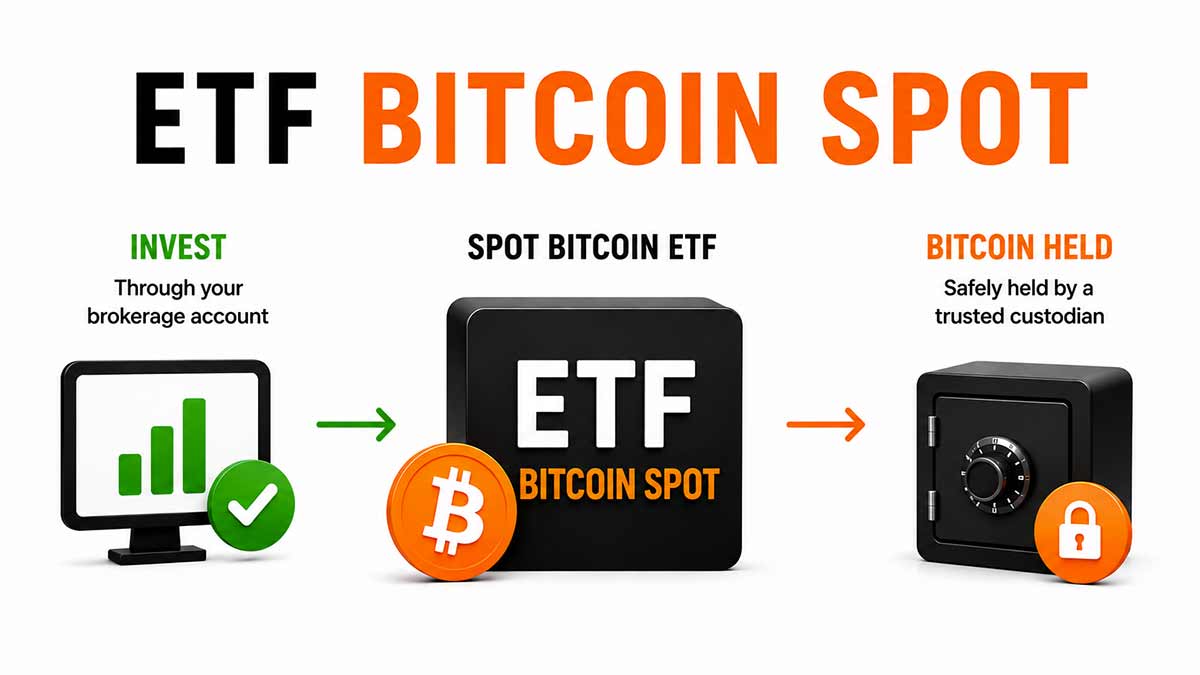
A spot Bitcoin ETF (ExchangeExchangeService that lets you buy, sell and swap cryptocurrencies against fiat money. Examples : Kraken, Coinbase, Bitstamp, Bitvavo. Most are custodial.See in the lexicon →-Traded Fund) is a stock-listed fund that holds real bitcoins on behalf of its unitholders. Buying an ETF share is therefore, economically, equivalent to buying a fraction of the bitcoin stock held by the fund, without ever touching private keys. This equivalence, long refused by the SEC, made headlines in January 2024 with the simultaneous approval of eleven US products.
Europe uses another legal vehicle: the ETNETN (Exchange Traded Note)European / Swiss equivalent of an ETF. Structured note backed by physical bitcoin. Several ETNs have been listed in Switzerland since 2018.See in the lexicon → (Exchange-Traded Note) or ETPETP (Exchange Traded Product)Family of exchange-listed products tracking an asset: ETF, ETN, ETC. In Europe, most listed Bitcoin products are legally ETNs backed by physical BTC.See in the lexicon → (Exchange-Traded Product), structured as a debt security backed by bitcoins in custodyCustodyThe custody of funds. See self-custody and custodial in the dedicated section below.See in the lexicon →. An important legal difference, but a very similar buying experience for the retail investor. This guide covers both families, the brokers that give access to them, taxation in each CapBitcoin perimeter country, and above all: when the ETF really makes sense compared to direct spot bitcoin, and when it makes less.
US spot Bitcoin ETFs
On 10 January 2024, the SEC approved as a block eleven spot Bitcoin ETFs, including GBTC which was converted from a historic trust into an ETF. Two years on, the offering has consolidated around a few dominant players. Here they are ranked by 2026 assets under management and management fees.
- IBIT (iShares Bitcoin Trust, BlackRockBlackRockWorld's largest asset manager. Launched its Bitcoin spot ETF IBIT in January 2024, which accumulated more than 500,000 BTC in 2 years.See in the lexicon →). By far the largest AUM in the segment, over USD 50 billion. Fees 0.25 % per year. The reference for those wanting a single Bitcoin ETF without thinking twice, with the BlackRock signature behind.
- FBTC (Fidelity Wise Origin Bitcoin Fund). Fees 0.25 %. CustodyCustodyThe custody of funds. See self-custody and custodial in the dedicated section below.See in the lexicon → managed in-house by Fidelity Digital Assets, which some prefer to Coinbase Custody. Very widespread among Fidelity clients.
- ARKB (Ark 21Shares Bitcoin ETF). Fees 0.21 %. Partnership between Cathie Wood (Ark Invest) and 21Shares for the structuring. Competitive on fees.
- BITB (Bitwise Bitcoin ETF). Fees 0.20 %. The ETF that publicly publishes the Bitcoin addresses of its reserves: a transparency argument appreciated by the community.
- HODLHODLHolding bitcoins without selling, despite the volatility. The word comes from a typo, « I AM HODLING », posted on a forum in 2013 that turned into a joke and then a mantra.See in the lexicon → (VanEck Bitcoin Trust). Fees 0.20 %. Smaller AUM, but well-known issuer.
- BTCO (Invesco Galaxy Bitcoin ETF). Fees 0.25 %, partnership with Galaxy Digital for custody.
- BRRR (Valkyrie Bitcoin Fund). Fees 0.25 %. Smaller AUM.
- GBTC (Grayscale Bitcoin Trust). Fees 1.5 %, i.e., 6 to 7 times competitors. Former trust converted into an ETF, still held by many historical portfolios that did not migrate for tax reasons. Uninteresting for a new purchase in 2026.
These products are accessible on the US stock exchanges (NYSE Arca, Nasdaq, Cboe BZX) and therefore reachable from Europe through a brokerBrokerIntermediary that sells bitcoins to an end customer at a fixed price, with no visible order book. Coinhouse, Bull Bitcoin and Pocket Bitcoin are brokers.See in the lexicon → offering US market access. For most European investors, IBIT, FBTC, ARKB or BITB amply cover the need.
European Bitcoin ETNs and ETPs
Since 2020, Europe has had another family of stock-listed products to gain bitcoin exposure: ETNs (ExchangeExchangeService that lets you buy, sell and swap cryptocurrencies against fiat money. Examples : Kraken, Coinbase, Bitstamp, Bitvavo. Most are custodial.See in the lexicon →-Traded Notes) and ETPs (Exchange-Traded Products). Legal difference with the US ETF: an ETNETN (Exchange Traded Note)European / Swiss equivalent of an ETF. Structured note backed by physical bitcoin. Several ETNs have been listed in Switzerland since 2018.See in the lexicon → is a debt security issued by a special-purpose vehicle, 100 % collateralised by bitcoins in custodyCustodyThe custody of funds. See self-custody and custodial in the dedicated section below.See in the lexicon →. The investor therefore legally buys a debt from the issuer backed by a BTC pool, not a fund share. In practice, price tracking is identical to within 0.01 %.
The main ETNs/ETPs available in 2026 on European venues:
- BTCetc Bitcoin Exchange Traded Crypto (ETC Group), ticker BTCE, listed on Deutsche Börse Xetra. Fees 2 % (the most historic, not very competitive). Very high volume, custody via BitGo.
- 21Shares Bitcoin ETPETP (Exchange Traded Product)Family of exchange-listed products tracking an asset: ETF, ETN, ETC. In Europe, most listed Bitcoin products are legally ETNs backed by physical BTC.See in the lexicon → (ABTC), listed on SIX Swiss Exchange, Xetra and Euronext. Fees 1.49 %. Pioneer Swiss issuer, recognised structuring quality.
- CoinShares Physical Bitcoin (BITC), listed on SIX, Xetra, Euronext. Fees 0.25 %, among the lowest in Europe. The best cost-quality option in 2026 for a European investor.
- WisdomTree Physical Bitcoin (BTCW), listed on SIX, Xetra, LSE. Fees 0.35 %. Custody via Coinbase Custody, very clear structure.
- VanEck Bitcoin ETN (VBTC), listed on Xetra and Euronext. Fees 1 %. Smaller AUM.
- Iconic Funds Physical Bitcoin (XBTI), listed on Deutsche Börse. Fees 0.95 %. Independent player.
Practical consequences of the ETF vs ETN difference: in case of issuer bankruptcy, the ETN holder has a senior claim on the bitcoins in custody, but must go through a recovery procedure. The US ETF holder has an indirect ownership of the fund's bitcoins, theoretically more protective. In practice, over 5 years, no serious European bitcoin ETN has experienced an incident, and the quality of the custodian (Komainu, BitGo, Coinbase, Copper) matters more than the legal structure. For a European, an ETN like CoinShares BITC or WisdomTree BTCW is probably simpler to acquire than a US ETF.
Brokers that allow buying
Not all brokers give access to the same products. Here, in summary, the 2026 landscape by brokerBrokerIntermediary that sells bitcoins to an end customer at a fixed price, with no visible order book. Coinhouse, Bull Bitcoin and Pocket Bitcoin are brokers.See in the lexicon → profile.
- Saxo Bank (Denmark, present in CH/FR/DE/IT). Access to US ETFs and European ETNs. Tiered pricing, around 3 to 10 EUR per order, relevant from 1,000 EUR. Quality tax reporting, multicurrency. Solid choice for medium to high amounts.
- Swissquote (CH). Wide access, US ETFs and ETNs, 9 CHF per order. Good Swiss tax reporting, multicurrency. Reference for Swiss residents.
- Interactive Brokers (US, accessible from Europe). Lowest pricing on the market (0.003 to 0.005 USD per share on US ETFs), access to all venues. Recommended for technical profiles; more complex interface than average.
- DEGIRO (NL, present in FR/DE/IT). Low fees, European ETFs near-free for a monthly selection. Access to US ETFs and Xetra ETNs. Good entry-level; watch out for default securities lending (option to disable).
- Trade Republic (DE). 1 EUR per order, European ETNs only (no direct access to US ETFs for European retail). Ideal for scheduled DCADCA (Dollar Cost Averaging)Buying a small fixed amount at regular intervals (for example 100 EUR a week), regardless of price. Smooths the average purchase cost and neutralises timing bias.See in the lexicon → on a low-fee ETNETN (Exchange Traded Note)European / Swiss equivalent of an ETF. Structured note backed by physical bitcoin. Several ETNs have been listed in Switzerland since 2018.See in the lexicon →.
- Boursorama / Fortuneo (FR). Access to European ETNs listed on Euronext and Xetra. Standard French online banking pricing.
- Scalable Capital (DE, accessible in AT/FR/IT). Automated savings plan (Sparplan) in ETN, from 1 EUR per execution. Very suited to monthly DCA.
- eToro (CySEC). Offers certain ETFs/ETNs but with an eToro-specific spread layer. To avoid when you have access to the brokers above.
Crucial point: since 2024, several European brokers have been restricting European retail access to US ETFs under the PRIIPs regulation (lack of compliant KID). In practice: prefer European ETNs (CoinShares BITC, WisdomTree BTCW, 21Shares ABTC) on the European side; go through a non-European broker or a qualified professional (depending on your status) to access IBIT, FBTC, ARKB.
Direct spot vs ETF/ETN: what you gain, what you lose
These are two economically close but operationally very different ways of holding Bitcoin. Honest table of pros and cons.
What the ETF/ETNETN (Exchange Traded Note)European / Swiss equivalent of an ETF. Structured note backed by physical bitcoin. Several ETNs have been listed in Switzerland since 2018.See in the lexicon → brings:
- Classic stock market framework. Bitcoin enters your ordinary brokerage account just like your stocks and index ETFs. Tax reporting often integrated, succession handled by the notary like any other security.
- No key management. No more seed phraseSeed phraseSequence of 12 or 24 words (usually in English) that encodes your master key. Universal wallet backup : with these words, you can restore your funds on any compatible software.See in the lexicon → to safeguard, no more hardware walletHardware walletSmall dedicated device (Ledger, Trezor, Coldcard, BitBox, etc.) that keeps the private key away from a potentially compromised computer. Signs transactions inside the device itself.See in the lexicon → to manage, no more risk of losing access to your funds. This risk is transferred to the fund's custodian (Coinbase, BitGo, Komainu).
- Portfolio integration. Diversification, allocation and rebalancingRebalancingRebalancing your portfolio by selling part of what has risen and buying what has fallen, to return to a target allocation.See in the lexicon → happen in a single dashboard with stocks and ETFs.
- Easy access to scheduled DCADCA (Dollar Cost Averaging)Buying a small fixed amount at regular intervals (for example 100 EUR a week), regardless of price. Smooths the average purchase cost and neutralises timing bias.See in the lexicon →. Trade Republic, Scalable, DEGIRO allow an automated Sparplan / savings plan on ETNs from a few euros.
What you lose (and that can be decisive):
- Annual management fees eat into returns. 0.25 % per year over 20 years represents about 5 % of cumulative performance. 1 % per year represents close to 20 %. On an asset like Bitcoin, this cost compounds downward.
- No self-custodySelf-custodyModel in which you hold your own private keys. Your bitcoins depend on no third party. This is Bitcoin's founding promise.See in the lexicon →. "Not your keysNot your keys, not your coinsMantra. If you do not hold the private keys to your bitcoins, you do not truly own them. Echoes of FTX, Mt. Gox, Celsius, and others.See in the lexicon →, not your coinsNot your keys, not your coinsMantra. If you do not hold the private keys to your bitcoins, you do not truly own them. Echoes of FTX, Mt. Gox, Celsius, and others.See in the lexicon →" applies: if the custodian suffers a major event (cyber, failure, regulatory freeze), your exposure depends on the recovery procedure, not on a private keyPrivate keySecret number that proves ownership of bitcoins at a given address. Whoever holds the private key holds the bitcoins. Never share it and never store it in plain text.See in the lexicon → you control.
- No walletWalletSoftware or device that manages your Bitcoin keys and lets you sign transactions. A wallet does not really « hold » your bitcoins, it holds the keys that prove you own them.See in the lexicon → transfer, no Lightning. You cannot send your "ETF bitcoins" to a personal address, any more than you can pay a merchant via Lightning. The ETF remains a financial product; direct bitcoin remains money.
- Counterparty risk. ETFs and ETNs rely on provider chains (issuer, custodian, depositary, market maker). Each link adds a risk, low but not zero.
- Market hours. The ETF only trades during stock exchangeExchangeService that lets you buy, sell and swap cryptocurrencies against fiat money. Examples : Kraken, Coinbase, Bitstamp, Bitvavo. Most are custodial.See in the lexicon → opening hours; spot bitcoin trades 24/7.
Honest synthesis: for a target allocation of 1 to 5 % of a classic brokerage portfolio, the low-fee European ETN is very defensible. For a long-term conviction at several tens of percent of net worth, direct spot on a regulated exchange then transfer to a hardware wallet remains preferable.
Taxation by country: CH, FR, DE, IT
The ETF/ETNETN (Exchange Traded Note)European / Swiss equivalent of an ETF. Structured note backed by physical bitcoin. Several ETNs have been listed in Switzerland since 2018.See in the lexicon → falls under classic securities taxation, which sometimes changes the trade-off versus direct bitcoin. Here is the 2026 landscape by CapBitcoin perimeter country.
Switzerland. For an individual outside professional activity, capital gains on securities remain federally tax-exempt, whether for direct BTC, ETN or Bitcoin ETF. The ETN/ETF just has to be declared in the wealth statement on 31 December at the closing price (cantonal wealth tax). No practical difference: Switzerland remains neutral between the two vehicles.
France. Gains on Bitcoin ETFs and ETNs fall under the securities gains regime (article 150-0 A of the CGI), subject to the 30 % flat tax (12.8 % income tax + 17.2 % social contributions). Identical to the direct BTC regime since article 150 VH bis. Note: ETFs and ETNs are not eligible for the PEA, so no tax wrapper is possible. Ordinary brokerage account required.
Germany. Decisive point: the 12-month Spekulationsfrist that fully exempts direct BTC gains does not apply to ETFs/ETNs. These, being legally investment products (Investmentfonds or Schuldverschreibungen depending on qualification), are subject to the Abgeltungsteuer of 25 % + 5.5 % Solidaritätszuschlag + possible Kirchensteuer (~27 % total). This is the tax argument that pushes long-term German hodlers to prefer direct BTC, and that radically changes the trade-off across the Rhine.
Italy. Bitcoin ETFs and ETNs fall under the 26 % imposta sostitutiva, identical to the direct BTC regime. Holding above 5,000 EUR in a foreign brokerage account remains subject to declaration in the quadro RWQuadro RT, Quadro RWSections of the Italian tax return covering crypto capital gains (RT) and holdings of foreign accounts (RW).See in the lexicon →. Note: ETFs/ETNs held with an Italian brokerBrokerIntermediary that sells bitcoins to an end customer at a fixed price, with no visible order book. Coinhouse, Bull Bitcoin and Pocket Bitcoin are brokers.See in the lexicon → or with access to the Italian substitute tax regime are declared directly by the intermediary (substitute taxpayer); the investor only has to check the supporting documents.
Practical consequences:
- In CH and IT: tax neutrality, the choice is made on non-tax criteria (fees, simplicity, self-custodySelf-custodyModel in which you hold your own private keys. Your bitcoins depend on no third party. This is Bitcoin's founding promise.See in the lexicon →).
- In FR: also neutrality (30 % on both sides), but the ETN brokerage account is simpler to report than an exchangeExchangeService that lets you buy, sell and swap cryptocurrencies against fiat money. Examples : Kraken, Coinbase, Bitstamp, Bitvavo. Most are custodial.See in the lexicon →.
- In DE: clearly favourable trade-off for direct BTC if horizon ≥ 12 months, due to the exempting Spekulationsfrist that does not apply to ETFs/ETNs.
When the ETF makes sense, when direct spot wins
Here is the most honest 2026 decision grid, independent of issuer and platform marketing.
The ETF / ETNETN (Exchange Traded Note)European / Swiss equivalent of an ETF. Structured note backed by physical bitcoin. Several ETNs have been listed in Switzerland since 2018.See in the lexicon → makes sense if:
- You already have a well-functioning brokerage account and want a moderate Bitcoin allocation (1 to 5 % of portfolio) without managing a walletWalletSoftware or device that manages your Bitcoin keys and lets you sign transactions. A wallet does not really « hold » your bitcoins, it holds the keys that prove you own them.See in the lexicon →.
- You are a CH, FR or IT resident (countries where taxation does not penalise the ETF detour).
- You want your heirs to recover the bitcoin via the same procedure as your stocks, without having to understand private keys.
- You want a minimalist automated DCADCA (Dollar Cost Averaging)Buying a small fixed amount at regular intervals (for example 100 EUR a week), regardless of price. Smooths the average purchase cost and neutralises timing bias.See in the lexicon → (Sparplan Trade Republic, Scalable, DEGIRO) without managing exchangeExchangeService that lets you buy, sell and swap cryptocurrencies against fiat money. Examples : Kraken, Coinbase, Bitstamp, Bitvavo. Most are custodial.See in the lexicon → buys yourself.
- You manage assets for a third party (elderly parent, minor, professional structure) who cannot operationally hold keys.
Direct spot wins if:
- You are a German resident aiming for a horizon over 12 months: the Spekulationsfrist alone justifies going through direct BTC.
- You want to actually use bitcoin: Lightning payments, ordinalsOrdinals (inscriptions)Protocol (2023) that numbers each satoshi and allows inscribing data (images, text) directly on-chain via Tapscript. At the origin of the debate on block space usage.See in the lexicon →, personal transactions, donations.
- Your target allocation is high (above 10-20 % of net worth): annual ETF fees become significant at that size.
- You care about self-custodySelf-custodyModel in which you hold your own private keys. Your bitcoins depend on no third party. This is Bitcoin's founding promise.See in the lexicon →, censorship resistance, independence from financial providers: this is Bitcoin's very philosophy.
- You want to fully enjoy the ecosystem (Lightning, non-custodialNon-custodialCommon synonym for self-custody in marketing communications.See in the lexicon → DCA like Relai/Pocket, multisigMultisig (multi-signature)Configuration where a transaction must be signed by several independent keys to be valid (for example 2 of 3). Reduces the risk that a single key theft causes loss of funds.See in the lexicon →, hardware walletHardware walletSmall dedicated device (Ledger, Trezor, Coldcard, BitBox, etc.) that keeps the private key away from a potentially compromised computer. Signs transactions inside the device itself.See in the lexicon →).
Very widespread hybrid strategy: a low-fee ETN pocket (CoinShares BITC, WisdomTree BTCW) in the brokerage account for readability and succession, and a direct spot pocket on a regulated exchange then hardware wallet for long-term conviction and use. The two are not mutually exclusive, and many serious investors combine both based on their wealth situation, country of residence and horizon.
Disclaimer
Educational and informational content only: not investment, tax or legal advice. Bitcoin carries significant risks, including high volatility and the possible loss of invested capital. Each reader remains responsible for their decisions; when in doubt, consult a qualified professional in your jurisdiction.
Going further
The ETF/ETNETN (Exchange Traded Note)European / Swiss equivalent of an ETF. Structured note backed by physical bitcoin. Several ETNs have been listed in Switzerland since 2018.See in the lexicon → is a convenient entry point, direct spot remains the historic heart of Bitcoin. To go further:
- Buy Bitcoin: overview of buying methods.
- Choose a buying platform: detailed spot exchangeExchangeService that lets you buy, sell and swap cryptocurrencies against fiat money. Examples : Kraken, Coinbase, Bitstamp, Bitvavo. Most are custodial.See in the lexicon → comparison.
- Buy your first Bitcoin: step-by-step beginner tutorial.
- In Switzerland, in France, in Germany, in Italy: taxation and platforms by country, essential complement to the ETF vs direct spot trade-off.