
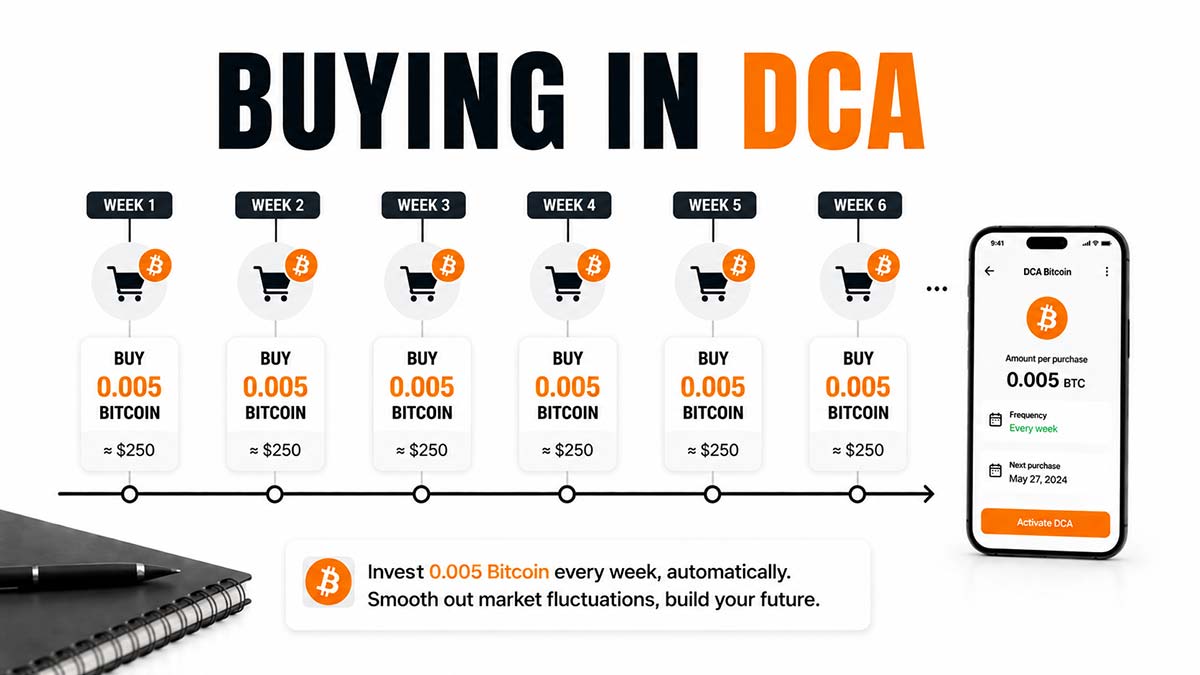
DCADCA (Dollar Cost Averaging)Buying a small fixed amount at regular intervals (for example 100 EUR a week), regardless of price. Smooths the average purchase cost and neutralises timing bias.See in the lexicon →, or Dollar Cost Averaging (in EUR, Euro Cost Averaging), means buying a fixed amount of Bitcoin at a regular interval (weekly, monthly), regardless of the market price. You buy the same EUR or CHF amount, whatever happens: more bitcoins when the price falls, fewer when it rises. Mechanically, your average entry price smooths over time, and the tricky question of "the right time to buy" disappears.
For many retail investors, this is the psychologically healthiest strategy. It suits both an employee investing 100 EUR per month and a larger estate wanting to scale exposure over 12 or 24 months. This article reviews the principle, the native DCA platforms, the options on standard exchanges, DCA through ETNs at a brokerBrokerIntermediary that sells bitcoins to an end customer at a fixed price, with no visible order book. Coinhouse, Bull Bitcoin and Pocket Bitcoin are brokers.See in the lexicon →, the frequency to choose, and the specific taxation in each of the four CapBitcoin perimeter countries.
The DCA principle and comparison with lump sum buying
DCADCA (Dollar Cost Averaging)Buying a small fixed amount at regular intervals (for example 100 EUR a week), regardless of price. Smooths the average purchase cost and neutralises timing bias.See in the lexicon → rests on three pillars: discipline (buying is automated, so procrastination and panic are avoided), volatility smoothing (buying at several different prices avoids putting all capital at the top), and simplicity (no market analysis skill required).
The alternative is the lump sum, the single buy: you take all available cash and invest it once. On equities history, Vanguard studies published between 2012 and 2023 show lump sum beating DCA in about 2/3 of cases, simply because markets are upward most of the time: the longer you wait, the more upside you miss. On Bitcoin, retrospective studies published by Casebitcoin, Curvo and Swan Bitcoin over 2015 to 2025 confirm the same trend: lump sum beats DCA on average, but with a much wider dispersion of outcomes.
Why then prefer DCA despite its lower average performance?
- The outcome distribution is less dispersed. DCA avoids the catastrophic scenario of buying 100 % of the allocation at a cycle peak. On Bitcoin, peak at 69,000 USD in November 2021 followed by a drop to 16,000 in November 2022: a monthly DCA over 12 months smoothed beautifully, a 69,000 lump sum took years to break even.
- DCA matches the salaried reality. If you save 200 EUR per month from your salary, you do not have a choice anyway: it is mechanically DCA, because you do not have an accumulated capital to invest at once.
- DCA is psychologically more resilient. Seeing the price fall 50 % after a lump sum often triggers an emotional sale at the worst moment. DCA, on the other hand, benefits from the drop: "cool, next month I buy cheaper".
Practical synthesis: if you have an existing capital of several tens of thousands of euros to allocate, lump sum is statistically winning, but DCA spread over 6 to 12 months remains very defensible as a trade-off between expected performance and risk tolerance. If you save from your monthly income, DCA is not even a choice: it is the only accessible mode of accumulation.
Native DCA platforms: Relai, Pocket, StackinSat, Bitcoin Reserve
Several European players were born around Bitcoin DCADCA (Dollar Cost Averaging)Buying a small fixed amount at regular intervals (for example 100 EUR a week), regardless of price. Smooths the average purchase cost and neutralises timing bias.See in the lexicon → alone, generally with a non-custodialNon-custodialCommon synonym for self-custody in marketing communications.See in the lexicon → approach: your bitcoins are delivered directly to your walletWalletSoftware or device that manages your Bitcoin keys and lets you sign transactions. A wallet does not really « hold » your bitcoins, it holds the keys that prove you own them.See in the lexicon → at each purchase, the platform never holds them. This is the healthiest offer for those who want to accumulate over the long run without platform risk.
Relai (Zurich, founded 2020) is the reference player in the Switzerland / EU zone. Very simple mobile app, standing transfer from your bank, automatic conversion to BTC on each incoming payment, direct delivery to the Bitcoin addressBitcoin addressString of characters that identifies a destination for receiving bitcoins. Four main formats, starting with 1..., 3..., bc1q... or bc1p... (Taproot, the recommended format in 2026).See in the lexicon → you provide (xpubxpub (extended public key)Extended public key. Lets a read-only wallet see addresses and balances without being able to sign. Used for tracking and observation.See in the lexicon → or single address). Fees 1 % to 2 % depending on the tier. Light KYCKYC (Know Your Customer)Mandatory identification procedure that regulated platforms apply to their users : ID document, proof of address, and so on.See in the lexicon → up to 1,000 CHF / EUR per year, then standard KYC. Recommended for 50 to 2,000 EUR/CHF per month.
Pocket Bitcoin (Zug, founded 2020) offers a similar model to Relai, focused on a standing transfer from your bank to their IBAN, immediate conversion, delivery to wallet. Fees around 1.5 %, light KYC up to an annual threshold. Strongly assumed bitcoin-only approach, strict non-custodial. Ideal for those wanting a FinmaFINMASwiss Financial Market Supervisory Authority. Frames crypto activities in Switzerland.See in the lexicon →-regulated Swiss player and a purely banking workflow (no app to buy, just a transfer).
StackinSat (Bayonne, France) is the French equivalent: non-custodial DCA, automatic conversion of your EUR transfer to BTC, delivery to your address. Fees 1.29 to 1.95 % depending on the monthly tier. PSANPSAN (French crypto registration)French mandatory registration status with the AMF for crypto platforms. Progressively replaced by the European CASP authorisation under MiCA.See in the lexicon → AMF compliant, French EUR accounts accepted without friction.
Bitcoin Reserve (Liechtenstein, accessible from DE/AT/EU) aims rather at higher volumes: OTCOTC (Over The Counter)Large-size trade executed off the order book, between two parties via a broker. Typically used for volumes above 100,000 EUR.See in the lexicon → from 1,000 EUR and scheduled monthly DCA at low fees (around 0.99 %). Non-custodial, direct wallet delivery. Good choice for 1,000 EUR per month and above.
21bitcoin (Innsbruck, Austria) offers a MiCAMiCA (Markets in Crypto-Assets)European regulation 2023/1114 that frames crypto services across the EU since 2024. Creates the CASP status.See in the lexicon →-Austria-licensed non-custodial DCA, fees variable by volume, wallet delivery. Recent but serious player, recommended mostly to AT/DE residents.
Common feature of these five players: delivery to wallet at each purchase avoids accumulating balances on a third-party platform. Practical consequence: you must have a wallet (ideally hardware: LedgerLedger, Trezor, Coldcard, BitBoxMain hardware wallet brands. Ledger Nano S Plus / X (French, the best-seller), Trezor Model T (Czech, open source), Coldcard Mk4 (Canadian, ultra-secure, Bitcoin-only), BitBox02 (Swiss, open source).See in the lexicon →, TrezorLedger, Trezor, Coldcard, BitBoxMain hardware wallet brands. Ledger Nano S Plus / X (French, the best-seller), Trezor Model T (Czech, open source), Coldcard Mk4 (Canadian, ultra-secure, Bitcoin-only), BitBox02 (Swiss, open source).See in the lexicon →, ColdcardLedger, Trezor, Coldcard, BitBoxMain hardware wallet brands. Ledger Nano S Plus / X (French, the best-seller), Trezor Model T (Czech, open source), Coldcard Mk4 (Canadian, ultra-secure, Bitcoin-only), BitBox02 (Swiss, open source).See in the lexicon →) before starting, and give the platform an xpub or a batch of fresh addresses.
Scheduled DCA on a standard exchange
If you prefer to stay on a generalist MiCAMiCA (Markets in Crypto-Assets)European regulation 2023/1114 that frames crypto services across the EU since 2024. Creates the CASP status.See in the lexicon → exchangeExchangeService that lets you buy, sell and swap cryptocurrencies against fiat money. Examples : Kraken, Coinbase, Bitstamp, Bitvavo. Most are custodial.See in the lexicon →, most now offer an integrated recurring buy feature. Fees often lower than dedicated DCADCA (Dollar Cost Averaging)Buying a small fixed amount at regular intervals (for example 100 EUR a week), regardless of price. Smooths the average purchase cost and neutralises timing bias.See in the lexicon → platforms, but a major drawback: bitcoins remain by default on the exchange account. You must plan a regular withdrawal to your walletWalletSoftware or device that manages your Bitcoin keys and lets you sign transactions. A wallet does not really « hold » your bitcoins, it holds the keys that prove you own them.See in the lexicon →.
- Kraken Recurring Buys: scheduled EUR/CHF to BTC buy, standard Kraken fees (0.16 to 0.26 % on Pro). The best cost/quality offer on the market. No extra cost for automation. Setup in 2 minutes from the interface.
- Bitstamp Recurring: similar to Kraken, fees 0 to 0.5 %. Particularly useful in DE/IT/FR via free SEPASEPA (Single Euro Payments Area)Single euro payments area: standardised bank transfers, free or nearly so, within one business day (a few seconds for the instant version). The cheapest deposit method on European exchanges.See in the lexicon → transfer.
- Coinbase Recurring Buys: available but with standard Coinbase fees, which remain high on the classic interface. Use only via Advanced Trade (0.4 to 0.6 %) to stay competitive.
- Bitpanda Savings: automated savings plan, multi-asset (BTC, ETH, gold, ETFs). Fees around 1.49 %. Well integrated in German-speaking countries and Italy.
- Young Platform Step: automatic daily DCA in Italy, with a rewards programme that refunds a fraction of the fees.
- Swissquote Bitcoin Recurring: available in CH, integrated into the classic securities account, standard Swissquote fees.
Good practice on an exchange: also schedule a regular withdrawal to your wallet, for example monthly or quarterly as soon as the balance exceeds a threshold (0.01 BTC for example). This limits exposure to an exchange incident (FTXFTXCentralised exchange that collapsed spectacularly in November 2022. Sam Bankman-Fried was convicted. Dragged Blockfolio and many funds down with it.See in the lexicon → in 2022 remains a warning). Some exchanges even allow an automatic scheduled withdrawal.
Special case Trade Republic and Scalable Capital: these two players offer Bitcoin DCA only via ETNETN (Exchange Traded Note)European / Swiss equivalent of an ETF. Structured note backed by physical bitcoin. Several ETNs have been listed in Switzerland since 2018.See in the lexicon →, not direct spot BTC. If you care about self-custodySelf-custodyModel in which you hold your own private keys. Your bitcoins depend on no third party. This is Bitcoin's founding promise.See in the lexicon →, they are not the right option. If you stay in a classic stock market framework, the ETN Sparplan is very efficient (see next section).
DCA via ETN at a broker (Sparplan)
The Sparplan (savings plan in German) has become Europe's simplest way to do Bitcoin DCADCA (Dollar Cost Averaging)Buying a small fixed amount at regular intervals (for example 100 EUR a week), regardless of price. Smooths the average purchase cost and neutralises timing bias.See in the lexicon → through a stock market product. You pick a Europe-listed Bitcoin ETNETN (Exchange Traded Note)European / Swiss equivalent of an ETF. Structured note backed by physical bitcoin. Several ETNs have been listed in Switzerland since 2018.See in the lexicon →, a monthly amount and an execution date. The brokerBrokerIntermediary that sells bitcoins to an end customer at a fixed price, with no visible order book. Coinhouse, Bull Bitcoin and Pocket Bitcoin are brokers.See in the lexicon → debits your account and runs the order automatically, like for an equity fund.
The three most relevant brokers in 2026:
- Trade Republic (DE, accessible CH/FR/IT/AT/NL). Sparplan from 1 EUR per execution on available Bitcoin ETNs (BTCetc, 21Shares ABTC, CoinShares BITC, WisdomTree). No fee on the Sparplan, 1 EUR per order outside the plan. The simplest combo in Europe for a monthly DCA on ETN.
- Scalable Capital (DE, accessible AT/FR/IT). Sparplan from 1 EUR, broad ETN catalogue, integrated into a traditional stock broker. Scalable account management fees depending on formula.
- DEGIRO (NL, accessible FR/DE/IT). Monthly savings plan on ETN, low fees per catalogue. Imperative to disable the default securities lending option.
Advantages of the ETN Sparplan over direct spot DCA:
- Integrated tax reporting. The broker issues an annual summary directly usable by the tax authority (FR/DE/IT). No personal spreadsheet to maintain.
- Simplified succession. The brokerage account is treated like any equity portfolio; heirs have no private keyPrivate keySecret number that proves ownership of bitcoins at a given address. Whoever holds the private key holds the bitcoins. Never share it and never store it in plain text.See in the lexicon → to manage.
- Reduced minimum amount. 1 EUR per execution, with no equivalent on spot DCA platforms (tier often at 25 or 50 EUR/month).
Disadvantages: annual ETN management fees (0.25 to 1.5 % per year, eating into performance), no self-custodySelf-custodyModel in which you hold your own private keys. Your bitcoins depend on no third party. This is Bitcoin's founding promise.See in the lexicon →, no withdrawal to personal walletWalletSoftware or device that manages your Bitcoin keys and lets you sign transactions. A wallet does not really « hold » your bitcoins, it holds the keys that prove you own them.See in the lexicon →, and for Germans: loss of the 12-month Spekulationsfrist benefit which applies only to direct BTC. In the long run, this last point makes the ETN Sparplan markedly less interesting than a direct spot DCA in Germany. Detail developed in the taxation section.
Frequency and parameters: weekly, bi-weekly, monthly?
DCADCA (Dollar Cost Averaging)Buying a small fixed amount at regular intervals (for example 100 EUR a week), regardless of price. Smooths the average purchase cost and neutralises timing bias.See in the lexicon → frequency is one of the most debated parameters, and the statistical answer is reassuring: beyond a 3 to 5-year horizon, frequency has almost no impact on the final result. Whether you buy every Monday, every two weeks or every month, cumulative performance is identical within a few percent.
The choice therefore rests on non-statistical criteria:
- Monthly. The simplest, aligned with salary. A standing transfer from your bank on the 5th of the month (after the 1st-of-month payroll), automatic execution on the platform. Reduced transaction feesTransaction feesAmount paid to miners so they include your transaction in a block. Expressed in satoshis per virtual byte (sat/vB). Varies with network congestion.See in the lexicon → since there is only one buy. Recommended for 90 % of cases. Ideal for 50 to 1,000 EUR/CHF per month.
- Bi-weekly. Compromise. Slightly more volatility smoothing, but also a bit more cumulative fees. Relevant above 500 EUR per month where fee differences become negligible.
- Weekly. Maximum smoothing, and above all reinforced psychological discipline. But noticeable cumulative fees on exchanges charging a per-order minimum, so reserve for platforms with no per-order surcharge (Kraken, Trade Republic Sparplan).
- Daily. Marginal effect. Reserved for platforms like Young Platform Step that make it their signature. Not necessary for most investors.
A few good practices to know:
- Variability or constancy? Keeping a fixed amount is the essence of DCA. Trying to modulate (buy more when price drops) amounts to market timing, which DCA precisely avoids. Stay constant.
- Pause on a drop? Classic mistake. It is precisely in a bear marketBear market, bull marketProlonged falling market (bear) or rising market (bull). Bitcoin cycles have historically alternated between the two around halvings, with 70 to 85 percent drops in bear markets.See in the lexicon → that DCA gives the most bitcoins per EUR invested. Keep discipline. Implicit rule: a Bitcoin DCA is paused only for a personal situation change (job loss, emergency), never for a market reason.
- Increase the amount? Ideal to revisit the amount once a year (annual review, alignment with a salary increase or estate change). Not more often.
- Stop? When you reach the target Bitcoin allocation in your overall estate (see the upcoming how much to invest article), or when your situation changes durably. Not in reaction to a market cycle.
DCA taxation by country: CH, FR, DE, IT
DCADCA (Dollar Cost Averaging)Buying a small fixed amount at regular intervals (for example 100 EUR a week), regardless of price. Smooths the average purchase cost and neutralises timing bias.See in the lexicon → mechanically produces a large number of small acquisition lots, each with its date and unit price. The way each country handles these lots on resale changes the administrative effort and sometimes the tax outcome.
Switzerland. No tax on private securities gains: the number of accumulated lots is therefore irrelevant. Simply declare the total BTC value on 31 December in the wealth statement. Fiscally, it is the simplest country for Bitcoin DCA.
France. Capital gainCapital gain, capital lossGain (or loss) realised when disposing of an asset: the difference between sale price and acquisition cost. Tax treatment varies by country; losses can often be offset against gains of the same year.See in the lexicon → is calculated using the weighted average price (PMP) method, mandated by article 150 VH bis of the CGI since 2019. Concretely: on each sale, the average acquisition price of the whole portfolio is computed (sum of EUR purchases / number of BTC held). DCA therefore simplifies life: a single average price, updated on each buy. No lot management, which is more practical than elsewhere.
Germany. The 12-month Spekulationsfrist applies lot by lot, on the FIFOFIFO (First In First Out)Capital gains method that treats the first bitcoins bought as the first sold. Used in Germany, Italy and the United States.See in the lexicon → basis (first in, first out). Each weekly or monthly purchase is an independent lot that must clear 12 months to be exempt. Practical consequences for DCA:
- A January 2025 buy becomes exempt in January 2026. A June 2025 buy becomes exempt in June 2026. And so on.
- On any resale, the tax authority considers the oldest lots are sold (FIFO). So, to maximise exemption, only sell when all targeted lots have cleared 12 months.
- A tracking tool (Cointracking.info, Blockpit, Accointing, CoinTracker) becomes almost indispensable beyond 12 months of DCA, to generate a reliable summary.
Good news for weekly or daily DCAs: on a multi-year horizon, the vast majority of lots will have cleared 12 months by the time of resale. Complexity is mostly about traceability, not the effective rate.
Italy. 26 % imposta sostitutiva on net gain. LIFOLIFO (Last In First Out)Capital gains calculation method: the last units bought are deemed sold first. Italy uses it for crypto, unlike the French weighted average cost or FIFO.See in the lexicon → method allowed in practice (confirm with your commercialista). DCA thus produces a long lot history to report in the quadro RTQuadro RT, Quadro RWSections of the Italian tax return covering crypto capital gains (RT) and holdings of foreign accounts (RW).See in the lexicon →. Italian native platforms (Young Platform, Bitpanda Italia) provide a usable annual tax report. For foreign exchanges (Kraken, Bitstamp), a tool consolidates lots. Above 5,000 EUR held abroad, do not forget the quadro RWQuadro RT, Quadro RWSections of the Italian tax return covering crypto capital gains (RT) and holdings of foreign accounts (RW).See in the lexicon →.
Trade-off consequence: a long-term German has a strong fiscal interest in DCA in direct spot BTC rather than ETNETN (Exchange Traded Note)European / Swiss equivalent of an ETF. Structured note backed by physical bitcoin. Several ETNs have been listed in Switzerland since 2018.See in the lexicon → Sparplan, because only spot benefits from the exempting Spekulationsfrist. In the three other countries, the choice between spot DCA and ETN DCA rests on non-fiscal criteria (fees, simplicity, self-custodySelf-custodyModel in which you hold your own private keys. Your bitcoins depend on no third party. This is Bitcoin's founding promise.See in the lexicon →).
Disclaimer
Educational and informational content only: not investment, tax or legal advice. Bitcoin carries significant risks, including high volatility and the possible loss of invested capital. Each reader remains responsible for their decisions; when in doubt, consult a qualified professional in your jurisdiction.
Going further
DCADCA (Dollar Cost Averaging)Buying a small fixed amount at regular intervals (for example 100 EUR a week), regardless of price. Smooths the average purchase cost and neutralises timing bias.See in the lexicon → is the healthiest entry strategy for most investors; the choice of platform and vehicle (direct spot, ETNETN (Exchange Traded Note)European / Swiss equivalent of an ETF. Structured note backed by physical bitcoin. Several ETNs have been listed in Switzerland since 2018.See in the lexicon →, exchangeExchangeService that lets you buy, sell and swap cryptocurrencies against fiat money. Examples : Kraken, Coinbase, Bitstamp, Bitvavo. Most are custodial.See in the lexicon →) depends on your country and horizon. To go further:
- Buy Bitcoin: overview of methods.
- Buy your first Bitcoin: step-by-step tutorial, prerequisite before starting a DCA.
- Choose a buying platform: detailed spot exchange comparison.
- Spot Bitcoin ETF: alternative via a traditional brokerBrokerIntermediary that sells bitcoins to an end customer at a fixed price, with no visible order book. Coinhouse, Bull Bitcoin and Pocket Bitcoin are brokers.See in the lexicon →, complementary to the Sparplan DCA.
- In Switzerland, in France, in Germany, in Italy: taxation and platforms by country, essential to calibrate your DCA.