
Buying your first bitcoins takes less than ten minutes. Holding them properly for ten years is another story. Between exchanges going bust (Mt. GoxMt. GoxFormer Japanese exchange that lost 850,000 BTC in 2014. Textbook case of custodial risk. Partial creditor compensation has been under way since 2024.See in the lexicon →, FTXFTXCentralised exchange that collapsed spectacularly in November 2022. Sam Bankman-Fried was convicted. Dragged Blockfolio and many funds down with it.See in the lexicon →, Celsius), phishing attacks emptying entire wallets, SIM swaps hijacking 2FA2FA (Two-Factor Authentication)Two-factor authentication. On top of the password, a second element is required to sign in (TOTP code, SMS, physical key). Standard on every serious platform.See in the lexicon →-SMS accounts, seed phrases lost during a move and bitcoins taken to the grave for lack of inheritance planning, the number-one risk in 2026 is no longer price volatility: it is the permanent loss of your coins.
This guide gathers the discipline of Bitcoin storage. It is designed so that a holder of 500 EUR or 500,000 EUR finds the same reading grid here: who holds the keys, which walletWalletSoftware or device that manages your Bitcoin keys and lets you sign transactions. A wallet does not really « hold » your bitcoins, it holds the keys that prove you own them.See in the lexicon → model to pick, how to back up the recovery phrase, when to step up to multisigMultisig (multi-signature)Configuration where a transaction must be signed by several independent keys to be valid (for example 2 of 3). Reduces the risk that a single key theft causes loss of funds.See in the lexicon →, how to split L1 and Lightning, and which risks to anticipate. Each solution has its own dedicated article in the topic.
Who holds the keys?
All Bitcoin storage revolves around a single question: who owns the private keys that control the bitcoins? The answer determines everything else: risk level, usable platforms, taxation, transmission to your heirs.
There are three main models, along a spectrum from least to most sovereign:
- Pure custodialCustodialModel in which a third party (exchange, broker, neobank) holds your private keys for you. You have a claim, not a bitcoin. « Not your keys, not your coins ».See in the lexicon → (the exchangeExchangeService that lets you buy, sell and swap cryptocurrencies against fiat money. Examples : Kraken, Coinbase, Bitstamp, Bitvavo. Most are custodial.See in the lexicon → holds for you). You leave your bitcoins on Kraken, Coinbase, Bitstamp or Bitpanda after the purchase. Convenient and simple, but you only hold a claim on the platform. If it shuts down (FTXFTXCentralised exchange that collapsed spectacularly in November 2022. Sam Bankman-Fried was convicted. Dragged Blockfolio and many funds down with it.See in the lexicon →, Celsius), freezes your account (sanctions, KYCKYC (Know Your Customer)Mandatory identification procedure that regulated platforms apply to their users : ID document, proof of address, and so on.See in the lexicon → suspicion), or gets hacked (Mt. GoxMt. GoxFormer Japanese exchange that lost 850,000 BTC in 2014. Textbook case of custodial risk. Partial creditor compensation has been under way since 2024.See in the lexicon →), your bitcoins can vanish. The "not your keysNot your keys, not your coinsMantra. If you do not hold the private keys to your bitcoins, you do not truly own them. Echoes of FTX, Mt. Gox, Celsius, and others.See in the lexicon →, not your coinsNot your keys, not your coinsMantra. If you do not hold the private keys to your bitcoins, you do not truly own them. Echoes of FTX, Mt. Gox, Celsius, and others.See in the lexicon →" mantra targets exactly this case.
- Non-custodialNon-custodialCommon synonym for self-custody in marketing communications.See in the lexicon → (you hold your own keys). Your bitcoins sit on a walletWalletSoftware or device that manages your Bitcoin keys and lets you sign transactions. A wallet does not really « hold » your bitcoins, it holds the keys that prove you own them.See in the lexicon → you control: mobile app (Phoenix, Muun, BlueWallet), desktop wallet (Sparrow, Electrum) or hardware walletHardware walletSmall dedicated device (Ledger, Trezor, Coldcard, BitBox, etc.) that keeps the private key away from a potentially compromised computer. Signs transactions inside the device itself.See in the lexicon → (LedgerLedger, Trezor, Coldcard, BitBoxMain hardware wallet brands. Ledger Nano S Plus / X (French, the best-seller), Trezor Model T (Czech, open source), Coldcard Mk4 (Canadian, ultra-secure, Bitcoin-only), BitBox02 (Swiss, open source).See in the lexicon →, TrezorLedger, Trezor, Coldcard, BitBoxMain hardware wallet brands. Ledger Nano S Plus / X (French, the best-seller), Trezor Model T (Czech, open source), Coldcard Mk4 (Canadian, ultra-secure, Bitcoin-only), BitBox02 (Swiss, open source).See in the lexicon →, ColdcardLedger, Trezor, Coldcard, BitBoxMain hardware wallet brands. Ledger Nano S Plus / X (French, the best-seller), Trezor Model T (Czech, open source), Coldcard Mk4 (Canadian, ultra-secure, Bitcoin-only), BitBox02 (Swiss, open source).See in the lexicon →, BitBoxLedger, Trezor, Coldcard, BitBoxMain hardware wallet brands. Ledger Nano S Plus / X (French, the best-seller), Trezor Model T (Czech, open source), Coldcard Mk4 (Canadian, ultra-secure, Bitcoin-only), BitBox02 (Swiss, open source).See in the lexicon →). No one can block or seize your funds as long as your seed phraseSeed phraseSequence of 12 or 24 words (usually in English) that encodes your master key. Universal wallet backup : with these words, you can restore your funds on any compatible software.See in the lexicon → stays secret. The flip side: you are solely responsible for backup and security.
- Full self-custodySelf-custodyModel in which you hold your own private keys. Your bitcoins depend on no third party. This is Bitcoin's founding promise.See in the lexicon → (never touched an exchange). Radical version: you buy P2PP2P (peer-to-peer)Direct exchange between two people, with no centralised platform in between. Bisq, HodlHodl and AgoraDesk are P2P platforms.See in the lexicon → without KYC, or withdraw to your wallet within minutes of each purchase. Paired with a personal Bitcoin node, this is the total sovereignty model. Reserved for technical profiles and amounts that justify the time invested.
The vast majority of serious bitcoiners sit at level 2: non-custodial with a hardware wallet, optionally backed up by a mobile app for small daily payments. It is the reasonable balance between security and convenience, and the implicit baseline of the rest of this guide. The classic beginner trap is to stay at level 1 for comfort: as long as the bitcoins remain on the exchange, they are not really yours.
The wallet solution spectrum
Beyond the custodialCustodialModel in which a third party (exchange, broker, neobank) holds your private keys for you. You have a claim, not a bitcoin. « Not your keys, not your coins ».See in the lexicon → / non-custodialNon-custodialCommon synonym for self-custody in marketing communications.See in the lexicon → choice, in 2026 there is a family of wallets tailored to each profile. Here are the six main categories, in increasing order of sovereignty and complexity.
- Custodial exchangeExchangeService that lets you buy, sell and swap cryptocurrencies against fiat money. Examples : Kraken, Coinbase, Bitstamp, Bitvavo. Most are custodial.See in the lexicon → storage. The built-in walletWalletSoftware or device that manages your Bitcoin keys and lets you sign transactions. A wallet does not really « hold » your bitcoins, it holds the keys that prove you own them.See in the lexicon → of Kraken, Coinbase, Bitstamp or Bitpanda. No setup, but risk of failure or freeze. Reserve for funds in transit, never for long-term storage.
- Hot mobile wallet. Phoenix and Muun (Lightning + L1), Aqua, BlueWallet. A private keyPrivate keySecret number that proves ownership of bitcoins at a given address. Whoever holds the private key holds the bitcoins. Never share it and never store it in plain text.See in the lexicon → on your phone, protected by PIN and biometrics. Convenient for daily payments and small amounts (up to 1,000 EUR). Vulnerable to mobile malware, fake screens and physical phone theft.
- Hot desktop wallet. Sparrow Wallet, Electrum. More control over fees and advanced options (coin control, PSBTPSBT (Partially Signed Bitcoin Transaction)Standard format (BIP 174) that lets you build a transaction on one device, sign it on another and broadcast it from a third. Backbone of the modern multisig workflow.See in the lexicon →, software multisigMultisig (multi-signature)Configuration where a transaction must be signed by several independent keys to be valid (for example 2 of 3). Reduces the risk that a single key theft causes loss of funds.See in the lexicon →), but exposed to PC malware and keyloggers. Often paired with a hardware walletHardware walletSmall dedicated device (Ledger, Trezor, Coldcard, BitBox, etc.) that keeps the private key away from a potentially compromised computer. Signs transactions inside the device itself.See in the lexicon → for offline signing.
- Cold hardware wallet. LedgerLedger, Trezor, Coldcard, BitBoxMain hardware wallet brands. Ledger Nano S Plus / X (French, the best-seller), Trezor Model T (Czech, open source), Coldcard Mk4 (Canadian, ultra-secure, Bitcoin-only), BitBox02 (Swiss, open source).See in the lexicon → Nano S+ / Stax, TrezorLedger, Trezor, Coldcard, BitBoxMain hardware wallet brands. Ledger Nano S Plus / X (French, the best-seller), Trezor Model T (Czech, open source), Coldcard Mk4 (Canadian, ultra-secure, Bitcoin-only), BitBox02 (Swiss, open source).See in the lexicon → Safe 5, ColdcardLedger, Trezor, Coldcard, BitBoxMain hardware wallet brands. Ledger Nano S Plus / X (French, the best-seller), Trezor Model T (Czech, open source), Coldcard Mk4 (Canadian, ultra-secure, Bitcoin-only), BitBox02 (Swiss, open source).See in the lexicon → Q, BitBox02. The private key never leaves the device; transactions are signed inside the secure element. Reference for most serious bitcoiners as soon as you exceed 1,000 EUR held. Cost: 80 to 230 EUR.
- Paper wallet. A Bitcoin addressBitcoin addressString of characters that identifies a destination for receiving bitcoins. Four main formats, starting with 1..., 3..., bc1q... or bc1p... (Taproot, the recommended format in 2026).See in the lexicon → printed on paper with its matching private key. Obsolete in 2026, except for the odd one-off gift. Too many practical pitfalls (partial spending exposes the key, paper fragility, complex offline generation). Do not adopt it out of aesthetics.
- Collaborative or personal multisig. Several distinct keys are needed to spend: for example 2 signatures out of 3. Casa and Unchained provide a turnkey collaborative multisig, or you can set up your own 2-of-3 or 3-of-5 multisig with Sparrow and several hardware wallets. Advanced level, recommended above 100,000 EUR held, or for organised inheritance.
The same holder can combine several wallets for different uses: a mobile Phoenix for daily Lightning spending (50 to 200 EUR), a Ledger for medium-term storage (1,000 to 50,000 EUR), a Casa or Unchained multisig for the main vaultVaultCustody setup for long-term storage, often multisig, kept offline and touched rarely.See in the lexicon → (above). Each of these wallets has a dedicated article article to come.
The seed phrase, root of everything
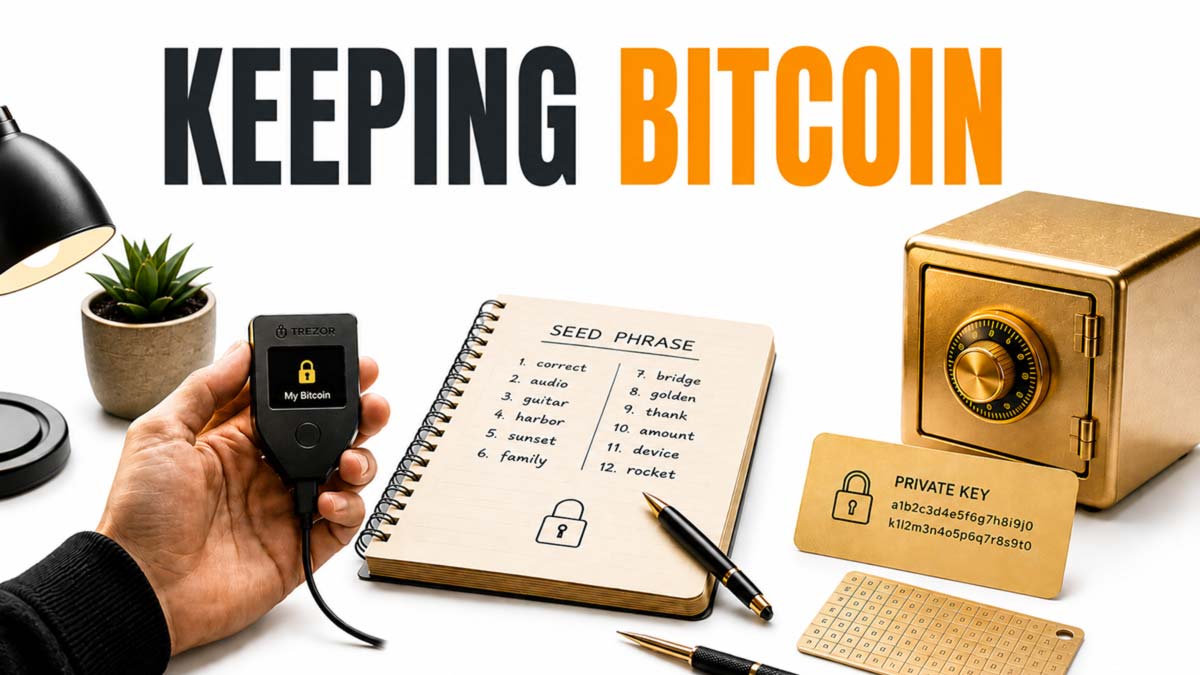
Whatever the walletWalletSoftware or device that manages your Bitcoin keys and lets you sign transactions. A wallet does not really « hold » your bitcoins, it holds the keys that prove you own them.See in the lexicon →, hot or cold, mobile or desktop, there is one common object to back up: the seed phrase, or recovery phrase. A list of 12 or 24 words from the BIP39BIP39Standard defining the list of 2,048 words used for seed phrases. Lets every wallet brand generate seeds that are compatible with each other.See in the lexicon → standard, which mathematically encodes all the private keys of the wallet. Anyone who knows these words can rebuild the wallet on any compatible software or hardware, and therefore spend the bitcoins.
Three practical consequences follow immediately:
- The seed phraseSeed phraseSequence of 12 or 24 words (usually in English) that encodes your master key. Universal wallet backup : with these words, you can restore your funds on any compatible software.See in the lexicon → is the only backup. If your LedgerLedger, Trezor, Coldcard, BitBoxMain hardware wallet brands. Ledger Nano S Plus / X (French, the best-seller), Trezor Model T (Czech, open source), Coldcard Mk4 (Canadian, ultra-secure, Bitcoin-only), BitBox02 (Swiss, open source).See in the lexicon → breaks, is stolen or falls into the sea, you reset a new wallet (any BIP39-compatible brand) from the 24 words and recover your funds. Without the seed, the hardware is useless: it's just a box.
- Whoever knows the seed owns the bitcoins. No vaultVaultCustody setup for long-term storage, often multisig, kept offline and touched rarely.See in the lexicon →, no verification, no call to Ledger will change that. Photographed, typed on a website, shared with a relative, stored in iCloud / Google Drive / Dropbox: theft guaranteed, sometimes years later.
- The backup must survive the home. A paper seed burns in a fire, rots in water damage, yellows in the light. A seed engraved on a stainless-steel plate (Cryptosteel Capsule, Hodlr Steel, SeedXOR, Steely) withstands fire, water and years. Cost: 50 to 150 EUR, one-time lifetime purchase.
The golden rules, in order of importance:
- Generate the seed on the hardware itself, never on a PC, never on a website, never on a pre-printed sheet provided by a third-party seller.
- Write or engrave it immediately, with no photo or screenshot.
- Store the backup in a dry, dark place, out of reach of intruders and out of a single point of failure (ideally two copies in two distinct locations).
- Never enter the seed on an internet-connected device, except for an emergency restore (and even then, caution).
- Test the restore at least once, with a symbolic amount, to make sure the backup is correct.
To go further, the BIP39 passphrasePassphraseExtra word or phrase you add to your seed phrase to create a hidden wallet. Optional security layer, independent of the seed.See in the lexicon → (an extra word of your choosing, sometimes called the "25th word") adds a layer of security against physical seed discovery. Topic detailed in the article article dedicated to the seed phrase.
L1 and Lightning: vault and pocket
There are two Bitcoin layers to store and use your funds: the main chain (Layer 1, or L1) and the Lightning NetworkLightning NetworkSecond-layer payment network on top of Bitcoin. Enables near-instant and near-free payments through channels opened between users.See in the lexicon → (Layer 2). Understanding when to use each avoids costly mistakes.
Layer 1, the Bitcoin chain itself. Highly secure (15 years without incident), unstoppable, but slow (one block every 10 minutes on average) and with variable fees. Peak-cycle fees: 5 to 50 EUR per transaction. Trough fees: 0.10 to 1 EUR. This is the storage layer: you deposit large amounts, leave them there, touch them rarely. It is also the only layer whose transactions are all confirmed in a verifiable public ledgerLedger, Trezor, Coldcard, BitBoxMain hardware wallet brands. Ledger Nano S Plus / X (French, the best-seller), Trezor Model T (Czech, open source), Coldcard Mk4 (Canadian, ultra-secure, Bitcoin-only), BitBox02 (Swiss, open source).See in the lexicon →.
Layer 2, the Lightning Network. Built on top of L1, designed for instant and very low-cost payments (often less than 1 cent). Ideally suited to daily spending: coffee, in-store purchase where accepted, online micropayments. More convenient but also more volatile: channels can close, routes can fail, funds must stay online to be usable. Reserve for small moving amounts.
The healthy architecture for most bitcoiners is 95 % in L1 cold storageCold storageStoring bitcoins on an offline wallet that is not connected to the Internet. Maximum security for amounts you are not spending.See in the lexicon → and 5 % in hot Lightning. L1 lives on a hardware walletHardware walletSmall dedicated device (Ledger, Trezor, Coldcard, BitBox, etc.) that keeps the private key away from a potentially compromised computer. Signs transactions inside the device itself.See in the lexicon → (Ledger, TrezorLedger, Trezor, Coldcard, BitBoxMain hardware wallet brands. Ledger Nano S Plus / X (French, the best-seller), Trezor Model T (Czech, open source), Coldcard Mk4 (Canadian, ultra-secure, Bitcoin-only), BitBox02 (Swiss, open source).See in the lexicon →, ColdcardLedger, Trezor, Coldcard, BitBoxMain hardware wallet brands. Ledger Nano S Plus / X (French, the best-seller), Trezor Model T (Czech, open source), Coldcard Mk4 (Canadian, ultra-secure, Bitcoin-only), BitBox02 (Swiss, open source).See in the lexicon →), Lightning on a dedicated mobile wallet (Phoenix mostly, or Muun in hybrid L1+LN mode). When the Lightning pocket runs low, you top up from L1 via an on-chain transaction. When it overflows, you push back to L1.
Avoid two pitfalls:
- Putting your whole stack on Lightning. A badly closed channel, a corrupted mobile walletWalletSoftware or device that manages your Bitcoin keys and lets you sign transactions. A wallet does not really « hold » your bitcoins, it holds the keys that prove you own them.See in the lexicon →, a vanishing remote nodeNodeComputer that runs the Bitcoin software and takes part in the network by validating blocks and transactions. A « full node » keeps a complete copy of the blockchain.See in the lexicon →: all scenarios that make funds unavailable or force a sometimes complex recovery procedure.
- Doing very small purchases on L1. Buying a 4 EUR coffee by paying 6 EUR of L1 fees is absurd. For this kind of spending, Lightning is designed exactly for that.
The five main risks to anticipate
Bitcoin storage rarely fails through a spectacular event. It fails because a foreseeable risk was not taken seriously. Here are the five cases behind 90 % of incidents.
- PhishingPhishingAttack where someone impersonates a legitimate service via email, SMS or clone website, in order to extract your credentials or your seed phrase.See in the lexicon →. Fake exchangeExchangeService that lets you buy, sell and swap cryptocurrencies against fiat money. Examples : Kraken, Coinbase, Bitstamp, Bitvavo. Most are custodial.See in the lexicon → site visited via Google Ads, fake walletWalletSoftware or device that manages your Bitcoin keys and lets you sign transactions. A wallet does not really « hold » your bitcoins, it holds the keys that prove you own them.See in the lexicon → app on the App Store, "verifyDon't trust, verifyBitcoiner mantra. Trust no one (bank, government, exchange, influencer), verify on your own through your own node.See in the lexicon → your wallet" email asking for the seed. Always reach exchanges and wallets through manually saved bookmarks, never through search. No one, ever, should ask for your seed phraseSeed phraseSequence of 12 or 24 words (usually in English) that encodes your master key. Universal wallet backup : with these words, you can restore your funds on any compatible software.See in the lexicon →.
- SIM swapSIM swapAttack where a fraudster convinces your phone carrier to transfer your number onto their own SIM card. They then receive your 2FA SMS messages and can take over your accounts.See in the lexicon →. An attacker convinces your telecom operator to transfer your number to their SIM, then captures the 2FA2FA (Two-Factor Authentication)Two-factor authentication. On top of the password, a second element is required to sign in (TOTP code, SMS, physical key). Standard on every serious platform.See in the lexicon → SMS and the password-reset emails. High risk on exchanges that still accept SMS 2FA. Counter: app-based 2FA (Aegis, Raivo, Authy), passkey or hardware (Yubikey), and a secondary phone number dedicated to sensitive accounts.
- Physical theft. Hardware walletHardware walletSmall dedicated device (Ledger, Trezor, Coldcard, BitBox, etc.) that keeps the private key away from a potentially compromised computer. Signs transactions inside the device itself.See in the lexicon → and seed plate stolen from the same drawer. The hardware alone is not enough (it's PIN-protected), but a seed plate found next to it is enough to rebuild everything. Counter: separate hardware and seed geographically, and consider the BIP39BIP39Standard defining the list of 2,048 words used for seed phrases. Lets every wallet brand generate seeds that are compatible with each other.See in the lexicon → passphrasePassphraseExtra word or phrase you add to your seed phrase to create a hidden wallet. Optional security layer, independent of the seed.See in the lexicon → for substantial amounts.
- Lost seed. Fire, water damage, move, forgetting where you hid the backup, untransmitted estate. A lost seed is the absolute equivalent of lost bitcoins. Counter: metal backup, two geographically separated copies, and a documented transmission procedure.
- Death without organised transmission. Your bitcoins die with you if no one knows where to find the seed or how to use it. For significant estates, plan an instruction letter (without the seed itself) with a notary or relative, and consider collaborative multisigMultisig (multi-signature)Configuration where a transaction must be signed by several independent keys to be valid (for example 2 of 3). Reduces the risk that a single key theft causes loss of funds.See in the lexicon → with an heir signatory (Casa Inheritance, Unchained legacy). Topic developed in the transmission article article.
Disclaimer
Educational and informational content only: not investment, tax or legal advice. Bitcoin carries significant risks, including high volatility and the possible loss of invested capital. Each reader remains responsible for their decisions; when in doubt, consult a qualified professional in your jurisdiction.
Going further
Each building block of Bitcoin storage has its dedicated article in the Store topic, to be published in upcoming sprints. The planned sequence, from the fundamental to the advanced:
- The BIP39 seed phrase: nature, generation, metal backups, optional passphrasePassphraseExtra word or phrase you add to your seed phrase to create a hidden wallet. Optional security layer, independent of the seed.See in the lexicon →.
- Hardware wallet: LedgerLedger, Trezor, Coldcard, BitBoxMain hardware wallet brands. Ledger Nano S Plus / X (French, the best-seller), Trezor Model T (Czech, open source), Coldcard Mk4 (Canadian, ultra-secure, Bitcoin-only), BitBox02 (Swiss, open source).See in the lexicon →, TrezorLedger, Trezor, Coldcard, BitBoxMain hardware wallet brands. Ledger Nano S Plus / X (French, the best-seller), Trezor Model T (Czech, open source), Coldcard Mk4 (Canadian, ultra-secure, Bitcoin-only), BitBox02 (Swiss, open source).See in the lexicon →, ColdcardLedger, Trezor, Coldcard, BitBoxMain hardware wallet brands. Ledger Nano S Plus / X (French, the best-seller), Trezor Model T (Czech, open source), Coldcard Mk4 (Canadian, ultra-secure, Bitcoin-only), BitBox02 (Swiss, open source).See in the lexicon →, BitBoxLedger, Trezor, Coldcard, BitBoxMain hardware wallet brands. Ledger Nano S Plus / X (French, the best-seller), Trezor Model T (Czech, open source), Coldcard Mk4 (Canadian, ultra-secure, Bitcoin-only), BitBox02 (Swiss, open source).See in the lexicon →, BitKey comparison; choosing a first model; buying without a suspicious middleman.
- Bitcoin multisig: Casa, Unchained, personal Sparrow 2-of-3 setup; when to switch, how to test.
- Mobile wallet: Phoenix vs Muun vs Aqua vs BlueWallet; setup and backup.
- Lightning wallet: Phoenix, WalletWalletSoftware or device that manages your Bitcoin keys and lets you sign transactions. A wallet does not really « hold » your bitcoins, it holds the keys that prove you own them.See in the lexicon → of SatoshiSatoshi (sat)The smallest unit of bitcoin. 1 BTC = 100 million satoshis. Named after the creator. In 2026, talking in sats becomes common as the price of one BTC rises.See in the lexicon →, Zeus; channels, swaps, fees.
- Bitcoin security: phishingPhishingAttack where someone impersonates a legitimate service via email, SMS or clone website, in order to extract your credentials or your seed phrase.See in the lexicon →, SIM swapSIM swapAttack where a fraudster convinces your phone carrier to transfer your number onto their own SIM card. They then receive your 2FA SMS messages and can take over your accounts.See in the lexicon →, malware, operational hygiene.
- Bitcoin inheritance and transmission: digital will, multisigMultisig (multi-signature)Configuration where a transaction must be signed by several independent keys to be valid (for example 2 of 3). Reduces the risk that a single key theft causes loss of funds.See in the lexicon → with heir, instruction letter.
- Personal Bitcoin node: UmbrelUmbrelEquivalent distribution for mini-PCs or Raspberry Pi, with a polished web interface and an app store (BTCPay, mempool.space, Sparrow Server, and so on).See in the lexicon →, Start9Start9 (StartOS)Umbrel alternative focused on sovereignty and privacy. More technically demanding, more rigorous on privacy.See in the lexicon →, RaspiBlitzRaspiBlitzReady-made software distribution that turns a Raspberry Pi into a Bitcoin and Lightning node. A pioneer of the genre, with an active German-speaking community.See in the lexicon →; why and how.
- Recovering lost bitcoins: partial seed, dust, old wallets.
Prerequisites and topic transitions:
- Buy Bitcoin guide: how to acquire the bitcoins you then want to store.
- Understand Bitcoin guide: if the notion of private keyPrivate keySecret number that proves ownership of bitcoins at a given address. Whoever holds the private key holds the bitcoins. Never share it and never store it in plain text.See in the lexicon →, address or transaction remains unclear, this is the right starting point.