
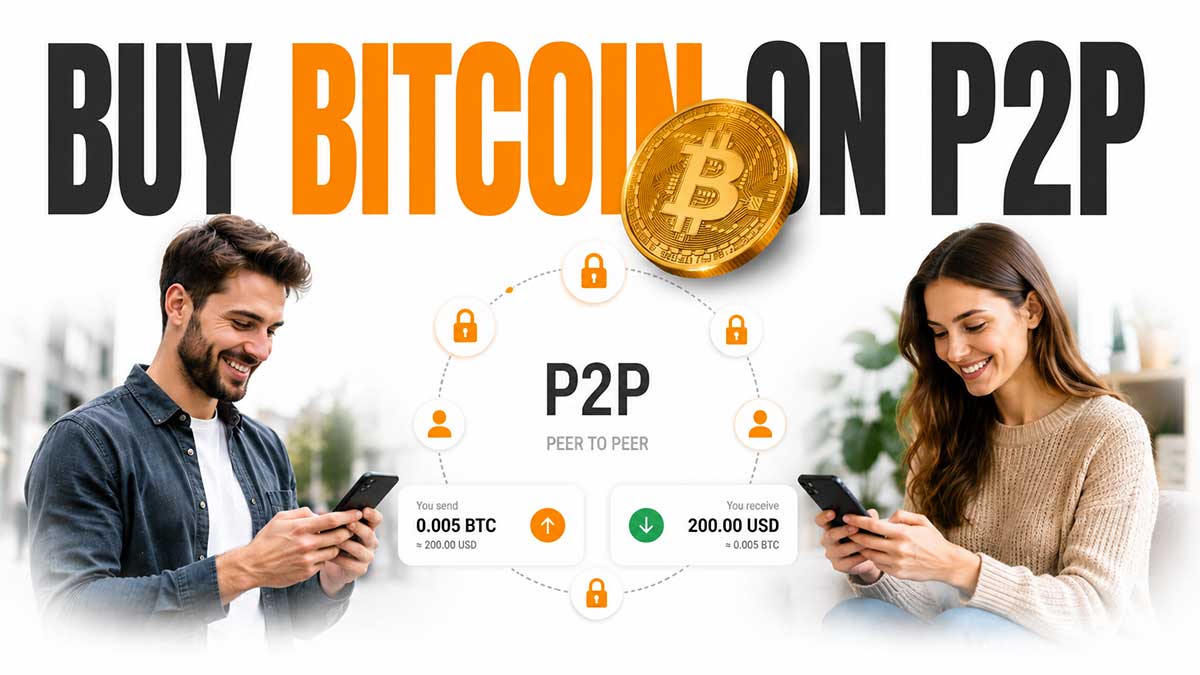
Peer-to-peer (P2PP2P (peer-to-peer)Direct exchange between two people, with no centralised platform in between. Bisq, HodlHodl and AgoraDesk are P2P platforms.See in the lexicon →) buying is, historically, the original acquisition mode of Bitcoin: before centralised exchanges, early users traded their bitcoins hand to hand, by transfer or by cash, on a street corner or via the BitcoinTalk forums. Fifteen years on, this mode survives and has professionalised around specialised platforms that act as bulletin board and escrow, without ever holding users' funds.
P2P answers several distinct needs: buys without KYCKYC (Know Your Customer)Mandatory identification procedure that regulated platforms apply to their users : ID document, proof of address, and so on.See in the lexicon → below certain legal tiers, censorship resistance (no exchangeExchangeService that lets you buy, sell and swap cryptocurrencies against fiat money. Examples : Kraken, Coinbase, Bitstamp, Bitvavo. Most are custodial.See in the lexicon → able to freeze an account), accessibility from jurisdictions where regulated exchanges do not operate, cash payment, buys from modest amounts (50 EUR) without banking fees. In return, it requires more operational discipline than buying on an exchange, heightened vigilance against scams, and accepts lower liquidity with a 1 to 5 % premium above the spot price. This guide reviews the main 2026 platforms, the concrete trade flow, payment methods and their risks, taxation by country and security best practices.
P2P principle and comparison with exchanges
On a classic centralised exchangeExchangeService that lets you buy, sell and swap cryptocurrencies against fiat money. Examples : Kraken, Coinbase, Bitstamp, Bitvavo. Most are custodial.See in the lexicon → (Kraken, Bitstamp, Coinbase), the platform holds both your fiatFiat (fiat currency)State currency with legal tender status (euro, Swiss franc, dollar), issued by a central bank and not backed by a physical asset. By contrast, Bitcoin has an issuance capped at 21 million units, with no central issuer.See in the lexicon → funds and a pool of bitcoins, and acts as the automatic counterparty of every order. You trust it, and in exchange you benefit from near-infinite liquidity, instant execution, and all integrated services (single KYCKYC (Know Your Customer)Mandatory identification procedure that regulated platforms apply to their users : ID document, proof of address, and so on.See in the lexicon →, tax reporting, support).
P2PP2P (peer-to-peer)Direct exchange between two people, with no centralised platform in between. Bisq, HodlHodl and AgoraDesk are P2P platforms.See in the lexicon → works on a radically different model. The P2P platform has neither your euros nor your bitcoins: it only plays two roles, bulletin board (matching buyers and sellers) and multisigMultisig (multi-signature)Configuration where a transaction must be signed by several independent keys to be valid (for example 2 of 3). Reduces the risk that a single key theft causes loss of funds.See in the lexicon → escrow (temporarily locking the seller's bitcoins while the buyer sends fiat). Fiat never transits through the platform, it goes directly from bank to bank between the two individuals. Bitcoins are released from multisig to the buyer's walletWalletSoftware or device that manages your Bitcoin keys and lets you sign transactions. A wallet does not really « hold » your bitcoins, it holds the keys that prove you own them.See in the lexicon → once payment is confirmed.
Practical consequences of this difference:
- No centralised liquidity pool. You buy from a specific individual, who posts an ad with their price, payment methods, limits. If no one offers the combination you want (amount, currency, method, premium), you must wait or adjust.
- Premium above the spot price. The seller sets their price, usually 1 to 5 % above the Kraken / Bitstamp rate. This is the compensation for the service, the liquidity offered, and the risk taken by the seller (notably the chargeback risk on some payments).
- No centralised customer service. In case of dispute, it is the P2P platform's arbitrator (BisqBisq, HodlHodl, AgoraDeskNo-KYC P2P platforms where you buy bitcoin directly from another individual via multisig escrow.See in the lexicon →, HodlHodlBisq, HodlHodl, AgoraDeskNo-KYC P2P platforms where you buy bitcoin directly from another individual via multisig escrow.See in the lexicon →) who rules, on evidence provided by both parties. Slower than an exchange.
- No platform KYC in most cases. Bisq and RoboSats require strictly no personal information. HodlHodl and Peach limit KYC to amount tiers. The flip side: the tax and reporting responsibility remains entirely with the user.
- Security by cryptography, not by trust. The 2-of-2 (Bisq) or 2-of-3 (HodlHodl with arbitrator) multisig escrow guarantees no party can run away with the bitcoins without cooperation or arbitration.
P2P is therefore a radically different trade-off from the exchange: more autonomy and confidentiality, in exchange for more operational discipline and lower liquidity. It addresses a user profile that understands wallets, knows how to manage a seed phraseSeed phraseSequence of 12 or 24 words (usually in English) that encodes your master key. Universal wallet backup : with these words, you can restore your funds on any compatible software.See in the lexicon →, and accepts the slower pace of a human exchange.
P2P platforms in 2026: Bisq, HodlHodl, RoboSats, Peach, AgoraDesk
Five main players shape the P2PP2P (peer-to-peer)Direct exchange between two people, with no centralised platform in between. Bisq, HodlHodl and AgoraDesk are P2P platforms.See in the lexicon → market in 2026, with different philosophies and audiences.
BisqBisq, HodlHodl, AgoraDeskNo-KYC P2P platforms where you buy bitcoin directly from another individual via multisig escrow.See in the lexicon → (since 2014, formerly Bitsquare) is the senior and the only fully decentralised one. Java desktop app (Windows, macOS, Linux) communicating with other peers via Tor, no central server. No KYCKYC (Know Your Customer)Mandatory identification procedure that regulated platforms apply to their users : ID document, proof of address, and so on.See in the lexicon → possible (there is no one to provide it to). 2-of-2 multisigMultisig (multi-signature)Configuration where a transaction must be signed by several independent keys to be valid (for example 2 of 3). Reduces the risk that a single key theft causes loss of funds.See in the lexicon → escrow with security deposit from both seller and buyer to enforce good behaviour. Very varied payment methods: SEPASEPA (Single Euro Payments Area)Single euro payments area: standardised bank transfers, free or nearly so, within one business day (a few seconds for the instant version). The cheapest deposit method on European exchanges.See in the lexicon →, Revolut, Wise, Faster Payments UK, Zelle US, cash in person, postal money order. Fees 0.1 to 0.7 %. For Bitcoin-only purists attached to full decentralisation.
HodlHodlBisq, HodlHodl, AgoraDeskNo-KYC P2P platforms where you buy bitcoin directly from another individual via multisig escrow.See in the lexicon → (since 2017, Riga-based) is the most popular web option. No KYC required below certain tiers, 2-of-3 multisig escrow with HodlHodl as third-party arbitrator (without key access without a dispute). Very varied methods including SEPA, Revolut, Wise, national wire, cash. Fees 0.5 %. Excellent for those wanting an ergonomic web interface without installing desktop software. Recent evolution: mobile app in 2024, and MiCAMiCA (Markets in Crypto-Assets)European regulation 2023/1114 that frames crypto services across the EU since 2024. Creates the CASP status.See in the lexicon → tier restrictions for EU residents.
RoboSats (since 2022) is the new pure-Lightning entrant. Accessible only via Tor (clearnet possible but discouraged), each user has a PGP-generated robot avatar, strong anonymity. Trades exclusively in Lightning, hence amounts limited by the protocol (~500 to 2,000 EUR max per trade). Lightning hold-invoice escrow, automatic release. Fees 0.2 to 0.3 %. Ideal for anonymous and fast micro-buys (5 to 10 minutes per trade).
Peach Bitcoin (since 2022, Swiss-based) is the most usable mobile option for daily use. iOS/Android app, light KYC by tier (anonymous up to a threshold, verified above). SEPA, Revolut, Wise, MB Way (Portugal), Faster Payments. Fees 1.5 %. Good ergonomics for those not wanting to handle Bisq or go through Tor.
AgoraDeskBisq, HodlHodl, AgoraDeskNo-KYC P2P platforms where you buy bitcoin directly from another individual via multisig escrow.See in the lexicon → (since 2020) is the modern heir to the former LocalBitcoins (closed in 2023). Web, multi-crypto but Bitcoin dominant, very varied payments including in-person cash and gift cards. No blockchainBlockchainA public, shared ledger that records every Bitcoin transaction in blocks linked together cryptographically. Each participant in the network keeps a copy.See in the lexicon → multisig escrow but internal centralised escrow: weaker than Bisq on security, but simpler to access. Fees 1 %. Useful for exotic payments but to handle carefully on security.
Synthetic comparison: for maximum decentralisation Bisq, for web ergonomics HodlHodl, for strong anonymity RoboSats, for daily mobile Peach, for exotic payments AgoraDesk. Most serious users combine two or three depending on context.
How a P2P trade unfolds in practice
The flow of a P2PP2P (peer-to-peer)Direct exchange between two people, with no centralised platform in between. Bisq, HodlHodl and AgoraDesk are P2P platforms.See in the lexicon → trade is standardised, with a few platform-specific variants. Here are the seven typical steps for a buy on HodlHodlBisq, HodlHodl, AgoraDeskNo-KYC P2P platforms where you buy bitcoin directly from another individual via multisig escrow.See in the lexicon → or BisqBisq, HodlHodl, AgoraDeskNo-KYC P2P platforms where you buy bitcoin directly from another individual via multisig escrow.See in the lexicon →, via SEPASEPA (Single Euro Payments Area)Single euro payments area: standardised bank transfers, free or nearly so, within one business day (a few seconds for the instant version). The cheapest deposit method on European exchanges.See in the lexicon → from a European account.
- Searching for an ad. Filter by currency (EUR/CHF), payment method (SEPA, Revolut), desired amount, BTC price. Read the seller's conditions (payment instructions, maximum delay, specific requirements) and their history: number of completed trades, account age, ratings.
- Opening the trade. By clicking "buy", you start the procedure. On some platforms (Bisq), a BTC security deposit is also locked on the buyer side, to enforce accountability. The seller receives the notification and confirms.
- Putting in escrow. The seller's bitcoins (trade amount + their own fees) are locked in 2-of-2 multisigMultisig (multi-signature)Configuration where a transaction must be signed by several independent keys to be valid (for example 2 of 3). Reduces the risk that a single key theft causes loss of funds.See in the lexicon → (Bisq) or 2-of-3 (HodlHodl). At this stage, neither seller nor buyer can unilaterally move the funds. Confirmation visible on-chain within 10 minutes (1 confirmation typically expected).
- Off-platform fiatFiat (fiat currency)State currency with legal tender status (euro, Swiss franc, dollar), issued by a central bank and not backed by a physical asset. By contrast, Bitcoin has an issuance capped at 21 million units, with no central issuer.See in the lexicon → payment. You send the fiat from your bank (SEPA, Revolut, etc.) to the seller's IBAN or payment alias, strictly respecting the requested transaction memo. Important: never include "Bitcoin" or "crypto" in the memo, which could trigger a TRACFIN-style flag by the bank. Use a neutral wording such as "private invoice" or nothing at all.
- "Payment sent" notification. On the P2P platform, click "payment sent". The seller receives the notification and awaits the fiat arrival on their account.
- Seller confirmation and release. The seller checks their bank account (or Revolut, etc.), sees the fiat arrived, and clicks "release". The multisig escrow is signed on the seller side, the bitcoins move to your walletWalletSoftware or device that manages your Bitcoin keys and lets you sign transactions. A wallet does not really « hold » your bitcoins, it holds the keys that prove you own them.See in the lexicon →. On-chain confirmation in a few minutes.
- Mutual rating. Buyer and seller rate each other (positive/negative), feeding the reputation system for future trades.
In case of dispute: if the seller claims not to have received the fiat although you sent it, or you claim not to have received the BTC, the platform arbitrator rules on evidence (bank statement, conversation, transaction hashHashFunction that turns data of any size into a fixed-size fingerprint. The same input always yields the same output, but you cannot go back from output to input.See in the lexicon →). This is the added value of third-party escrow: HodlHodl can force release in favour of the buyer if payment proof is clear.
Typical total time: 30 minutes to 3 hours for an Instant SEPA trade, 24 to 48 hours for a classic SEPA pending a D+1 transfer. Lightning on RoboSats: 5 to 15 minutes.
Payment methods and chargeback risks
The choice of payment method is probably the most important decision in a P2PP2P (peer-to-peer)Direct exchange between two people, with no centralised platform in between. Bisq, HodlHodl and AgoraDesk are P2P platforms.See in the lexicon → trade, because it determines the reversibility of fiatFiat (fiat currency)State currency with legal tender status (euro, Swiss franc, dollar), issued by a central bank and not backed by a physical asset. By contrast, Bitcoin has an issuance capped at 21 million units, with no central issuer.See in the lexicon → and therefore the seller-side risk (and indirectly the premium you pay).
Irreversible methods (recommended on both sides):
- SEPASEPA (Single Euro Payments Area)Single euro payments area: standardised bank transfers, free or nearly so, within one business day (a few seconds for the instant version). The cheapest deposit method on European exchanges.See in the lexicon → Instant. European instant transfer, finalised in less than 10 seconds, irrevocable. The top option in 2026, now standard at all major banks. The seller can release BTC almost immediately after reception.
- Standard SEPA. Irrevocable once executed, but can take 24 to 48 h pending. The seller awaits effective arrival before release.
- Lightning NetworkLightning NetworkSecond-layer payment network on top of Bitcoin. Enables near-instant and near-free payments through channels opened between users.See in the lexicon →. For RoboSats buys, Lightning itself is irrevocable on the Bitcoin side. Not applicable to fiat except in advanced uses.
- In-person cash. Irrevocable by nature. To secure: public place, reasonable amounts (typically below 2,000 EUR to stay below LBA/AMLD reporting thresholds), no visible large-amount transport.
- Postal money order. Quasi-irrevocable once received. Slow (3 to 5 days), but useful for profiles without fluid electronic banking access.
Reversible methods (handle with care):
- Revolut / Wise / N26. Officially "like a transfer", but a buyer protection can be triggered up to 30 or 60 days later. Any serious seller either requires a hold before release, or a higher premium, or refuses this method above a certain amount.
- PayPal Friends & Family. Officially unprotected, but PayPal can still freeze the seller's account if the buyer disputes later. Many serious operators refuse.
- Bank card / Stripe. Chargeback possible up to 90-120 days later. Almost never accepted in Bitcoin P2P, by sellers or arbitrators.
- Gift cards (Amazon, Apple, Steam). Accepted on AgoraDeskBisq, HodlHodl, AgoraDeskNo-KYC P2P platforms where you buy bitcoin directly from another individual via multisig escrow.See in the lexicon → and a few specialised operators. Very risky: codes potentially already used, stolen cards, often a very high premium (10 to 20 %). To avoid except in special cases.
Buyer's golden rule: favour SEPA Instant or in-person cash, which are irrevocable and therefore accepted by all sellers without surcharge. Seller's golden rule (if you sell BTC against fiat): never release the multisigMultisig (multi-signature)Configuration where a transaction must be signed by several independent keys to be valid (for example 2 of 3). Reduces the risk that a single key theft causes loss of funds.See in the lexicon → before effective verification on your bank statement, not on a screenshot; and apply a safety delay before release on reversible methods (typically wait 7 to 14 days on Revolut/Wise above 1,000 EUR).
P2P regulation by country: CH, FR, DE, IT
P2PP2P (peer-to-peer)Direct exchange between two people, with no centralised platform in between. Bisq, HodlHodl and AgoraDesk are P2P platforms.See in the lexicon → between individuals is, in the four CapBitcoin perimeter countries, perfectly legal under certain conditions. Here is the 2026 reading by country, bearing in mind that this synthesis does not replace a personalised opinion.
Switzerland. One-off private buys are perfectly legal and not subject to the LBA. If the activity becomes regular (more than a few trades per month, or significant cumulative volume), it can shift to professional activity requiring affiliation to a Self-Regulatory Organisation (OAR) or to FinmaFINMASwiss Financial Market Supervisory Authority. Frames crypto activities in Switzerland.See in the lexicon →. Bity and Värdex regularly publish guides on the topic. No tax on private securities gains, so fiscally neutral on the result side.
France. Private P2P is legal under article L54-10-1 of the Monetary and Financial Code. But: any service activity on digital assets carried out professionally (repeated buy-sell, intermediation for others) requires PSANPSAN (French crypto registration)French mandatory registration status with the AMF for crypto platforms. Progressively replaced by the European CASP authorisation under MiCA.See in the lexicon → registration with the AMF. For the individual buying for their own account, no administrative obligation. Fiscally, gains are subject to the 30 % flat tax just as on an exchangeExchangeService that lets you buy, sell and swap cryptocurrencies against fiat money. Examples : Kraken, Coinbase, Bitstamp, Bitvavo. Most are custodial.See in the lexicon →. Keep purchase proofs to compute the weighted average price at future resale.
Germany. Private P2P is explicitly recognised and remains eligible for the 12-month exempting Spekulationsfrist, like any privately held BTC. Above regular volume, the activity can shift to commercial (BaFin licence). For the individual accumulating via P2P DCADCA (Dollar Cost Averaging)Buying a small fixed amount at regular intervals (for example 100 EUR a week), regardless of price. Smooths the average purchase cost and neutralises timing bias.See in the lexicon → or one-off buys, the private regime remains applicable. Notable advantage: P2P buys do not generate a KYCKYC (Know Your Customer)Mandatory identification procedure that regulated platforms apply to their users : ID document, proof of address, and so on.See in the lexicon → file at an exchange, so less risk of automatic transmission to tax authorities, which remain dependent on your own declaration.
Italy. P2P is legal but subject to the same reporting rules as any other purchase: quadro RTQuadro RT, Quadro RWSections of the Italian tax return covering crypto capital gains (RT) and holdings of foreign accounts (RW).See in the lexicon → for gains, quadro RWQuadro RT, Quadro RWSections of the Italian tax return covering crypto capital gains (RT) and holdings of foreign accounts (RW).See in the lexicon → above 5,000 EUR held abroad. 26 % imposta sostitutiva. The absence of a declaring platform on the P2P side (unlike Young Platform or Bitpanda producing tax reports) reinforces the taxpayer's documentary responsibility: keep a precise spreadsheet of each trade with date, EUR amount, BTC amount, transaction hashHashFunction that turns data of any size into a fixed-size fingerprint. The same input always yields the same output, but you cannot go back from output to input.See in the lexicon →, bank evidence.
MiCAMiCA (Markets in Crypto-Assets)European regulation 2023/1114 that frames crypto services across the EU since 2024. Creates the CASP status.See in the lexicon → 1,000 EUR travel rule. Since 2024, transfers between CASPs (Crypto Asset Service Providers) must include identifying data of both parties above 1,000 EUR. This rule does not apply to direct P2P (exchange between two individuals via their own wallets), but can apply indirectly if you later send your BTC to a regulated exchange: it may ask the origin. Good practice: document the legal origin of any BTC acquired via P2P to avoid being blocked on a future exchange withdrawal.
Security best practices and common scams
P2PP2P (peer-to-peer)Direct exchange between two people, with no centralised platform in between. Bisq, HodlHodl and AgoraDesk are P2P platforms.See in the lexicon →, by its decentralised nature, attracts both very serious users and a few opportunists. Security best practices boil down to about ten rules, to apply without exception.
Before the trade:
- Check the counterparty's account age (at least 6 months recommended, ideally > 1 year).
- Check the number of successfully completed trades (> 20 ideally, > 100 for large amounts).
- Check ratings left by previous partners: read the comments, not just the score.
- For a first trade with a counterparty, start with a small amount (50-100 EUR) before committing a larger sum.
During the trade:
- Always stay strictly within the P2P platform interface for any communication. Refuse any contact drifting to Telegram, WhatsApp, Signal off-platform: it is almost always a scam signal trying to get you out of the arbitration system.
- Always use the platform's multisigMultisig (multi-signature)Configuration where a transaction must be signed by several independent keys to be valid (for example 2 of 3). Reduces the risk that a single key theft causes loss of funds.See in the lexicon → escrow. Never an "off-escrow" trade even with a reputed counterparty. The mere fact of being offered one is a red flag.
- Carefully verifyDon't trust, verifyBitcoiner mantra. Trust no one (bank, government, exchange, influencer), verify on your own through your own node.See in the lexicon → the requested payment memo and apply it to the letter. A typo in the memo can serve as a pretext for a false release refusal.
- For the seller: never release the multisig before effectively seeing the fiatFiat (fiat currency)State currency with legal tender status (euro, Swiss franc, dollar), issued by a central bank and not backed by a physical asset. By contrast, Bitcoin has an issuance capped at 21 million units, with no central issuer.See in the lexicon → arrived on your official bank statement. Not on a screenshot, not on an app notification, but on the authentic bank statement viewed from your own session.
Common scams to know:
- Fake payment confirmation. The buyer sends a bogus screenshot (Photoshop, or payment immediately cancelled) and insists on multisig release. Always check on your real bank account, not on what you are shown.
- Delayed chargeback. The buyer pays via Revolut or PayPal, you release, then 7 to 30 days later triggers a chargeback claiming not to have received a service. Solution: refuse these methods for large amounts, or require a waiting period before release.
- Triangulation. A buyer pays you from someone else's account (stolen account, front). When the real victim disputes, your bank freezes the funds. Solution: require the sender's name on the transfer to exactly match that of the counterparty on the platform.
- Rushed fake buyer. Psychological pressure to make you release before verification ("I have to leave", "family emergency", "I have a plane"). Always respect your own verification pace.
- Fake escrow. Someone offers you a "simpler" trade by going through a "private escrow" they guarantee. Always a pure and simple scam. Escrow happens on the official platform or nowhere.
Final golden rule: if something seems too good (unbeatable price, very rushed counterparty, unusual method), it is almost certainly a scam. Serious P2P is slow, meticulous and a bit boring, and that is precisely what makes it safe.
Disclaimer
Educational and informational content only: not investment, tax or legal advice. Bitcoin carries significant risks, including high volatility and the possible loss of invested capital. Each reader remains responsible for their decisions; when in doubt, consult a qualified professional in your jurisdiction.
Going further
P2PP2P (peer-to-peer)Direct exchange between two people, with no centralised platform in between. Bisq, HodlHodl and AgoraDesk are P2P platforms.See in the lexicon → is a buying method apart, complementary to exchanges and ATMs, that requires more autonomy and discipline. It addresses profiles already familiar with walletWalletSoftware or device that manages your Bitcoin keys and lets you sign transactions. A wallet does not really « hold » your bitcoins, it holds the keys that prove you own them.See in the lexicon → management and Bitcoin security. To go further:
- Buy Bitcoin: overview of methods.
- Buy your first Bitcoin: prerequisite before any P2P buy (notably mastering a personal wallet and a seed phraseSeed phraseSequence of 12 or 24 words (usually in English) that encodes your master key. Universal wallet backup : with these words, you can restore your funds on any compatible software.See in the lexicon →).
- Choose a buying platform: regulated exchangeExchangeService that lets you buy, sell and swap cryptocurrencies against fiat money. Examples : Kraken, Coinbase, Bitstamp, Bitvavo. Most are custodial.See in the lexicon → as an alternative for large amounts or non-technical profiles.
- Bitcoin ATM: another cash alternative, complementary to P2P.
- How much to invest in Bitcoin: frame the target allocation before starting in P2P.
- In Switzerland, in France, in Germany, in Italy: country focus including tax and regulatory doctrine applicable to P2P.