
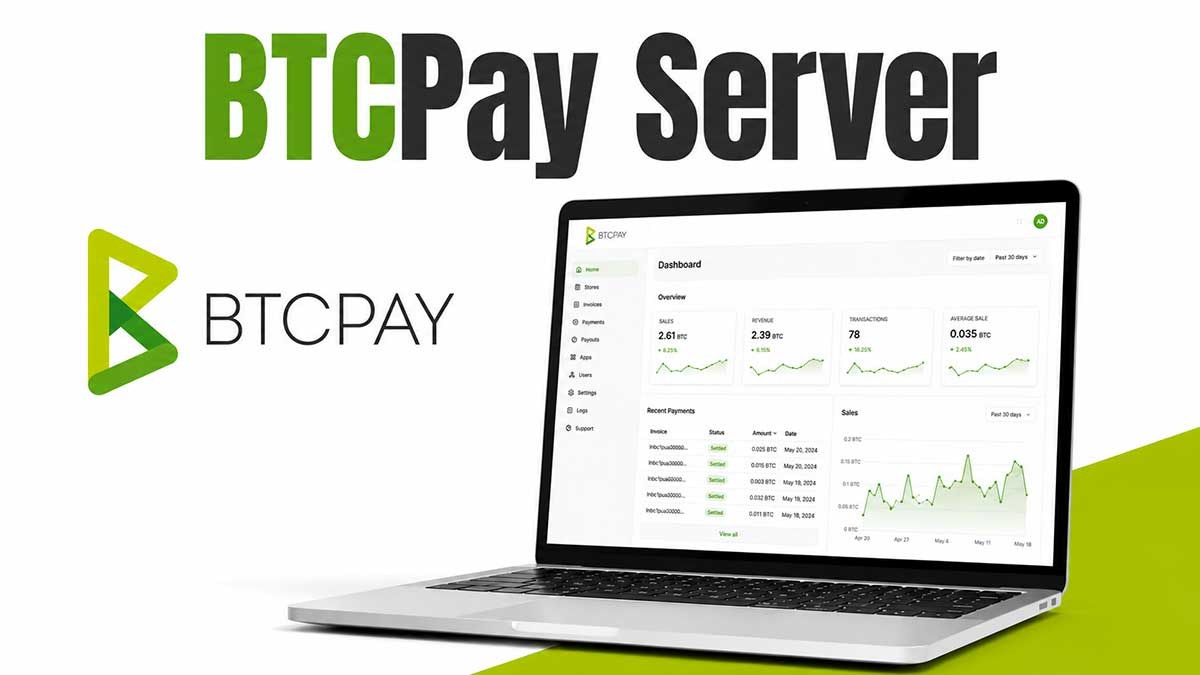
Accepting Bitcoin on the merchant side long required either going through a centralised acquirer taking a 1 % commission and holding the funds in custodyCustodyThe custody of funds. See self-custody and custodial in the dedicated section below.See in the lexicon → (BitPay, early Coinbase Commerce), or manual tinkering via a generic Bitcoin walletWalletSoftware or device that manages your Bitcoin keys and lets you sign transactions. A wallet does not really « hold » your bitcoins, it holds the keys that prove you own them.See in the lexicon →. BTCPay Server, launched by Nicolas Dorier in 2017, changed that equation : an open-source, free, self-hosted server generating invoices, integrating e-commerce, and keeping the funds in a wallet controlled by the merchant.
In 2026, BTCPay Server is carried by the BTCPay Server Foundation and deployed on thousands of instances. More than 500 identified European merchants (restaurants, freelancers, e-commerces) use it in production. The ecosystem has native WooCommerce, Magento, Shopify, PrestaShop integrations, physical BTCPay POS terminals, and a community extension store (Bitcoin payroll via Bitwage, accounting integration, etc.).
This article covers the two deployment paths, integration with common e-commerce platforms, the physical BTCPay POS terminal, the auto-EUR-conversion vs BTC retention decision, and the comparison with non-self-hosted third-party alternatives (OpenNode, Strike, IBEX Pay).
Two deployment paths : dedicated VPS or Umbrel integration
Path 1 : dedicated BTCPay VPSVPS (Virtual Private Server)Virtual server rented from a hosting provider (Hetzner, DigitalOcean, OVH), accessed via SSH. Typical price 5 to 30 EUR per month.See in the lexicon →. The historical method. Rent a VPS (DigitalOcean, Hetzner, OVH or other, from 10-15 EUR/month depending on spec), choose Ubuntu 22.04 or 24.04 LTS, run the BTCPay One-Click script (btcpayserver-dockerDockerTechnology that packages an application and its dependencies into an isolated container that can be started with one command on any system.See in the lexicon →/btcpay-setup.sh). The script deploys a docker-compose with Bitcoin CoreBitcoin CoreReference implementation of the Bitcoin software, written in C++ and maintained by an open-source community. This is the software that most nodes run.See in the lexicon → in pruned mode, BTCPay, LND for Lightning, NBXplorer for indexing, and Nginx for reverse proxy. In 30-45 minutes, the instance is online, accessible via an HTTPS URL of your choice.
Path 2 : UmbrelUmbrelEquivalent distribution for mini-PCs or Raspberry Pi, with a polished web interface and an app store (BTCPay, mempool.space, Sparrow Server, and so on).See in the lexicon →/Start9Start9 (StartOS)Umbrel alternative focused on sovereignty and privacy. More technically demanding, more rigorous on privacy.See in the lexicon →/RaspiBlitzRaspiBlitzReady-made software distribution that turns a Raspberry Pi into a Bitcoin and Lightning node. A pioneer of the genre, with an active German-speaking community.See in the lexicon → integration. If you already have a mini-PCMini-PC (NUC)Small fanless computer such as Intel NUC, Beelink or Minisforum. More powerful than a Raspberry Pi, ideal for a serious node running Lightning and BTCPay.See in the lexicon → or Raspberry PiRaspberry PiSmall credit-card-sized computer at a low price (60 to 100 EUR). Lets you run a Bitcoin node at home.See in the lexicon → under Umbrel or Start9 running your nodeNodeComputer that runs the Bitcoin software and takes part in the network by validating blocks and transactions. A « full node » keeps a complete copy of the blockchain.See in the lexicon →, BTCPay is available as an installable app from the store. Two clicks, a few minutes to download Docker images, and the app runs on your local Bitcoin Core. Simpler than the VPS path, but limited to modest use : a Raspberry Pi 5 supports a medium business but not a heavy e-commerce with hundreds of orders per hour.
First access. Browse to the BTCPay URL, create an admin account (first account = admin), follow the wizard : create a store (your business profile), connect a walletWalletSoftware or device that manages your Bitcoin keys and lets you sign transactions. A wallet does not really « hold » your bitcoins, it holds the keys that prove you own them.See in the lexicon → (xpubxpub (extended public key)Extended public key. Lets a read-only wallet see addresses and balances without being able to sign. Used for tracking and observation.See in the lexicon → from Sparrow/Specter or seed phraseSeed phraseSequence of 12 or 24 words (usually in English) that encodes your master key. Universal wallet backup : with these words, you can restore your funds on any compatible software.See in the lexicon → for hot walletHot walletWallet connected to the Internet (mobile, desktop or online). Convenient for small amounts and fast payments, but more exposed to attacks.See in the lexicon →), configure optional fiatFiat (fiat currency)State currency with legal tender status (euro, Swiss franc, dollar), issued by a central bank and not backed by a physical asset. By contrast, Bitcoin has an issuance capped at 21 million units, with no central issuer.See in the lexicon → conversion. In 15 minutes, you can generate your first invoice and settle it from a test wallet.
E-commerce integrations : WooCommerce, Magento, Shopify
WooCommerce (WordPress) is the most mature integration. The BTCPay for WooCommerce plugin, distributed on the WordPress repository, adds Bitcoin and Lightning as payment methods among the classic ones (Stripe card, transfer). Configuration : install the plugin, paste your BTCPay Server URL and APIAPI (Application Programming Interface)Interface that lets one program query another program or service. mempool.space exposes a public API for querying the chain.See in the lexicon → key, link the stores, enable Bitcoin and Lightning in WooCommerce. Fifteen minutes in all.
Magento, PrestaShop, OpenCart. Official plugins available on the BTCPay GitHubGitHubWeb platform that hosts most of the world's open-source projects, including Bitcoin Core, electrs, BDK and LDK. Lets you read the code, browse change history and submit contributions.See in the lexicon → repoRepo (repository)Code repository on GitHub or an equivalent platform. The Bitcoin Core repo is github.com/bitcoin/bitcoin.See in the lexicon →, similar configuration. For Magento 2, the BTCPay-for-magento2 plugin is community-maintained. Shopify is a special case : Shopify does not allow a crypto payment plugin directly (Shopify policy), you need to go through a third-party integration (Coincharge or similar) which routes to BTCPay. More friction but possible.
Custom platforms (PHPPHPServer-side programming language used by CapBitcoin. Runs on most shared hosting providers.See in the lexicon → shop, NodeNodeComputer that runs the Bitcoin software and takes part in the network by validating blocks and transactions. A « full node » keeps a complete copy of the blockchain.See in the lexicon →.js, Django, etc.). BTCPay exposes a full REST API documented at docs.btcpayserver.org. Create an invoice via POST /api/v1/stores/{storeId}/invoices, receive a webhook when the payment is confirmed, update the order in your backoffice. Development takes a day for a Bitcoin-familiar backend dev, plus a few days to integrate cleanly with error handling and returns.
BTCPay POS physical terminal for stores
For physical businesses (restaurant, cafe, store, workshop), BTCPay POS is a dedicated touch interface turning a tablet or phone into a Bitcoin checkout terminal. Available natively in BTCPay Server : Apps → POS App. Configure a list of items with EUR price (or CHF, etc.), choose display (categories or flat list), activate.
Use : the employee opens BTCPay POS on the tablet (bookmarked URL), selects the sold items, the total displays, clicks "Pay with Bitcoin". A QR codeQR codeTwo-dimensional barcode, ubiquitous in Bitcoin: addresses, Lightning invoices, payment URIs. Always check the decoded amount and address before confirming.See in the lexicon → appears on screen, the customer scans it with their Lightning walletWalletSoftware or device that manages your Bitcoin keys and lets you sign transactions. A wallet does not really « hold » your bitcoins, it holds the keys that prove you own them.See in the lexicon → (Phoenix, Muun, Wallet of SatoshiSatoshi (sat)The smallest unit of bitcoin. 1 BTC = 100 million satoshis. Named after the creator. In 2026, talking in sats becomes common as the price of one BTC rises.See in the lexicon →). Visual and audio confirmation in BTCPay POS as soon as the Lightning payment confirms (typical : 2 seconds). The money is in your BTCPay wallet, itself controlled by your seed phraseSeed phraseSequence of 12 or 24 words (usually in English) that encodes your master key. Universal wallet backup : with these words, you can restore your funds on any compatible software.See in the lexicon → or multisigMultisig (multi-signature)Configuration where a transaction must be signed by several independent keys to be valid (for example 2 of 3). Reduces the risk that a single key theft causes loss of funds.See in the lexicon →.
Hardware. Any Android tablet or iPad 8-10 inches with a recent browser is enough. Initial investment : 200-400 EUR for a decent tablet and its checkout mount. Connection : stable local WiFi. Plan B in case of BTCPay outage : a classic mobile Lightning wallet on smartphone (Phoenix with static Lightning addressLightning AddressEmail-style address (alice@strike.me) that lets you receive Lightning payments without generating an invoice each time.See in the lexicon →). In 2026, this has become a standard setup for businesses seriously accepting Bitcoin.
Automatic EUR conversion vs BTC retention
Strategic decision for a merchant : when a Bitcoin payment arrives, should you keep it in BTC or auto-convert to EUR to stabilise treasury ? Both are valid depending on profile, taxation and risk appetite.
BTC retention. The payment arrives in sats in your BTCPay walletWalletSoftware or device that manages your Bitcoin keys and lets you sign transactions. A wallet does not really « hold » your bitcoins, it holds the keys that prove you own them.See in the lexicon → and stays there. Pros : exposure to Bitcoin upside (interesting if you have a bullish thesis), no conversion cost, full control. Cons : volatility (can lose 30 % in weeks), more complex tax management (each future sale triggers a capital gainCapital gain, capital lossGain (or loss) realised when disposing of an asset: the difference between sale price and acquisition cost. Tax treatment varies by country; losses can often be offset against gains of the same year.See in the lexicon → to compute), treasury in volatile currency for EUR-denominated costs. More suited to a small share (10-30 %) of revenue, intentionally kept as Bitcoin treasury.
Automatic conversion. BTCPay Server can be configured with an exchangeExchangeService that lets you buy, sell and swap cryptocurrencies against fiat money. Examples : Kraken, Coinbase, Bitstamp, Bitvavo. Most are custodial.See in the lexicon → connector (Kraken, Bitfinex via APIAPI (Application Programming Interface)Interface that lets one program query another program or service. mempool.space exposes a public API for querying the chain.See in the lexicon →) that converts each received payment to EUR instantly. Pros : stable EUR treasury, simpler accounting, removed volatility risk. Cons : exchange commission (typically 0.1-0.3 %), exposure to exchange failure (do not leave more than needed). More suited for the majority of business flow. Recommended 2026 configuration : 80-90 % auto-conversion, 10-20 % BTC retention.
Third-party alternatives : OpenNode, Strike, IBEX Pay
If self-hosting BTCPay is too technical or too expensive for a startup, several third-party services offer a similar experience in custodialCustodialModel in which a third party (exchange, broker, neobank) holds your private keys for you. You have a claim, not a bitcoin. « Not your keys, not your coins ».See in the lexicon → mode : they operate the infrastructure, you pay a service commission. Three players dominate in 2026.
OpenNode (USA, since 2018). Full custodial service, e-commerce integrations identical to BTCPay (WooCommerce, Magento, Shopify), automatic USD/EUR conversion offered. Typical commission : 1 % per successful transaction, free until a certain threshold. Pro : zero infrastructure to manage. Con : trust in OpenNode (they hold your funds between payment and withdrawal, have a US MSB licence so IRSIRSUnited States tax administration. For US expatriates, crypto reporting to the IRS remains mandatory even outside the US.See in the lexicon → tax reporting possible).
Strike (USA, Jack Mallers, since 2019). More mainstream-oriented and Lightning AddressLightning AddressEmail-style address (alice@strike.me) that lets you receive Lightning payments without generating an invoice each time.See in the lexicon → (payment by email-like address such as alice@strike.me). Low commission (0.3 % or less depending on volume). Excellent for freelancers invoicing internationally, and for US merchants. Less common in Europe due to partial geographic coverage. IBEX Pay (El SalvadorEl SalvadorFirst country to adopt Bitcoin as legal tender, in September 2021 under Nayib Bukele. Its status was amended in 2025 under IMF pressure.See in the lexicon →, since 2021). Latin America and Europe focus. Custodial with native Lightning offer, competitive commissions. Merchant dashboard more business than technical oriented. 2026 decision : BTCPay for those who can self-host (maximum sovereignty), OpenNode/Strike/IBEX for those starting out and wanting simple.
Maintenance, security, backup
Maintenance. A self-hosted BTCPay instance requires some care. Update : a btcpay-update.sh script rotates DockerDockerTechnology that packages an application and its dependencies into an isolated container that can be started with one command on any system.See in the lexicon → images to the latest versions, to run every 1-2 months. Monitoring : BTCPay logs errors, to check occasionally via SSHSSH (Secure Shell)Protocol for connecting to a remote server's command line in an encrypted way.See in the lexicon →. Disk space : a pruned Bitcoin nodeNodeComputer that runs the Bitcoin software and takes part in the network by validating blocks and transactions. A « full node » keeps a complete copy of the blockchain.See in the lexicon → consumes ~50 GB, to watch. Backup : regularly export configurations (Settings → Maintenance → Export), store outside the VPSVPS (Virtual Private Server)Virtual server rented from a hosting provider (Hetzner, DigitalOcean, OVH), accessed via SSH. Typical price 5 to 30 EUR per month.See in the lexicon → to be able to rebuild in case of loss.
Security. Good practices : 2FA2FA (Two-Factor Authentication)Two-factor authentication. On top of the password, a second element is required to sign in (TOTP code, SMS, physical key). Standard on every serious platform.See in the lexicon → enabled on admin account (TOTPTOTP (Time-based One-Time Password)Six-digit code that changes every 30 seconds, produced by a dedicated app (Aegis, Raivo, Google Authenticator). Preferred 2FA method over SMS.See in the lexicon → via Aegis or Raivo), SSH access to VPS only by key (no password), fail2ban to block bruteforce attacks, ufw firewall to limit open ports (80, 443, 22 only). The walletWalletSoftware or device that manages your Bitcoin keys and lets you sign transactions. A wallet does not really « hold » your bitcoins, it holds the keys that prove you own them.See in the lexicon → connected to BTCPay : prefer a watch-onlyWatch-onlyMode in which a wallet observes balances and address history without holding the private key. Used to monitor a cold vault from a less secure device.See in the lexicon → xpubxpub (extended public key)Extended public key. Lets a read-only wallet see addresses and balances without being able to sign. Used for tracking and observation.See in the lexicon → from Sparrow/Specter rather than a hot walletHot walletWallet connected to the Internet (mobile, desktop or online). Convenient for small amounts and fast payments, but more exposed to attacks.See in the lexicon → with seed in BTCPay, limiting exposure in case of server compromise.
Disclaimer
Educational and informational content only: not investment, tax or legal advice. Bitcoin carries significant risks, including high volatility and the possible loss of invested capital. Each reader remains responsible for their decisions; when in doubt, consult a qualified professional in your jurisdiction.
See also
For the wider business decision to accept Bitcoin, see Accepting Bitcoin on the merchant side. For Lightning NetworkLightning NetworkSecond-layer payment network on top of Bitcoin. Enables near-instant and near-free payments through channels opened between users.See in the lexicon → on which BTCPay POS depends, see Advanced Lightning Network. For tax implications of Bitcoin revenue, see Bitcoin tax. for the overview, see Bitcoin tools.
The 7 articles of the Tools topic: