
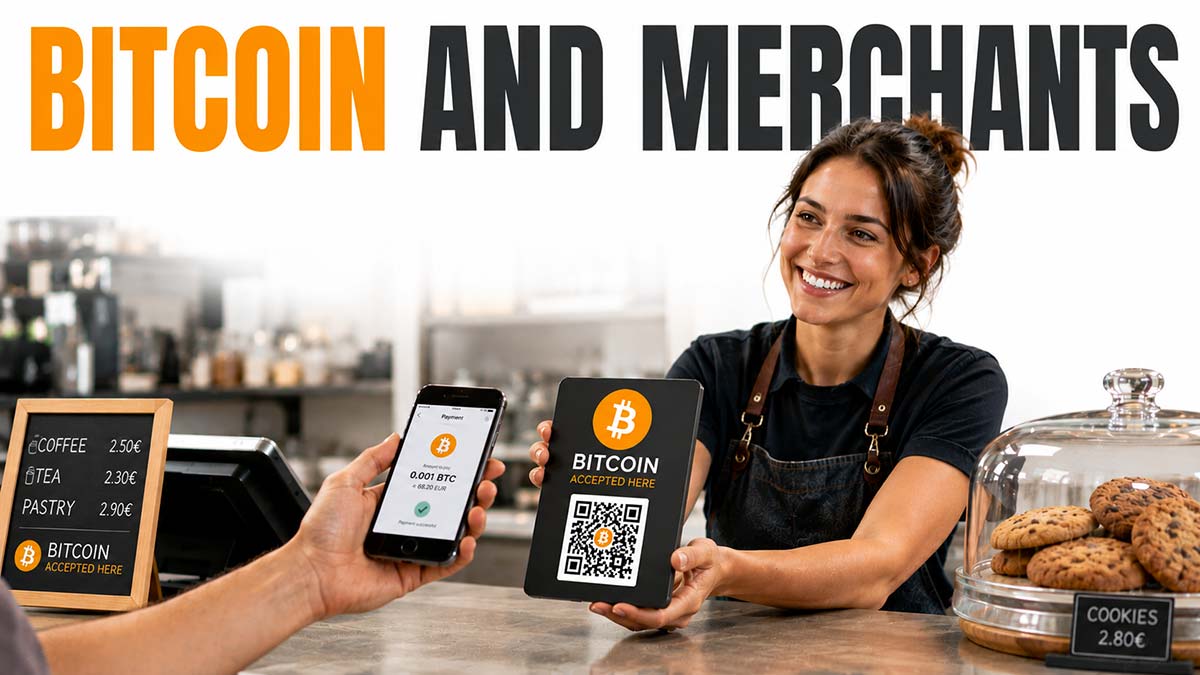
Accepting Bitcoin on the merchant side was long seen as a PR move. In 2026, it has become a serious operational choice in certain sectors : restaurants in tourist areas, international e-commerce, freelancers invoicing abroad. Lightning made it technically viable : two-second payment, one-sat fees, no card acquirer, no chargeback, no 48-hour bank transfer wait.
Four reasons drive opening up : near-zero acquisition costs (versus 1 to 2 % on cards), zero chargeback, instant payment without a banking intermediary, and access to an international clientele without FX friction. On top of that, some merchants choose to keep part of their revenue in bitcoin as an alternative treasury.
This article details the four reasons to accept, compares the technical solutions (self-hosted BTCPay Server, OpenNode, Strike, IBEX Pay), covers automatic conversion to EUR for those who do not want exposure, addresses the accounting and tax aspects in France, Switzerland, Germany and Italy, and exposes the pitfalls (unmanaged volatility, Lightning refund, routing issues).
Why accept Bitcoin: 4 concrete reasons
"To look modern" does not suffice to justify the time and attention integration requires. Four solid reasons exist in 2026, of which at least one speaks to the majority of merchants.
- Tap a growing Bitcoin clientele. In DACH/French-speaking Switzerland, ~250,000 people use Bitcoin daily and actively steer their purchases toward accepting merchants. The BTC Map acts as a Yelp for Bitcoiners. For a café, restaurant, hotel, gift shop, accepting Bitcoin = appearing on BTC Map = attracting a regular flow of customers who would not have walked in otherwise. Effect more visible in tourist zones (LuganoLugano (Plan ₿)Swiss city that launched a Bitcoin adoption programme in 2022 (tax payments, shops, events). The annual Plan B Forum has become a European fixture.See in the lexicon →, Zermatt, El SalvadorEl SalvadorFirst country to adopt Bitcoin as legal tender, in September 2021 under Nayib Bukele. Its status was amended in 2025 under IMF pressure.See in the lexicon →) than in residential areas.
- Eliminate chargebacks and bank acquirer fees. A Bitcoin payment is irreversible once confirmed (cf. confirmations article). No "90-day customer dispute" as with Visa/Mastercard, no forced product return after shipment. For merchants prone to chargebacks (e-commerce, digital services, ticketing), it is a major relief. Add: bank acquirer fees 1.5 to 3 % on cards vs 0.5 to 1 % on Bitcoin processor, or even 0 % on self-hosted BTCPay.
- Settle instantly across borders. A Japanese customer buys at 3 a.m. Swiss time. By card: bank wire 3-5 days after transaction, SWIFT fees, unfavourable Visa exchangeExchangeService that lets you buy, sell and swap cryptocurrencies against fiat money. Examples : Kraken, Coinbase, Bitstamp, Bitvavo. Most are custodial.See in the lexicon → rate. By Lightning: 2 seconds, 0.01 EUR fees, market spot exchange rate. Particularly relevant for online sellers with international clientele (artisans, trainers, digital services, marketplaces).
- Signal sovereign and innovative positioning. Displaying "Bitcoin accepted here" has become a brand signal in some sectors. The merchant showcasing BTCPay integration sends a message: independence from the banking system, technicality, alignment with a community that values financial sovereignty. Opposite to "we accept Apple Pay" which no longer distinguishes anyone. Strong marketing effect in B2B tech, premium restaurants, boutique hotels, indie bookstores.
Conversely, three false good reasons not to give yourself.
- "To speculate on Bitcoin going up." Holding received bitcoins hoping they appreciate is investing, not commercial acceptance. It mixes two ledgers and exposes the business to volatility (fiatFiat (fiat currency)State currency with legal tender status (euro, Swiss franc, dollar), issued by a central bank and not backed by a physical asset. By contrast, Bitcoin has an issuance capped at 21 million units, with no central issuer.See in the lexicon → revenue in euros or francs vs BTC treasury). If you want to invest, do it with your personal wealth, not the company cash flow. Auto-conversion to local currency is the sane path for most merchants.
- "Because it is free." No. Self-hosted BTCPay needs ~300 EUR hardware and ~30 min/month maintenance. A turnkey processor takes 0.5-1 %. Team training takes ~2 h. Not free, just cheaper and more sovereign than bank cards.
- "Because my customers really ask for it." To verifyDon't trust, verifyBitcoiner mantra. Trust no one (bank, government, exchange, influencer), verify on your own through your own node.See in the lexicon →. One request every 6 months does not justify the effort. Three requests per month yes. Track a counter for 3 months before deciding.
The 3 technical options to accept Bitcoin
Three families of solutions coexist in 2026, with a very different sovereignty/simplicity slider. The table below gives the overview, followed by detailed commentary.
| Option | Initial cost | Recurring fees | Sovereignty | Required skill | Target profile |
|---|---|---|---|---|---|
| Self-hosted BTCPay (UmbrelUmbrelEquivalent distribution for mini-PCs or Raspberry Pi, with a polished web interface and an app store (BTCPay, mempool.space, Sparrow Server, and so on).See in the lexicon →, Start9Start9 (StartOS)Umbrel alternative focused on sovereignty and privacy. More technically demanding, more rigorous on privacy.See in the lexicon →, raspiblitzRaspiBlitzReady-made software distribution that turns a Raspberry Pi into a Bitcoin and Lightning node. A pioneer of the genre, with an active German-speaking community.See in the lexicon →) | ~300 EUR hardware | 0 EUR/month | Maximum | Medium (2 h install, 30 min/month) | Mid-high volume, sovereignty-aware |
| Third-party hosted BTCPay (BTCPay Jungle, LunaNode, Voltage) | 0 EUR | 5 to 30 EUR/month | Good | Low (web config) | Start, low-mid volume |
| Turnkey processor (Strike, OpenNode, IBEX, NowPayments) | 0 EUR | 0.5 to 1 % per transaction | Low (KYCKYC (Know Your Customer)Mandatory identification procedure that regulated platforms apply to their users : ID document, proof of address, and so on.See in the lexicon →, dependence) | Very low (plug-in) | High-volume e-commerce, auto fiatFiat (fiat currency)State currency with legal tender status (euro, Swiss franc, dollar), issued by a central bank and not backed by a physical asset. By contrast, Bitcoin has an issuance capped at 21 million units, with no central issuer.See in the lexicon → conversion |
Three detailed clarifications on each option.
- Self-hosted BTCPay Server. Open-source software installed on a small computer (Raspberry PiRaspberry PiSmall credit-card-sized computer at a low price (60 to 100 EUR). Lets you run a Bitcoin node at home.See in the lexicon → 5 with 1 TB SSD, or mini-PCMini-PC (NUC)Small fanless computer such as Intel NUC, Beelink or Minisforum. More powerful than a Raspberry Pi, ideal for a serious node running Lightning and BTCPay.See in the lexicon → like Intel NUC) running in parallel a full Bitcoin nodeNodeComputer that runs the Bitcoin software and takes part in the network by validating blocks and transactions. A « full node » keeps a complete copy of the blockchain.See in the lexicon → (cf. node article) and a Lightning node. Turnkey distributions: Umbrel (easiest, nice web UI), Start9 (sovereignty focus, yearly audit), raspiblitz (pure open-source, CLI). Initial install ~2 h with 24 h of blockchainBlockchainA public, shared ledger that records every Bitcoin transaction in blocks linked together cryptographically. Each participant in the network keeps a copy.See in the lexicon → synchronisation in the background. Once running: merchant points their ERP/cashier at the local URL, generates invoices on demand, settles directly to their own walletWalletSoftware or device that manages your Bitcoin keys and lets you sign transactions. A wallet does not really « hold » your bitcoins, it holds the keys that prove you own them.See in the lexicon →. Long-term cost: 0 EUR fees, only electricity (~3 EUR/month) and maintenance (~30 min/month for updates).
- Third-party hosted BTCPay Server. The same BTCPay software runs on a rented server at a specialised provider (BTCPay Jungle, Voltage, LunaNode, Nodl, ServerWise). The merchant accesses their instance via a dedicated URL, configures their own wallet (bitcoins still arrive in their wallet, not the host's). Advantage: no hardware to manage, no blockchain sync, starts in 15 min. Drawback: the host sees invoices flow through (partial privacy), and if the host shuts down, you must migrate. Typical 2026 pricing: 5-30 EUR/month based on volume and options.
- Turnkey processors (centralised SaaS). Strike, OpenNode, IBEX, NowPayments, Coinbase Commerce. The merchant adds a few lines to the site, the SaaS handles it all: invoices, reception, automatic fiat conversion if asked (often by default), bank wire settlement daily or weekly. Fees 0.5 to 1 % per transaction. Mandatory merchant KYC. Structural drawbacks: bitcoins flow through the SaaS which can be seized, censor a merchant category (Coinbase Commerce cut some accounts in 2024), or default. Auto fiat conversion is so much the default that most merchants never receive bitcoins, only euros. It is convenience, not Bitcoin adoption.
Simple decision rule: start on third-party hosted BTCPay to validate interest without investing in hardware, migrate to self-hosted BTCPay once monthly volume passes ~3,000 EUR of Bitcoin received (hardware ROI reached in 6-12 months and sovereignty gained), use a turnkey processor only if you have a strong need for automatic fiat conversion with no available technical skill, accepting the sovereignty/dependence trade-offs.
Accounting and tax for received Bitcoin payments
Receiving Bitcoin as revenue raises two structuring questions: convert immediately to local currency or hold in BTC, and how to declare and keep the accounting ledgerLedger, Trezor, Coldcard, BitBoxMain hardware wallet brands. Ledger Nano S Plus / X (French, the best-seller), Trezor Model T (Czech, open source), Coldcard Mk4 (Canadian, ultra-secure, Bitcoin-only), BitBox02 (Swiss, open source).See in the lexicon →. The answers depend on company profile and local law.
Choice auto-conversion vs BTC holding.
- Auto-conversion to fiatFiat (fiat currency)State currency with legal tender status (euro, Swiss franc, dollar), issued by a central bank and not backed by a physical asset. By contrast, Bitcoin has an issuance capped at 21 million units, with no central issuer.See in the lexicon → at payment time. Recommended by default for 90 % of merchants. Money received in BTC is immediately converted to EUR/CHF/USD at the market spot rate, and settled to the merchant's bank account within 24-72 h. No volatility exposure. Compatible with classic fiat accounting. Possible via Strike, OpenNode, BTCPay + greenlight, or simply by manually selling BTC weekly on an exchangeExchangeService that lets you buy, sell and swap cryptocurrencies against fiat money. Examples : Kraken, Coinbase, Bitstamp, Bitvavo. Most are custodial.See in the lexicon →.
- Full or partial holding in BTC. For merchants who already have a Bitcoin asset strategy (convinced Bitcoiners, crypto-related sectors). Advantage: participate in potential appreciation. Drawback: volatility exposure (BTC can lose 30 % in a month), tax complications (separate investment vs activity declaration). Frequent compromise: convert 70-80 % to fiat for working capital, hold 20-30 % in BTC long-term.
Keeping the Bitcoin accounting ledger.
- For each received payment: export or record date and time (UTC), amount in BTC or sats, equivalent amount in local currency at day's rate, exchange rate used, transaction identifier (on-chain txid or Lightning invoice hashHashFunction that turns data of any size into a fixed-size fingerprint. The same input always yields the same output, but you cannot go back from output to input.See in the lexicon →), counterparty name if available.
- BTCPay Server automatically generates this exportable CSV ledger. Turnkey processors too (Strike, OpenNode customer interface, etc.). For a manual walletWalletSoftware or device that manages your Bitcoin keys and lets you sign transactions. A wallet does not really « hold » your bitcoins, it holds the keys that prove you own them.See in the lexicon →, keep a Google Sheet or Excel.
- Keep exports for at least 10 years for France, Switzerland, Germany, Italy (legal retention duration for company accounting records).
Tax: general 2026 rules (to verifyDon't trust, verifyBitcoiner mantra. Trust no one (bank, government, exchange, influencer), verify on your own through your own node.See in the lexicon → case by case with an accountant).
- France and Switzerland: Bitcoin received = revenue at day's rate, integrated into activity income (BIC for merchants, BNC for liberal professions in France). Later sale of BTC for fiat conversion = separate capital gainCapital gain, capital lossGain (or loss) realised when disposing of an asset: the difference between sale price and acquisition cost. Tax treatment varies by country; losses can often be offset against gains of the same year.See in the lexicon →, subject to digital-asset disposal capital-gains regime (Flat Tax 30 % in France for individuals, but BIC/IS regime if professional activity).
- Germany: Bitcoin received = activity income at day's rate. Later sale can benefit from exemption after 1 year holding for individuals (Section 23 EStG), but that rule does not apply if the company is GmbH/AG or if Bitcoin is treated as a business asset.
- Italy: Bitcoin received = ricavo at day's rate. Later conversion enters the cripto-attivitàCripto-attivitàItalian legal term (law 197/2022) for crypto assets, taxed at a 26 percent flat rate above an annual threshold of 2,000 EUR.See in the lexicon → tax regime (capital gains at 26 %, with exemption below 2,000 EUR annual gains).
- El SalvadorEl SalvadorFirst country to adopt Bitcoin as legal tender, in September 2021 under Nayib Bukele. Its status was amended in 2025 under IMF pressure.See in the lexicon →: Bitcoin is legal tender since 2021. Received = revenue at rate, without distinction from USD. No capital gain at sale.
Three cross-cutting good practices: have an accountant familiar with crypto-assets validate the approach, use a dedicated accounting tool (Koinly, CoinTracker, or BTCPay → accounting software APIAPI (Application Programming Interface)Interface that lets one program query another program or service. mempool.space exposes a public API for querying the chain.See in the lexicon → integration) to automate daily rate calculation, and declare even small volumes to avoid grey zones in case of audit.
Team training and cashier workflow
Technique alone is not enough. If the cashier team panics at every Bitcoin payment request, the system is useless. A 2-hour training and a simple memo are enough to start.
Typical team training programme.
- Concept in 10 minutes. Bitcoin = digital currency, not a bank card. Lightning = instant layer 2. Payment irreversible once confirmed. No bank validation, no chargeback, no PIN. The client scans a QR generated by the cashier.
- Cashier demo in 20 minutes. The trainer plays the customer with their phone, the team plays the cashier. Do 5 test payments (1 EUR, 5 EUR, 50 EUR, 500 EUR, failure simulation). See the QR appear, the scan, the confirmation sound, the "payment validated" button.
- Edge case handling in 30 minutes. What to do if: the customer has only an on-chain walletWalletSoftware or device that manages your Bitcoin keys and lets you sign transactions. A wallet does not really « hold » your bitcoins, it holds the keys that prove you own them.See in the lexicon → and wants to pay for a coffee (answer: politely refuse, propose card, explain Lightning to the customer for next time). What if: the transaction does not show after 30 sec in Lightning (answer: check cashier internet connection, wait 1 min, redo the transaction). What if: the merchant wants to know the day's received Bitcoin balance (answer: BTCPay interface on manager tablet, or processor tracking app).
- Security in 30 minutes. Never give cashier wallet access to a customer (never show the seed, never click a customer-sent link). On payment doubt (amount looks weird, missed confirmation sound), cancel and redo. Have the BTCPay technician or processor support number posted at the cashier.
- Laminated cashier memo in 30 minutes. An A5 laminated card next to the cashier tablet with: 4 payment steps (enter amount > generate QR > wait customer scan > confirm on cashier screen), how to open BTCPay if closed, who to call on bug, where to find the day's received Bitcoin balance.
Typical physical-shop cashier workflow in 5 steps.
- Order total entered into cashier as usual.
- "Bitcoin / Lightning" button tapped on the cashier tablet (BTCPay POS integration).
- QR generated and displayed on the tablet facing the customer.
- Customer scans with their phone, validates, payment broadcast.
- The cashier tablet emits a confirmation sound (or shows "paid"), the cashier thanks the customer, end of transaction.
Three traps to anticipate in training.
- The cashier who thinks it is instant even on-chain. Bitcoin on-chain takes 10 min minimum. Lightning takes 2 sec. The cashier must clearly distinguish. If the shop accepts both, plan a workflow for on-chain (generate QR, tell customer "I will prepare your product, come back in 10 min after confirmation").
- The customer who wants to pay a slightly different amount. In Lightning, BOLT11BOLT11Standard format for a Lightning invoice, as a character string or QR code. An invoice is single-use, with an amount and an expiry date.See in the lexicon → is fixed: amount cannot be modified after issuance. If customer wants to pay 20 EUR instead of 18 EUR (tip rounding), cancel the initial QR and generate a new one at 20 EUR. Training: show how to cancel an unpaid invoice.
- The customer who asks for a refund. On Bitcoin, you cannot cancel the customer's transaction. To refund, the merchant must make a new outgoing transaction to a Bitcoin addressBitcoin addressString of characters that identifies a destination for receiving bitcoins. Four main formats, starting with 1..., 3..., bc1q... or bc1p... (Taproot, the recommended format in 2026).See in the lexicon → the customer provides. Specific procedure to document in the memo.
Scaling by volume
The right solution depends on the expected Bitcoin payment volume. A neighbourhood bakery receiving 2 Bitcoin payments a week does not have the same needs as an e-commerce marketplace processing 500 per day. The table below maps choices against monthly volume.
| Monthly volume | Recommended solution | Year 1 total investment | Justification |
|---|---|---|---|
| 0 to 1,000 EUR | Third-party hosted BTCPay (5 EUR/month) | ~60 EUR/year | Volume too low to break even on self-hosted hardware. Sovereignty not urgent. |
| 1,000 to 5,000 EUR | Third-party hosted BTCPay (15 EUR/month) OR turnkey processor if fiatFiat (fiat currency)State currency with legal tender status (euro, Swiss franc, dollar), issued by a central bank and not backed by a physical asset. By contrast, Bitcoin has an issuance capped at 21 million units, with no central issuer.See in the lexicon → conversion mandatory | ~180 EUR/year | Validation stage, sovereignty margin still acceptable. |
| 5,000 to 20,000 EUR | Self-hosted BTCPay on UmbrelUmbrelEquivalent distribution for mini-PCs or Raspberry Pi, with a polished web interface and an app store (BTCPay, mempool.space, Sparrow Server, and so on).See in the lexicon → | ~300 EUR (one-shot hardware) then ~50 EUR/year electricity | Hardware ROI reached in 6-12 months. Sovereignty gained. Volume justifies maintenance time. |
| 20,000 to 100,000 EUR | Self-hosted BTCPay on dedicated mini-PCMini-PC (NUC)Small fanless computer such as Intel NUC, Beelink or Minisforum. More powerful than a Raspberry Pi, ideal for a serious node running Lightning and BTCPay.See in the lexicon → (Intel NUC) with redundancy backup | ~700 EUR (hardware + UPS + backup disk) then ~80 EUR/year | Critical volume, costly downtime. Invest in reliability. |
| 100,000+ EUR | Several redundant BTCPay nodes, multisigMultisig (multi-signature)Configuration where a transaction must be signed by several independent keys to be valid (for example 2 of 3). Reduces the risk that a single key theft causes loss of funds.See in the lexicon → for cold storageCold storageStoring bitcoins on an offline wallet that is not connected to the Internet. Maximum security for amounts you are not spending.See in the lexicon → of received funds | ~3,000 EUR + IT team integration | Serious professional volume. HA architecture, hot/cold segregation, security audits. |
Three typical 2026 transitions.
- Transition 1: from turnkey processor to hosted BTCPay. When the merchant realises they pay 1 % fees on volumes that would justify their own BTCPay. Migration in 2-3 days, real 80 % savings on fees.
- Transition 2: from hosted BTCPay to self-hosted BTCPay. When volume passes ~5,000 EUR/month and sovereignty becomes priority. Hardware breaks even in a few months, and the merchant gains in privacy (no more third party seeing transactions).
- Transition 3: from single hot walletHot walletWallet connected to the Internet (mobile, desktop or online). Convenient for small amounts and fast payments, but more exposed to attacks.See in the lexicon → to multisig hot/cold. When company Bitcoin balance exceeds ~50,000 EUR. At that level, keeping everything on the cashier walletWalletSoftware or device that manages your Bitcoin keys and lets you sign transactions. A wallet does not really « hold » your bitcoins, it holds the keys that prove you own them.See in the lexicon → permanently exposed is reckless. Set up a 2-of-3 multisig (cf. multisig article) with a cashier key for daily rotation and two cold storage keys for treasury.
Important note on volume peaks. During high season (Christmas for retail, summer for tourism), volume can triple in a few weeks. The solution's technical capacity must absorb peaks without degradation. Self-hosted BTCPay on Raspberry PiRaspberry PiSmall credit-card-sized computer at a low price (60 to 100 EUR). Lets you run a Bitcoin node at home.See in the lexicon → 5 handles ~10 payments/min, plenty for a physical shop. For e-commerce that may peak at 50 payments/min, switch to Intel NUC or dedicated server from the design stage.
Physical shop vs e-commerce, and 2026 feedback
Constraints differ between physical point of sale and online shop. Synthesis in 4 points, then field feedback.
Physical shop: POS tablet + modern cashier.
- 2026 standard solution: an Android or iOS tablet dedicated to the cashier, with BTCPay POS app installed. The tablet connects via Wi-Fi to the BTCPay instance (self-hosted or third-party hosted). QR generation < 1 sec.
- Modern cashier integration: LightSpeed, Square, SumUp, Lightspeed Retail offer in 2026 official BTCPay plugins or integrations via Zapier / webhook. The receipt includes Bitcoin payment as a normal payment.
- Mandatory bank card backup: if cashier internet drops, or BTCPay tablet bugs, switch to classic card payment without blocking the customer.
- External display: "Bitcoin accepted here" sticker on storefront, presence on BTC Map (free registration by any customer).
E-commerce: native plugin or custom integration.
- WooCommerce: official BTCPay plugin maintained by the BTCPay foundation. 30 min install, BTCPay → shop config in 1 h. Compatible with WordPress 6.x.
- Shopify: no native BTCPay support (Shopify Payments policy). Workaround via Coinbase Commerce or OpenNode plugin, which are turnkey processors. Sovereignty trade-off.
- Magento, PrestaShop: official BTCPay plugins available, similar to WooCommerce.
- Custom site: integration via BTCPay Server REST APIAPI (Application Programming Interface)Interface that lets one program query another program or service. mempool.space exposes a public API for querying the chain.See in the lexicon →, ~2-4 developer days. Full official documentation at docs.btcpayserver.org.
2026 merchant feedback, in 5 zones.
- LuganoLugano (Plan ₿)Swiss city that launched a Bitcoin adoption programme in 2022 (tax payments, shops, events). The annual Plan B Forum has become a European fixture.See in the lexicon → (Switzerland). ~400 active merchants since the municipal Plan ₿. Average Bitcoin volume 5-10 % of revenue depending on merchant. Mixed testimonials on volume ("less than expected but real"), positive on image and Bitcoin tourist attractiveness. Restaurants and hotels most profitable. Some negative cases: more complex accounting at first, team training underestimated.
- El Zonte (El SalvadorEl SalvadorFirst country to adopt Bitcoin as legal tender, in September 2021 under Nayib Bukele. Its status was amended in 2025 under IMF pressure.See in the lexicon →). ~80 % of town merchants accept Bitcoin via Chivo, Blink or BTCPay. Very real volume (often > 30 % of revenue in tourist season). It is the zone of the world where Bitcoin is most normalised in commerce. Bitcoin tourists specifically attracted. Emerging "Bitcoin tourism" economic model.
- Bedford-Stuyvesant, NYC. ~50 merchants (cafés, bookstores, hair salons) integrated in the Bitcoin BeachBitcoin BeachNickname for El Zonte in El Salvador, the first 100 percent Bitcoin monetary community (2019). Inspired the 2021 Bitcoin law.See in the lexicon → Brooklyn ecosystem. Low volume (~2-5 % of revenue) but very loyal community. Strong marketing effect in the African-American Bitcoin community. Social model as much as economic.
- Argentina (Buenos Aires and provinces). ~4,000 merchants directly accepting in 2026, plus ~15,000 indirectly via Strike/Belo that converts to pesos. Very high volume in the inflation context. Use case that exceeds ideology: it is practical, less risky than pesos, so people use it.
- Typical European e-commerce shop in 2026. WooCommerce site with BTCPay plugin. Bitcoin volume 1-3 % of revenue on average, 5-10 % for Bitcoin niche shops (hardware wallets, Bitcoin books, Bitcoin fashion). Average ticket 50-200 EUR. Marketing advantage often greater than direct financial advantage.
Synthesis: merchants who succeed with their Bitcoin integration share three traits. A clear motivation at start (sovereignty, image, clientele capture, anti-chargeback), not just "to try". Serious team training from the start. Clean accounting from the first payment, no accumulation of tax technical debt.
Disclaimer
Educational and informational content only: not investment, tax or legal advice. Bitcoin carries significant risks, including high volatility and the possible loss of invested capital. Each reader remains responsible for their decisions; when in doubt, consult a qualified professional in your jurisdiction.
Going further
Accepting Bitcoin as a merchant opens onto related topics. To dig into each brick:
- Paying with Bitcoin: the counterpart on the customer side, to know to understand the experience you offer.
- The Lightning Network: the layer 2 that makes daily merchant payment viable.
- Running your own Bitcoin node: the technical brick under self-hosted BTCPay.
- Bitcoin fees and mempool: what to know to manage BTC withdrawals from the shop to cold storageCold storageStoring bitcoins on an offline wallet that is not connected to the Internet. Maximum security for amounts you are not spending.See in the lexicon →.
To place merchant acceptance back in the global journey:
- Use Bitcoin guide: overview of daily Bitcoin life and the place of commerce in the ecosystem.
- Bitcoin multisig: advanced security for shops accumulating a significant BTC balance.