
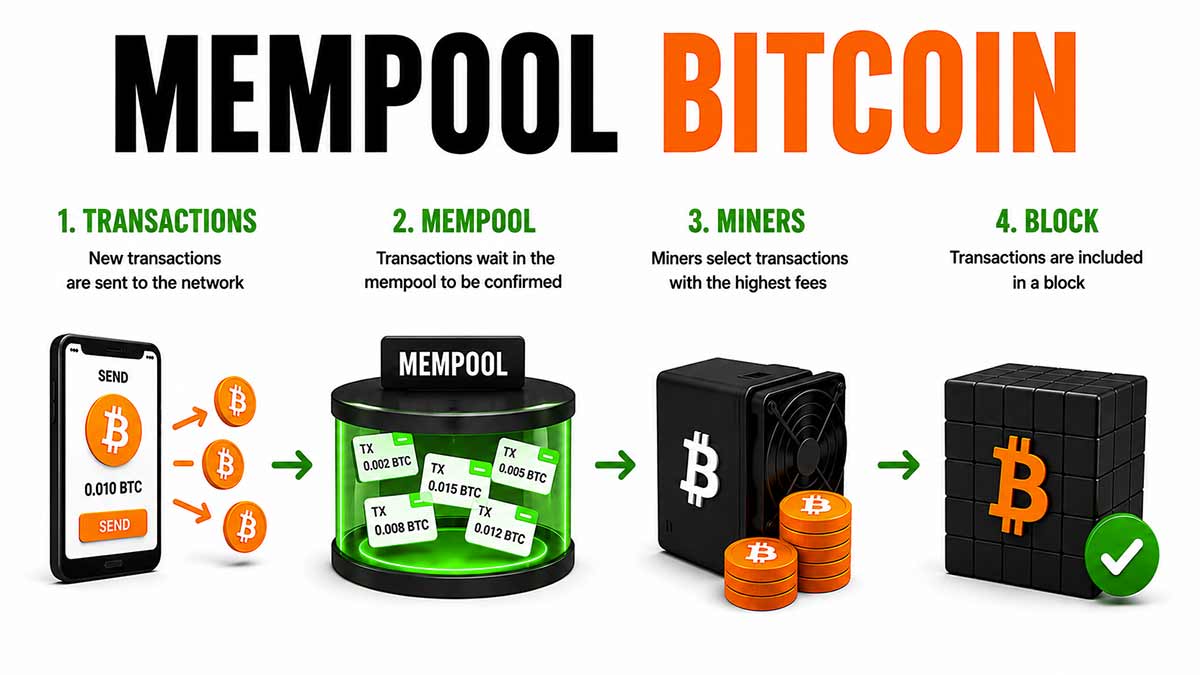
Each Bitcoin block holds about 1 MB of useful transactions, that is 2 000 to 3 000 transactions depending on their size. When 5 000 transactions want into the next block, miners take the 2 000 that pay the highest fees and let the others wait. It is a temporary auction for a fixed resource (block space), where transactions queue in a holding area called the mempoolMempoolWaiting area where Bitcoin transactions sit before being included in a block. The fuller the mempool, the higher the fees required.See in the lexicon →.
Direct consequence : Bitcoin fees are not a percentage of the amount, but a price in sats per byte (sat/vBsat/vB (satoshi per vbyte)Standard unit for expressing the Bitcoin fee rate. A typical transaction is 100 to 250 vB. At 5 sat/vB it costs 500 to 1,250 sats.See in the lexicon →) depending only on congestion. Sending 1 sat or sending 1 BTC costs the same if the transaction takes the same space. During a lull, you pay 1 sat/vB. During a peak (post-halvingHalvingScheduled event every 210,000 blocks (roughly every 4 years) that cuts the miner reward in half. This mechanism makes Bitcoin issuance decline towards the total cap of 21 million.See in the lexicon →, ETF launch, ordinalsOrdinals (inscriptions)Protocol (2023) that numbers each satoshi and allows inscribing data (images, text) directly on-chain via Tapscript. At the origin of the debate on block space usage.See in the lexicon → frenzy), you climb to 200 sat/vB or more.
This article explains how the mempool works, how to read mempool.spacemempool.spaceReference open-source Bitcoin explorer in 2026. Visualisation of blocks, fees and the mempool. Launched by Wiz and the mempool.space team.See in the lexicon → and its fee histogram, how to estimate a sufficient fee without overpaying, how to unstuck a transaction via RBFRBF (Replace-By-Fee)Mechanism that lets you replace an unconfirmed transaction with a new one carrying higher fees, in order to speed it up.See in the lexicon → or CPFPCPFP (Child Pays For Parent)Alternative to RBF where a high-fee child transaction pulls its stuck parent out of the mempool.See in the lexicon →, and how Lightning lets daily payments escape this market entirely.
The mempool: the blockchain's auction market
The mempoolMempoolWaiting area where Bitcoin transactions sit before being included in a block. The fuller the mempool, the higher the fees required.See in the lexicon → is the waiting room for unconfirmed transactions. When you broadcast a transaction, it enters the mempool of every Bitcoin nodeNodeComputer that runs the Bitcoin software and takes part in the network by validating blocks and transactions. A « full node » keeps a complete copy of the blockchain.See in the lexicon → receiving it. As long as no minerMinerComputer or farm of computers that solves the cryptographic puzzle required to add a new block to the blockchain, in exchange for a bitcoin reward.See in the lexicon → has included it in a block, it stays there, pending.
Three properties to know not to get false ideas.
- The mempool is not a single object on the blockchainBlockchainA public, shared ledger that records every Bitcoin transaction in blocks linked together cryptographically. Each participant in the network keeps a copy.See in the lexicon →. Each node has its own mempool, synchronised by the gossip protocol. In practice, public node mempools converge within seconds to the same view. But technically there are ~18,000 in parallel, one per public node.
- Miners cherry-pick from the mempool. When a miner finds a valid block, they pick the ~2,500 transactions maximising fee revenue. Not by arrival order, not by amount, not by author: by descending sat/vbyte. A transaction paying 50 sat/vbyte goes before one paying 5 sat/vbyte, even if it arrived in the mempool 24 h later.
- Transactions expire from the mempool. If a transaction sat too long without inclusion (typically 14 days), nodes drop it. Funds are not lost: they were just suspended, and become spendable again (from the origin). But the sender must rebroadcast a new transaction.
The resulting auction mechanic is clear-cut. At any instant, the mempool holds X megabytes of transactions. The next block will take ~1 MB. If X = 2 MB, half must wait for the next block. If X = 20 MB, there is a real queue, and you must pay dearly to jump ahead.
Practical consequence in 4 points.
- Fees swing constantly. The mempool drains at every block (every 10 min on average) and fills back up with new transactions. Depending on inflow, the fees needed for fast inclusion vary continuously.
- Surcharge during peaks. A massive exchangeExchangeService that lets you buy, sell and swap cryptocurrencies against fiat money. Examples : Kraken, Coinbase, Bitstamp, Bitvavo. Most are custodial.See in the lexicon → sell-off (exchanges move their UTXOs), an OrdinalsOrdinals (inscriptions)Protocol (2023) that numbers each satoshi and allows inscribing data (images, text) directly on-chain via Tapscript. At the origin of the debate on block space usage.See in the lexicon → inscription rush (each inscription is a transaction), a geopolitical event: demand spikes and fees with it.
- Bargain fees on weekend nights. Bitcoin activity drops on Saturday evenings / Sunday mornings (European time) and fees too. Ideal time for patient operations: UTXOUTXO (Unspent Transaction Output)« Chunk » of bitcoin received and not yet spent. A wallet does not have a single balance, it has a collection of UTXOs whose sum makes up the balance.See in the lexicon → consolidationConsolidation (UTXO batching)Merging several small UTXOs into one during a low-fee period, to avoid paying dearly when spending them later. A common wallet management practice.See in the lexicon →, paper-walletWalletSoftware or device that manages your Bitcoin keys and lets you sign transactions. A wallet does not really « hold » your bitcoins, it holds the keys that prove you own them.See in the lexicon → sweep, move to cold storageCold storageStoring bitcoins on an offline wallet that is not connected to the Internet. Maximum security for amounts you are not spending.See in the lexicon →.
- No manipulation possible. No single actor controls fees. It is a true market: supply is blockchain throughput (fixed), demand is transaction flow (variable), the equilibrium price emerges.
Sat per vbyte: the reference unit
Any discussion about Bitcoin fees revolves around one unit: sat/vbyte, satoshis per virtual byte. Understanding this unit unlocks reading mempool.spacemempool.spaceReference open-source Bitcoin explorer in 2026. Visualisation of blocks, fees and the mempool. Launched by Wiz and the mempool.space team.See in the lexicon →, wallets and estimators.
Mechanic in three points.
- A transaction has a size in vbytes. The "v" comes from "virtual": since SegWitSegWit (Segregated Witness)Upgrade activated in 2017 that separates signature data from the rest of the transaction. Lowered fees and paved the way for Lightning Network.See in the lexicon → (2017), a transaction's effective size is computed differently per part (signatures count for less). 2026 orders of magnitude: a simple transaction with 1 input and 2 outputs in TaprootTaprootMajor Bitcoin upgrade activated in November 2021 (BIP 341). Brings more privacy, scripting flexibility and the efficiency of Schnorr signatures.See in the lexicon → weighs ~110 vbytes. With 5 inputs (consolidationConsolidation (UTXO batching)Merging several small UTXOs into one during a low-fee period, to avoid paying dearly when spending them later. A common wallet management practice.See in the lexicon →), ~250 vbytes. With 10 inputs and 20 outputs (enterprise batch), ~1,500 vbytes.
- Fees are in sat/vbyte. You pick (or the walletWalletSoftware or device that manages your Bitcoin keys and lets you sign transactions. A wallet does not really « hold » your bitcoins, it holds the keys that prove you own them.See in the lexicon → picks) a rate in sat/vbyte. Multiplying that rate by the vbyte size gives total fees. A 200-vbyte transaction at 10 sat/vbyte costs 2,000 sats. At 50 sat/vbyte, it costs 10,000 sats.
- Miners sort by descending sat/vbyte. The rate determines inclusion priority, not total fee amount. A small transaction paying 100 sats at 50 sat/vbyte goes before a big one paying 10,000 sats at 5 sat/vbyte, because per byte, the small one is more profitable for the minerMinerComputer or farm of computers that solves the cryptographic puzzle required to add a new block to the blockchain, in exchange for a bitcoin reward.See in the lexicon →.
Three useful practical consequences to remember.
- A simple transaction is cheaper than a consolidation. Sending a single UTXOUTXO (Unspent Transaction Output)« Chunk » of bitcoin received and not yet spent. A wallet does not have a single balance, it has a collection of UTXOs whose sum makes up the balance.See in the lexicon → costs ~110 vbytes. Consolidating 50 UTXOs into a single output costs ~5,000 vbytes. Same sat/vbyte rate, but 50 times the absolute cost. That is why you consolidate UTXOs in calm periods.
- Address format matters. A Taproot bc1p... address generates smaller transactions than a legacy 1... for the same operation. Saving ~10 to 15 % in vbytes depending on the case. See the send and receive Bitcoin article for details.
- Estimators output sat/vbyte. When mempool.space shows "next block: 25 sat/vbyte", it means a transaction at 25 sat/vbyte or above has good odds of being mined within the next 10 minutes. A transaction at 24 sat/vbyte will wait for the block after.
Important note: the minimum technically viable sat/vbyte is 1. Bitcoin CoreBitcoin CoreReference implementation of the Bitcoin software, written in C++ and maintained by an open-source community. This is the software that most nodes run.See in the lexicon → refuses to relay transactions below 1 sat/vbyte (`minRelayTxFee` parameter by default). So even in a fully empty mempoolMempoolWaiting area where Bitcoin transactions sit before being included in a block. The fuller the mempool, the higher the fees required.See in the lexicon →, you will pay at minimum ~110 sats (~0.03 EUR at 2026 rate) for a simple transaction. That is the absolute floor.
The 4 fee regimes observed in 2026
Cross-referencing mempool.spacemempool.spaceReference open-source Bitcoin explorer in 2026. Visualisation of blocks, fees and the mempool. Launched by Wiz and the mempool.space team.See in the lexicon → data over 12 months in 2026, four operating regimes emerge. Knowing their frequency and intensity helps plan operations.
| Regime | Typical sat/vbyte | Simple transaction cost | 2026 frequency | When to use |
|---|---|---|---|---|
| Calm | 1 to 5 | 0.03 to 0.15 EUR | 2 to 4 % of time | ConsolidationConsolidation (UTXO batching)Merging several small UTXOs into one during a low-fee period, to avoid paying dearly when spending them later. A common wallet management practice.See in the lexicon →, sweep, patient operations |
| Standard | 10 to 30 | 0.30 to 1.00 EUR | 60 to 70 % of time | Routine operations, no absolute urgency |
| Tight | 50 to 150 | 1.50 to 5.00 EUR | 15 to 25 % of time | If urgent: pay; otherwise postpone |
| Saturated | 200 to 1,000+ | 7 to 50 EUR | 1 to 3 % of time | Postpone or switch to Lightning |
Three recurring 2026 patterns useful to anticipate.
- Weekly cycle. Peak activity Tuesday to Thursday 9 a.m.-6 p.m. European time (overlapping US and EU office hours). Minimal activity Saturday evening 10 p.m. through Sunday morning 8 a.m. For patient operations, waiting for the Saturday-to-Sunday night divides fees by 5 to 10 versus Tuesday noon.
- OrdinalsOrdinals (inscriptions)Protocol (2023) that numbers each satoshi and allows inscribing data (images, text) directly on-chain via Tapscript. At the origin of the debate on block space usage.See in the lexicon → and inscriptions peaks. When a new Ordinals or Runes inscription project drops, the mempoolMempoolWaiting area where Bitcoin transactions sit before being included in a block. The fuller the mempool, the higher the fees required.See in the lexicon → saturates within minutes. Fees jumping from 15 to 500 sat/vbyte. Typical peak duration: 2 to 6 hours. If you are not in the project, wait it out.
- ExchangeExchangeService that lets you buy, sell and swap cryptocurrencies against fiat money. Examples : Kraken, Coinbase, Bitstamp, Bitvavo. Most are custodial.See in the lexicon →-driven peaks. Large exchanges (Binance, Kraken, Coinbase) move their hot UTXOs to cold storageCold storageStoring bitcoins on an offline wallet that is not connected to the Internet. Maximum security for amounts you are not spending.See in the lexicon → in gigantic batches (sometimes 100,000 UTXOs in one transaction). Those operations saturate the mempool for hours. Mempool.space colours those big batches in purple, eye-catching.
Four practical strategies based on waiting tolerance.
- Urgent operation (on-chain merchant payment, urgent withdrawal). Pick the walletWalletSoftware or device that manages your Bitcoin keys and lets you sign transactions. A wallet does not really « hold » your bitcoins, it holds the keys that prove you own them.See in the lexicon →'s "next block" level, ~1.5x to 2x the mempool median rate. Confirmation in 10 minutes, certain.
- Standard operation (sending to a friend, paying a non-urgent invoice). "3 blocks" or "standard" level, ~mempool median rate. Average confirmation in 30 minutes, reasonable fees.
- Patient operation (consolidation, sweeping an old wallet, transfer to cold storage). "Economic" level or manual entry at 1 sat/vbyte if calm mempool, 3 to 5 sat/vbyte otherwise. Confirmation in 2 to 24 hours, minimised cost.
- Non-urgent operation (yearly donation, asset move). Actively wait for the right moment. Watch mempool.space for a few days, act when mempool is below 5 MB and median rate under 10 sat/vbyte. Potential 80 % saving versus peak-time sending.
Reading mempool.space efficiently
Mempool.spacemempool.spaceReference open-source Bitcoin explorer in 2026. Visualisation of blocks, fees and the mempool. Launched by Wiz and the mempool.space team.See in the lexicon → became in 2026 the reference dashboard to assess fees before sending. It exists in public form (mempool.space) and as self-hosted on a personal nodeNodeComputer that runs the Bitcoin software and takes part in the network by validating blocks and transactions. A « full node » keeps a complete copy of the blockchain.See in the lexicon → (cf. Bitcoin node article). Four interface zones to know how to read.
- Upcoming blocks (top right). Three coloured blocks numbered "next block", "1 block", "2 blocks". Each shows a sat/vbyte figure. That figure is the rate you must pay to be included in that block. Typical standard 2026 example: next block = 25 sat/vbyte, 1 block = 18 sat/vbyte, 2 blocks = 12 sat/vbyte. The more you wait, the less you pay.
- MempoolMempoolWaiting area where Bitcoin transactions sit before being included in a block. The fuller the mempool, the higher the fees required.See in the lexicon → graph (center, animated colours). Visually represents the volume of pending transactions by sat/vbyte tranche. High-sat/vbyte transactions sit on top (red-yellow), low-sat/vbyte at the bottom (green-blue). In calm periods, the graph is small (under 5 MB). In tight periods, it swells (20 MB and beyond).
- Recent blocks (bottom right). The 10 most recently mined blocks, each with median fee (in sat/vbyte) and size. Lets you see the trend of recent hours: if the last 10 blocks show 8, 10, 12, 18, 25, 35, 45 sat/vbyte, you are on the rise and should not delay.
- Top counters. Global hashHashFunction that turns data of any size into a fixed-size fingerprint. The same input always yields the same output, but you cannot go back from output to input.See in the lexicon → rate, next difficulty adjustmentDifficulty adjustmentAutomatic recalibration every 2016 blocks (about 2 weeks) to keep one block every 10 minutes on average, whatever the current hashrate.See in the lexicon →, next halvingHalvingScheduled event every 210,000 blocks (roughly every 4 years) that cuts the miner reward in half. This mechanism makes Bitcoin issuance decline towards the total cap of 21 million.See in the lexicon → (days estimate). Handy for macro Bitcoin context.
Three practical operational uses.
- Assess before sending. Open mempool.space 30 seconds before clicking "send". Look at next block or 3-block sat/vbyte depending on urgency, check your walletWalletSoftware or device that manages your Bitcoin keys and lets you sign transactions. A wallet does not really « hold » your bitcoins, it holds the keys that prove you own them.See in the lexicon → proposes a coherent rate. If your wallet suggests 100 sat/vbyte while mempool.space shows 20 sat/vbyte is enough, adjust manually and save 80 %.
- Pick the right moment for patient operations. Watch mempool.space for a few days to spot calm windows. Schedule consolidations for Sunday night, or wait for a post-OrdinalsOrdinals (inscriptions)Protocol (2023) that numbers each satoshi and allows inscribing data (images, text) directly on-chain via Tapscript. At the origin of the debate on block space usage.See in the lexicon →-peak lull.
- Track a pending transaction. Paste the txid in the search bar. The page shows the status (mempool or block X), fees paid, queue position. If the transaction is below the upcoming-blocks threshold, consider RBFRBF (Replace-By-Fee)Mechanism that lets you replace an unconfirmed transaction with a new one carrying higher fees, in order to speed it up.See in the lexicon → or CPFPCPFP (Child Pays For Parent)Alternative to RBF where a high-fee child transaction pulls its stuck parent out of the mempool.See in the lexicon →.
One practical tip: install the mempool.space app on mobile. Push notifications when sat/vbyte drops below a custom threshold, alerts on events (Ordinals rush, difficulty adjustment). Free tool, no registration, syncs with your personal node if you have one.
RBF and CPFP: rescuing a stuck transaction
You sent a transaction at 5 sat/vbyte yesterday, and the mempoolMempoolWaiting area where Bitcoin transactions sit before being included in a block. The fuller the mempool, the higher the fees required.See in the lexicon → has since become tight: it now takes 30 sat/vbyte to get through. Your transaction is "stuck" in queue. Two tools let you unblock it without abandoning the funds.
RBFRBF (Replace-By-Fee)Mechanism that lets you replace an unconfirmed transaction with a new one carrying higher fees, in order to speed it up.See in the lexicon → (Replace-by-Fee). Official Bitcoin mechanism since 2016. If you enable the RBF flag at send time (default on Sparrow, Electrum, BlueWallet, Phoenix since 2023), you can rebroadcast the same transaction with higher fees. Nodes replace the old with the new in their mempool, and miners take the one paying the most.
- Open Sparrow or Electrum, load the sending walletWalletSoftware or device that manages your Bitcoin keys and lets you sign transactions. A wallet does not really « hold » your bitcoins, it holds the keys that prove you own them.See in the lexicon →.
- Transactions tab, pick the stuck transaction (status "unconfirmed").
- Right-click, "Bump fee" or "Increase fee".
- Enter the new sat/vbyte rate (e.g. 35 sat/vbyte if the mempool wants 30).
- Sign the new version. Broadcast. The stuck transaction is replaced.
- Surcharge: the difference between old and new rate. For a 200-vbyte transaction going from 5 to 35 sat/vbyte, that is ~6,000 extra sats (~2 EUR).
CPFPCPFP (Child Pays For Parent)Alternative to RBF where a high-fee child transaction pulls its stuck parent out of the mempool.See in the lexicon → (Child-Pays-for-Parent). Fallback when RBF was not enabled on the original transaction (rare in 2026, but happens with old wallets or less-progressive exchanges). The idea: send a new transaction spending an unconfirmed output of the stuck transaction, with very high fees. Miners must confirm the parent transaction to include the child: they cannot separate them.
- Identify an output of the stuck transaction pointing to one of your addresses (typically the change returned to your change address).
- Build a new Sparrow or Electrum transaction, manually selecting that unconfirmed output as input.
- Send to another of your addresses, with aggressive fees (e.g. 80 sat/vbyte if the mempool wants 30).
- Broadcast. Miners see the parent+child combo profitable and mine both in the next block.
- Surcharge: the child's fees, which must offset the parent's deficit. Compute by hand or via Sparrow's built-in CPFP mode.
Three pitfalls to know.
- RBF must be enabled at initial send. If you disabled the RBF flag (or used an old wallet that does not support it), no RBF rescue is possible. Check your wallets enable RBF by default.
- CPFP needs an output to yourself. If the stuck transaction is a pure send to a third party and you got no change, you cannot CPFP from the sender side. The recipient can (if they agree) on their unconfirmed received output.
- Some exchanges do not tolerate RBF. If you pay an exchangeExchangeService that lets you buy, sell and swap cryptocurrencies against fiat money. Examples : Kraken, Coinbase, Bitstamp, Bitvavo. Most are custodial.See in the lexicon → with RBF enabled, some refuse to credit until the transaction is confirmed, fearing double-spend. Check the exchange policy.
A transaction is rarely lost over fees. With RBF or CPFP, you recover nearly every stuck case. See the recovering lost bitcoins article for advanced details and edge cases.
On-chain vs Lightning vs exchanges: what real fees
The word "fees" covers very different realities depending on the layer used. This table summarises real 2026 fees across 4 typical scenarios.
| Scenario | On-chain | Lightning | ExchangeExchangeService that lets you buy, sell and swap cryptocurrencies against fiat money. Examples : Kraken, Coinbase, Bitstamp, Bitvavo. Most are custodial.See in the lexicon → withdrawal |
|---|---|---|---|
| Paying a 4 EUR coffee | 0.30 to 5 EUR (network fees) | 0.001 to 0.01 EUR | Not applicable |
| Sending 1,000 EUR to a friend | 0.30 to 5 EUR (network fees) | 0.01 to 0.1 EUR if capacity | 2 to 15 EUR + network fees |
| Withdrawing 10,000 EUR from an exchange | Included in exchange fees | Often unavailable | 5 to 25 EUR + network fees |
| Consolidating 50 UTXOs | 10 to 100 EUR (mempoolMempoolWaiting area where Bitcoin transactions sit before being included in a block. The fuller the mempool, the higher the fees required.See in the lexicon →-dependent) | Not applicable | Not applicable |
Four practical observations on these differences.
- Lightning wins by 100 to 1,000x on small payments. For amounts up to 1,000 EUR, Lightning crushes on-chain by orders of magnitude in fees. For a 4 EUR coffee, no contest. For 1,000 EUR, Lightning still preferable if you have channel capacity.
- On-chain takes over above ~1,500 EUR. Lightning channels have limited capacity. Beyond, MPPMPP (Multi-Path Payment)Lightning payment split across several simultaneous paths, recombined on arrival. Allows paying amounts larger than the capacity of a single channel.See in the lexicon → splitting or fallback on-chain. Typical on-chain fees for a 5,000 EUR send: 1 to 5 EUR, negligible as a percentage.
- Exchanges double-charge. Operator fee (typically 5 to 25 EUR per withdrawal, amount-independent) + actual network fee. So withdrawing 100 EUR costs the same in fees as withdrawing 10,000 EUR. Strategy: withdraw in large infrequent batches to amortise.
- Seasonal on-chain consolidations save long-term. Holding 50 small UTXOs multiplies the size of future transactions. Consolidating into 1 or 2 UTXOs in calm periods costs 10 EUR in fees but saves 200 EUR in fees over 5 years of use.
Three best practices to minimise fees in 2026.
- Always shift to Lightning if possible. For any daily payment under 1,500 EUR, Lightning is unbeatable. Keep 100 to 500 EUR on Phoenix or Muun, top up once a month.
- Pick the moment for on-chain sending. For patient sends, mempool.spacemempool.spaceReference open-source Bitcoin explorer in 2026. Visualisation of blocks, fees and the mempool. Launched by Wiz and the mempool.space team.See in the lexicon → on Sunday morning. Saving 50 to 80 % on 1 transaction a month adds up.
- Optimise exchange withdrawals. Rather than withdrawing 100 EUR weekly (~25 EUR cumulative fees), withdraw 400 EUR monthly (~7 EUR fees). Quick math, immediate net gain.
Disclaimer
Educational and informational content only: not investment, tax or legal advice. Bitcoin carries significant risks, including high volatility and the possible loss of invested capital. Each reader remains responsible for their decisions; when in doubt, consult a qualified professional in your jurisdiction.
Going further
Understanding Bitcoin fees opens up related topics. To dig into each brick:
- Sending and receiving Bitcoin: the step-by-step mechanics where fees apply.
- The Lightning Network: why Lightning makes on-chain fees nearly irrelevant for daily life.
- Recovering lost bitcoins: if a stuck transaction refuses RBFRBF (Replace-By-Fee)Mechanism that lets you replace an unconfirmed transaction with a new one carrying higher fees, in order to speed it up.See in the lexicon →/CPFPCPFP (Child Pays For Parent)Alternative to RBF where a high-fee child transaction pulls its stuck parent out of the mempool.See in the lexicon →, the full article on edge cases.
- Running your own Bitcoin node: self-host mempool.spacemempool.spaceReference open-source Bitcoin explorer in 2026. Visualisation of blocks, fees and the mempool. Launched by Wiz and the mempool.space team.See in the lexicon → for private locally-synced data.
To place fees back in the global journey:
- Use Bitcoin guide: overview of daily Bitcoin life where fees are a daily parameter.
- Store Bitcoin guide: choice of asset UTXOs and infrequent consolidationConsolidation (UTXO batching)Merging several small UTXOs into one during a low-fee period, to avoid paying dearly when spending them later. A common wallet management practice.See in the lexicon → strategies.