
A 4.50 EUR coffee shows up as 4 500 sats on a Phoenix walletWalletSoftware or device that manages your Bitcoin keys and lets you sign transactions. A wallet does not really « hold » your bitcoins, it holds the keys that prove you own them.See in the lexicon → and 0.000045 BTC on a Sparrow wallet. Same exact amount, but one speaks plainly, the other demands mental arithmetic. This unit difference, trivial on the surface, structures the whole daily Bitcoin experience : depending on the display, you understand what you are doing or you do not.
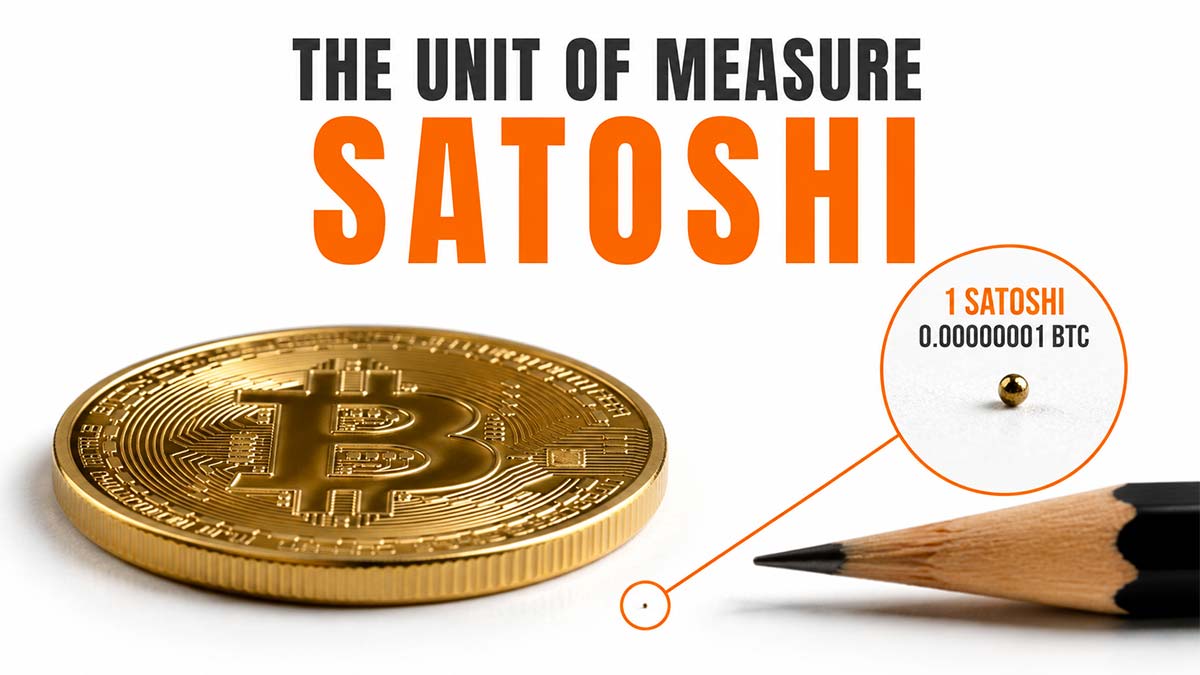
Bitcoin has a maximum supply of 21 million21 millionMaximum number of bitcoins that will ever exist, hard-coded in the protocol. This programmed scarcity is a founding feature. The last sat will be mined around the year 2140.See in the lexicon → units, set in the protocol. As demand grows, BTC becomes too large a unit for everyday use. The satoshiSatoshi (sat)The smallest unit of bitcoin. 1 BTC = 100 million satoshis. Named after the creator. In 2026, talking in sats becomes common as the price of one BTC rises.See in the lexicon →, named after the creator, is the smallest division : 1 BTC = 100 million sats. By 2026, reasoning in sats has become the norm for daily payments and the community has made it an identity marker ("stack satsStack satsAccumulating satoshis over time. A classic HODL mantra.See in the lexicon →").
This article explains why 100 million sats per BTC rather than another split, presents the 5 possible units (BTC, mBTC, μBTC, sat, msat on Lightning), provides a mental EUR/sats conversion table at 9 steps, exposes 5 BTC/sats confusion traps when sending, and tells the history of the satoshi name (proposed by ribuck in 2010) and the ₿ glyph (Unicode U+20BF).
Why 100 million sats per bitcoin
Splitting a bitcoin into 100 million satoshis is not a community arbitrary choice. It is written in the Bitcoin protocol itself since block 0 in January 2009. Satoshi NakamotoSatoshi NakamotoPseudonym of the creator (or collective) behind Bitcoin. Active on forums from 2008 to 2011, then vanished without revealing any identity. Holds roughly 1.1 million BTC that have never moved.See in the lexicon → planned 8 decimals from design. Three technical reasons justify the choice.
- Compatibility with programmed scarcity. Bitcoin has a fixed max supply of 21 million21 millionMaximum number of bitcoins that will ever exist, hard-coded in the protocol. This programmed scarcity is a founding feature. The last sat will be mined around the year 2140.See in the lexicon → units. If the entire world economy (~100 trillion EUR GDP in 2026) were one day to adopt Bitcoin as a reference unit of account, you would need to represent very small fractions. With 8 decimals, you can represent ~21 × 10^14 elementary units (sats). Plenty enough to serve as payment money even with BTC price in the millions of EUR.
- Protocol compactness. More decimals = more bits per amount in every transaction = heavier blocks. SatoshiSatoshi (sat)The smallest unit of bitcoin. 1 BTC = 100 million satoshis. Named after the creator. In 2026, talking in sats becomes common as the price of one BTC rises.See in the lexicon → picked 8 decimals as a compromise between useful granularity and compactness. At the time (2009), with BTC near zero, no practical urgency to go lower. The 8 decimals stayed and still hold.
- Integer type internally. In Bitcoin CoreBitcoin CoreReference implementation of the Bitcoin software, written in C++ and maintained by an open-source community. This is the software that most nodes run.See in the lexicon → code, all amounts are stored in satoshis as 64-bit integers, never in BTC as a float. This avoids catastrophic rounding errors that floats would cause (the famous 0.1 + 0.2 = 0.30000000000000004 in computing). "BTC" is just a walletWalletSoftware or device that manages your Bitcoin keys and lets you sign transactions. A wallet does not really « hold » your bitcoins, it holds the keys that prove you own them.See in the lexicon → display layer, the protocol only knows sats.
Practical consequences of that architecture.
- Everything is precise to the sat. A 12,345,678 sat transaction is exact, no rounding ambiguity. Same for fees: paying 23 sat/vbyte on a 192-vbyte transaction costs exactly 4,416 sats, calculation reproducible everywhere.
- No sat fraction. There is no "0.5 sat". It is the indivisible unit. (Lightning NetworkLightning NetworkSecond-layer payment network on top of Bitcoin. Enables near-instant and near-free payments through channels opened between users.See in the lexicon → introduces the millisat = 1/1,000 sat for internal routing math, but millisats never leave Lightning: any on-chain settlement is rounded to the sat.)
- Hard cap of sats. 21 million × 100 million = 2.1 × 10^15 sats max. Compared to 1.5 × 10^14 dollars in global circulation in 2026: Bitcoin has about 14 times more elementary units than all dollars combined, comfortable margin to serve as money.
Anecdote: the first public mention of "satoshi" as the unit name does not come from Satoshi Nakamoto himself, but from a Bitcointalk forum user named ribuck in November 2010 (thread "More divisibility required - move the decimal point"). Satoshi Nakamoto, who answered regularly on the forum at the time, never commented on the naming. The community tacitly adopted it and usage took hold without official validation. Detail very much in the Bitcoin decentralised spirit.
The Bitcoin units table
Five units coexist in Bitcoin documentation, but only two really count in daily use: sat and BTC. The table below gives the overview for general culture.
| Unit | Symbol | Value in sats | Value in BTC | 2026 usage |
|---|---|---|---|---|
| satoshiSatoshi (sat)The smallest unit of bitcoin. 1 BTC = 100 million satoshis. Named after the creator. In 2026, talking in sats becomes common as the price of one BTC rises.See in the lexicon → | sat or s | 1 | 0.00000001 | Daily reference for Lightning and small payments |
| finney | (rare) | 1,000 | 0.00001000 | Almost unused, homage to Hal Finney |
| microbitcoin (bit) | µBTC or bit | 100 | 0.00000100 | Almost unused in 2026 |
| millibitcoin | mBTC | 100,000 | 0.00100000 | Marginal, sometimes technical exchanges |
| bitcoin | BTC or ₿ | 100,000,000 | 1.00000000 | Wealth and large amounts reference |
Three useful comments on this table.
- Sat dominates for small amounts and Lightning, BTC dominates for wealth and investment. In 2026, it is the de facto convention. Phoenix displays in sats by default. Sparrow displays in BTC by default. LedgerLedger, Trezor, Coldcard, BitBoxMain hardware wallet brands. Ledger Nano S Plus / X (French, the best-seller), Trezor Model T (Czech, open source), Coldcard Mk4 (Canadian, ultra-secure, Bitcoin-only), BitBox02 (Swiss, open source).See in the lexicon → Live lets you choose. This duality reflects two real uses: paying for coffee (sats) vs managing a 50,000 EUR treasury (BTC). No wrong choice, just different context.
- Finney, µBTC, mBTC are historical leftovers. Finney (1,000 sats) honours Hal Finney, first recipient of a Bitcoin transaction from Satoshi in 2009. The bit (µBTC, 100 sats) had ephemeral popularity around 2014 when some thought it would emerge as the "easy" unit between sat and BTC. mBTC (100,000 sats) remains used on a few technical exchangeExchangeService that lets you buy, sell and swap cryptocurrencies against fiat money. Examples : Kraken, Coinbase, Bitstamp, Bitvavo. Most are custodial.See in the lexicon → interfaces. None has broken through against sat and BTC.
- The ₿ symbol for BTC is an official Unicode character. Character U+20BF "BITCOIN SIGN", added in Unicode 10.0 in June 2017 on Unicode Consortium proposal. It is the only officially recognised Bitcoin symbol. Used by Bitfinex, Strike, Phoenix, and more and more wallets. To prefer over the "BTC" abbreviation in polished visual communications.
Technical note for developers: BIP21 "bitcoin: URI scheme" only accepts amounts in BTC. An on-chain invoice looks like `bitcoin:bc1q...?amount=0.001&label=Coffee`. The 0.001 value here is in BTC (= 100,000 sats), not in sats. Confusing the unit in an integration produces a transaction 100 million times the intended amount, or the inverse. Mandatory testnet testing before deployment.
Why sats dominates in 2026
Ten years ago, talking in BTC was the norm. "I have 0.5 BTC" was said without hesitation. In 2026, it is the opposite: for daily payments and patient accumulation, talking in sats has taken over. Three forces drove that cultural shift.
- The psychological effect of large positive numbers. With BTC at ~100,000 EUR, owning "0.001 BTC" looks trifling. Owning "100,000 sats" looks substantial, although it is exactly the same. This cognitive asymmetry is known in psychology as "money illusion". WalletWalletSoftware or device that manages your Bitcoin keys and lets you sign transactions. A wallet does not really « hold » your bitcoins, it holds the keys that prove you own them.See in the lexicon → architects took the lesson: switching to sats gives the beginner the feeling of "having something" and encourages them to continue.
- The emergence of the "stack satsStack satsAccumulating satoshis over time. A classic HODL mantra.See in the lexicon →" slogan. Instead of "buy bitcoin" (sounds investment), the phrase "stack sats" (sounds daily savings) gained popularity around 2020-2022 and took hold in 2026. It became a way of thinking: you do not "own Bitcoin", you "stack sats", at the pace of 10,000 sats per week or 50,000 per month depending on means. Automatic DCADCA (Dollar Cost Averaging)Buying a small fixed amount at regular intervals (for example 100 EUR a week), regardless of price. Smooths the average purchase cost and neutralises timing bias.See in the lexicon → (Dollar Cost Averaging) on Strike, Bitwise, Bitcoin Reserve naturally expresses in sats.
- Lightning NetworkLightning NetworkSecond-layer payment network on top of Bitcoin. Enables near-instant and near-free payments through channels opened between users.See in the lexicon → makes sats display indispensable. On Lightning, payments range from 1 sat (test, micro-tip) to a few million sats (larger payment). Displaying in BTC would give "0.00000001 BTC" which is unreadable. All native Lightning wallets (Phoenix, Muun, Wallet of SatoshiSatoshi (sat)The smallest unit of bitcoin. 1 BTC = 100 million satoshis. Named after the creator. In 2026, talking in sats becomes common as the price of one BTC rises.See in the lexicon →, Strike) display in sats. Mempool.spacemempool.spaceReference open-source Bitcoin explorer in 2026. Visualisation of blocks, fees and the mempool. Launched by Wiz and the mempool.space team.See in the lexicon → and all Lightning explorers display in sats. As Lightning represents a growing share of payments (~25 % of Bitcoin volume by value in 2026), sats took over as the lingua franca of daily transactions.
Three practical consequences of that dominance.
- Most Bitcoin conversations happen in sats. On Twitter/X, Nostr, Bitcoin podcasts, conferences, prices are quoted in sats. "My first ColdcardLedger, Trezor, Coldcard, BitBoxMain hardware wallet brands. Ledger Nano S Plus / X (French, the best-seller), Trezor Model T (Czech, open source), Coldcard Mk4 (Canadian, ultra-secure, Bitcoin-only), BitBox02 (Swiss, open source).See in the lexicon → hardware walletHardware walletSmall dedicated device (Ledger, Trezor, Coldcard, BitBox, etc.) that keeps the private key away from a potentially compromised computer. Signs transactions inside the device itself.See in the lexicon → cost me 2 million sats" speaks louder than "200 EUR" in the ecosystem.
- Merchants display in sats for small amounts. In LuganoLugano (Plan ₿)Swiss city that launched a Bitcoin adoption programme in 2022 (tax payments, shops, events). The annual Plan B Forum has become a European fixture.See in the lexicon →, El Zonte, Bedford-Stuy, Bitcoin cashier receipts are systematically in sats. "Coffee 4,500 sats" readable, "coffee 0.000045 BTC" unreadable.
- But wealth and exchanges stay in BTC. When discussing a "5-year accumulation plan targeting 2 BTC", BTC is kept because the orders of magnitude (2 vs 200,000,000) stay more readable. Bitcoin company balance sheets (Tesla, MicroStrategyMicroStrategy (Strategy)US company led by Michael Saylor, which has made bitcoin its main treasury asset since 2020. More than 400,000 BTC accumulated by 2025.See in the lexicon →, KuCoin) are in BTC. Empirical rule: below 1 million sats, talk in sats; above, talk in BTC.
Quick mental EUR conversion grid
Reading a Bitcoin amount and instantly estimating its value in euros is a practical skill. At ~100,000 EUR per BTC in 2026, the table below gives the useful correspondences to memorise.
| Amount in sats | Amount in BTC | EUR equivalent (rate 100k) | Typical use case |
|---|---|---|---|
| 1 sat | 0.00000001 BTC | ~0.001 EUR (10 hundredths) | Micro-tip, minimum Lightning fee |
| 100 sats | 0.00000100 BTC | ~0.10 EUR | Nostr tip, like-paywall |
| 1,000 sats | 0.00001 BTC | ~1 EUR | Article paywall, podcast tip |
| 5,000 sats | 0.00005 BTC | ~5 EUR | Coffee, baguette, metro ticket |
| 50,000 sats | 0.0005 BTC | ~50 EUR | Restaurant meal, weekly groceries |
| 500,000 sats | 0.005 BTC | ~500 EUR | Modest monthly rent, smartphone |
| 1 million sats (1M sat) | 0.01 BTC | ~1,000 EUR | Full appliance set, travel weekend |
| 10 million sats | 0.1 BTC | ~10,000 EUR | Substantial purchase, used car |
| 1 BTC (100M sats) | 1 BTC | ~100,000 EUR | Wealth, real estate |
Three 2026 mnemonic rules (to adjust mentally if rate changes).
- Rule of three zeros. At ~100,000 EUR per BTC, 1,000 sats ≈ 1 EUR. The central anchor. To go from sats to EUR, divide by 1,000. 5,000 sats = 5 EUR. 50,000 sats = 50 EUR. 1 million sats = 1,000 EUR. This rule covers 90 % of daily conversions.
- Rule of order of magnitude. For a BTC amount, multiply by 100,000 to get EUR. 0.01 BTC = 1,000 EUR. 0.1 BTC = 10,000 EUR. 0.5 BTC = 50,000 EUR. 1 BTC = 100,000 EUR. Works in reverse: an EUR amount divided by 100,000 gives BTC.
- Rate adjustment rule. Price varies. At 50,000 EUR per BTC, divide the above by 2. At 200,000 EUR per BTC, multiply by 2. Keep the grid at 100,000 in mind and adjust mentally, rather than recalculate every time.
Practical tip: most wallets Phoenix, Muun, BlueWallet display in double each amount (in sats AND in EUR at instant rate). Enable this option to avoid any mental math and any error. On first payment confirmation, glance at both displays to validate consistency. If the two displays strongly diverge (e.g. walletWalletSoftware or device that manages your Bitcoin keys and lets you sign transactions. A wallet does not really « hold » your bitcoins, it holds the keys that prove you own them.See in the lexicon → shows "1,000 EUR" but "100 sats"), there is a bug or manipulation: cancel immediately.
Classic BTC/sats confusion traps
Confusing one unit for another in a Bitcoin transaction can cost dearly. Five recurring traps are documented, each with its defence.
- Trap n°1: the 100-million-times-too-big transaction. Wanting to send 1,000 sats to a friend for coffee, but entering "1000" in a field expecting BTC. The walletWalletSoftware or device that manages your Bitcoin keys and lets you sign transactions. A wallet does not really « hold » your bitcoins, it holds the keys that prove you own them.See in the lexicon → sends 1,000 BTC, 100 million times too much. If you do not have 1,000 BTC, the transaction fails. If you have them (or it is a company wallet), it is ~100 million EUR lost irreversibly. Defence: always check the unit of the input field (does the wallet show "sats" or "BTC" to the right of the field?) before clicking send.
- Trap n°2: the 100-million-times-too-small transaction. The inverse. Wanting to send 1 BTC to your cousin, but entering 1 in a sats-expecting field. You send 1 sat (~0.001 EUR). The cousin receives less than nothing. Not financially catastrophic, but embarrassing and transaction time lost. Defence same as trap 1.
- Trap n°3: BIP21 confusion in an integration. A developer integrates Bitcoin payment on their site. They write `bitcoin:bc1q...?amount=1000` thinking 1,000 sats. It is 1,000 BTC. All Bitcoin clients scanning that QR see "1,000 BTC = 100 million EUR" and refuse. Fortunately none pay, but embarrassing. Defence: BIP21 amount = always BTC, not sats. When in doubt, use decimals: `amount=0.00001` for 1,000 sats is unambiguous.
- Trap n°4: misreading a block explorer. On mempool.spacemempool.spaceReference open-source Bitcoin explorer in 2026. Visualisation of blocks, fees and the mempool. Launched by Wiz and the mempool.space team.See in the lexicon → or blockstream.info, transactions are displayed in BTC by default. "Sent 0.00050000 BTC" is easily misread as "50,000 BTC" if you do not count decimals. Defence: count the decimals (8 digits after the decimal for BTC) or switch display to sats (option in most explorers).
- Trap n°5: confusion between wallets that do not display the same. You send "50,000 sats" from Phoenix to your cousin on Sparrow. Phoenix shows "50,000 sats", Sparrow shows "0.0005 BTC". The cousin thinks you sent an insignificant fraction when it is 50 EUR. Not a loss but a social confusion. Defence: agree on the unit before sending in a P2PP2P (peer-to-peer)Direct exchange between two people, with no centralised platform in between. Bisq, HodlHodl and AgoraDesk are P2P platforms.See in the lexicon → discussion, or use EUR equivalent as a neutral reference.
Three global good practices to avoid all these traps.
- Enable double EUR + sats/BTC display in your wallet. Any discrepancy between the two displays must trigger immediate cancellation.
- Read the transaction twice before confirmation. Particularly the "amount" field and the "recipient address" field. On a large transaction (> 1,000 EUR), read aloud if alone.
- Test with a small amount first for new addresses. Before sending 50,000 EUR to a new cold storageCold storageStoring bitcoins on an offline wallet that is not connected to the Internet. Maximum security for amounts you are not spending.See in the lexicon → address, first send 1,000 sats (1 EUR), wait for confirmation, verifyDon't trust, verifyBitcoiner mantra. Trust no one (bank, government, exchange, influencer), verify on your own through your own node.See in the lexicon → the recipient really got it. Then send the large amount. Extra cost: ~0.01 EUR fees, gain: certainty there is no unit or address error.
Satoshi history and Bitcoin Sign Language
The name and symbol of the Bitcoin unit have their own history, which sheds light on the decentralised culture of the protocol.
Invention of the "satoshiSatoshi (sat)The smallest unit of bitcoin. 1 BTC = 100 million satoshis. Named after the creator. In 2026, talking in sats becomes common as the price of one BTC rises.See in the lexicon →" name. On November 15, 2010, on the Bitcointalk forum, user ribuck posts a thread titled "More divisibility required - move the decimal point". They propose naming the smallest Bitcoin unit after its inventor: "satoshi". The proposal is discussed for several weeks. Other names are floated ("bitcent", "microbit") and rejected. By early 2011, "satoshi" usage has become common in forum conversations and documentation. The protocol's creator, Satoshi NakamotoSatoshi NakamotoPseudonym of the creator (or collective) behind Bitcoin. Active on forums from 2008 to 2011, then vanished without revealing any identity. Holds roughly 1.1 million BTC that have never moved.See in the lexicon →, still active on the forum at the time, never commented or officially validated the naming. The community tacitly adopted it, and that silent adoption is what makes its legitimacy.
Emergence of the ₿ symbol. During the early years, Bitcoin was abbreviated "BTC" by market convention (like USD, EUR, JPY). A distinct graphic character was missing. Several proposals circulated between 2011 and 2017: a horizontally barred B (B with two horizontal bars crossing the sides), a simplified B, calligraphic variants. The retained proposal is a B with two short vertical bars, inspired by existing currency symbols (Japanese ¥, Korean ₩).
In June 2017, the Unicode Consortium officialises the character U+20BF "BITCOIN SIGN" in Unicode 10.0 version. It is the first (and to date only) Unicode character officially assigned to a cryptocurrency. From there, ₿ becomes progressively usable in all keyboards, fonts, websites. In 2026, it is supported by all modern operating systems (Windows, macOS, Linux, iOS, Android).
Bitcoin Sign Language adoption in 2026. Several major players adopt ₿ to communicate about Bitcoin:
- Bitfinex and Strike display ₿ in their interface instead of "BTC".
- Phoenix WalletWalletSoftware or device that manages your Bitcoin keys and lets you sign transactions. A wallet does not really « hold » your bitcoins, it holds the keys that prove you own them.See in the lexicon → uses ₿ in its icons and menus.
- Mempool.spacemempool.spaceReference open-source Bitcoin explorer in 2026. Visualisation of blocks, fees and the mempool. Launched by Wiz and the mempool.space team.See in the lexicon → offers a ₿ / sat / BTC toggle.
- El SalvadorEl SalvadorFirst country to adopt Bitcoin as legal tender, in September 2021 under Nayib Bukele. Its status was amended in 2025 under IMF pressure.See in the lexicon → uses ₿ in all official Bitcoin communications (government, Chivo Wallet, BTC Bonds).
- Bitcoin media (Bitcoin Magazine, Bitcoin Times, podcasts) use ₿ in titles and infographics.
The writing rule that emerged:
- ₿1.5 for "1.5 bitcoin", like $100 for "100 dollars".
- 50,000 sat or 50k sat for sat units, with no equivalent symbol (the lone "s" is confused with "second").
- "BTC" remains used in accounting, tax and banking contexts where the graphic symbol does not fit.
Comparison with other divisible currencies: the euro (€) has 100 cents (2 decimals), the dollar ($) has 100 cents, the yen (¥) historically had 100 sen but today 1 unit, the pound sterling (£) had 240 pence before 1971 then 100. All share an indivisible elementary unit (cent). Bitcoin is unique by its division depth (100 million sats per BTC), a direct reflection of its programmed scarcity. If tomorrow the euro had to be capped at 21 million21 millionMaximum number of bitcoins that will ever exist, hard-coded in the protocol. This programmed scarcity is a founding feature. The last sat will be mined around the year 2140.See in the lexicon → total units, we would surely also see a "euro-centesimal" at 8 decimals to keep being able to pay for a coffee.
Disclaimer
Educational and informational content only: not investment, tax or legal advice. Bitcoin carries significant risks, including high volatility and the possible loss of invested capital. Each reader remains responsible for their decisions; when in doubt, consult a qualified professional in your jurisdiction.
Going further
Mastering Bitcoin units enlightens the whole practical experience. To dig into each brick:
- Sending and receiving Bitcoin: transaction mechanics where unit must be read correctly.
- Paying with Bitcoin: how wallets display sat or BTC depending on context.
- Bitcoin fees and mempool: why fees are systematically in sat/vbyte.
- Understand Bitcoin guide: origin of the protocol and its programmed scarcity that justifies 100M sats per BTC.
To place units back in the global journey:
- Use Bitcoin guide: overview of daily Bitcoin life and the place of sats in all use cases.
This article closes the Use Bitcoin topic. You have now read the 8 articles: guide, send/receive, Lightning NetworkLightning NetworkSecond-layer payment network on top of Bitcoin. Enables near-instant and near-free payments through channels opened between users.See in the lexicon →, fees and mempoolMempoolWaiting area where Bitcoin transactions sit before being included in a block. The fuller the mempool, the higher the fees required.See in the lexicon →, confirmations, pay, accept as merchant, and the sat vs BTC units. At this stage, you have the keys to use Bitcoin daily without surprise.