
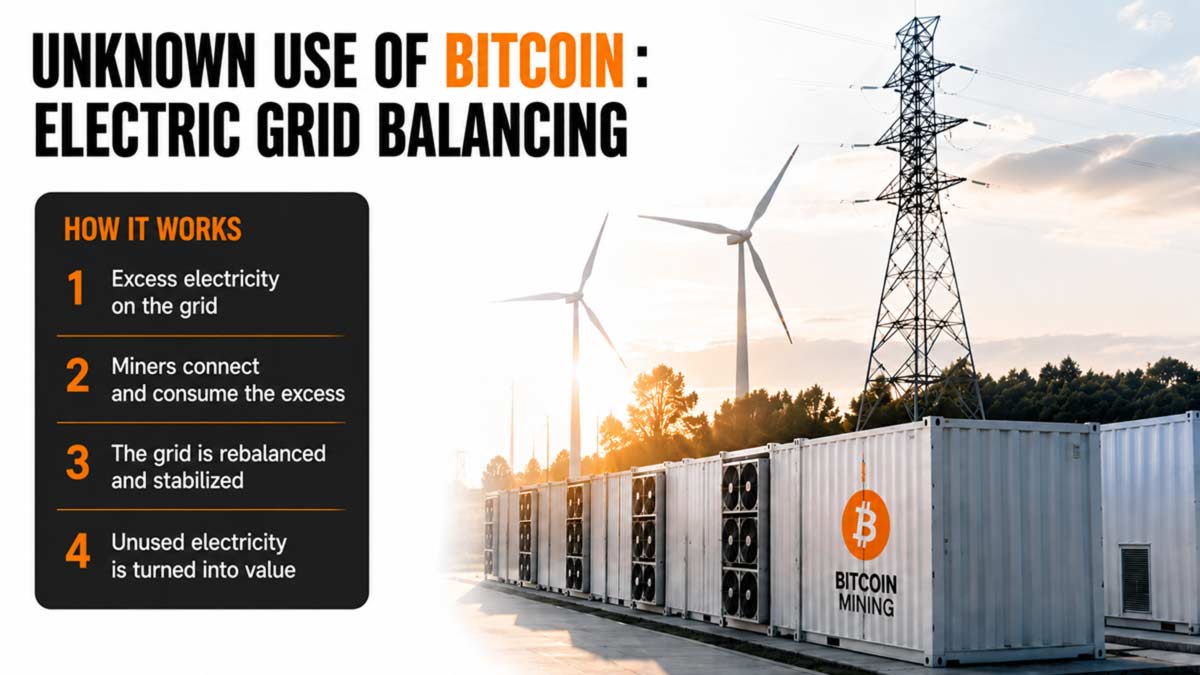
Bitcoin miningMiningProcess of validating blocks through proof of work. Consumes electricity by design : that is what secures the network.See in the lexicon → is often blamed for its electricity consumption. It is a legitimate debate, covered elsewhere on this site. But there is a reverse, lesser-known reading: under certain conditions, a minerMinerComputer or farm of computers that solves the cryptographic puzzle required to add a new block to the blockchain, in exchange for a bitcoin reward.See in the lexicon → is not a load endured by the grid, it becomes an ally. Its ability to start and stop instantly makes it a consumer that can be controlled.
This flexibility has concrete value for grid operators, whose job is to maintain, every second, the equality between production and consumption. A consumer that agrees to power down on demand is worth gold when demand spikes, and a buyer of last resort avoids wasting electricity when it is too abundant.
This article explains why a grid must balance permanently, how mining fits into that mechanism, and what the Texas experience shows concretely, without hiding the criticism this model raises.
A grid balances every second
Electricity cannot easily be stored at large scale. What is consumed must be produced at the same instant, otherwise the grid frequency drifts and, in extreme cases, outages protect the equipment. Operators therefore spend their time adjusting production to a demand that varies with the hour, the weather and the season.
Renewable energy complicates the exercise. Solar and wind produce when the sun shines or the wind blows, not necessarily when needed. So a wind farm may produce in the dead of night, when nobody consumes, or a sunny noon may pour out more electricity than the grid can absorb. With no buyer, that production is sometimes curtailed, that is, deliberately wasted.
The reverse problem also exists. During a heatwave or a cold snap, demand climbs abruptly and production struggles to keep up. The wholesale price of electricity then soars, and the grid seeks any means to reduce consumption. It is in these two situations, too much energy or not enough, that a controllable load becomes precious.
The miner, a load you can switch off
Most large electricity consumers cannot stop on command. An aluminium smelter, a data centre hosting websites or a hospital need a continuous current. Cutting their supply breaks an industrial process or interrupts a service. Bitcoin miningMiningProcess of validating blocks through proof of work. Consumes electricity by design : that is what secures the network.See in the lexicon → is different: if a farm stops for an hour, it only loses that hour's revenue, without damaging anything.
This property makes the minerMinerComputer or farm of computers that solves the cryptographic puzzle required to add a new block to the blockchain, in exchange for a bitcoin reward.See in the lexicon → what is called an interruptible load. It can absorb electricity when it is over-abundant and cheap, then vanish from the grid within seconds when overall demand picks up. No other industrial activity of this size offers such flexibility, and that is precisely what grid operators seek to cushion imbalances.
The miner thus turns a constraint into a service. Rather than wasting the curtailed electricity of an isolated wind farm, it is used to mine on site. Rather than building costly lines to evacuate distant production, consumption is placed as close as possible to the source. Mining becomes a valve that puts to use energy that would otherwise be lost.
The case of Texas and ERCOT
Texas has its own power grid, run by a body called ERCOT, largely independent from the rest of the United States. The state produces vast amounts of wind and solar energy, but its demand sees violent peaks during scorching summers and freezing winters. It is an ideal terrain for a flexible load.
Several miningMiningProcess of validating blocks through proof of work. Consumes electricity by design : that is what secures the network.See in the lexicon → farms have settled there with a particular contract: they commit to cutting their consumption when the grid is under stress, in exchangeExchangeService that lets you buy, sell and swap cryptocurrencies against fiat money. Examples : Kraken, Coinbase, Bitstamp, Bitvavo. Most are custodial.See in the lexicon → for payment. This mechanism, called demand response or load shedding, already existed for large industrials. Miners added near-instant reactivity to it. During peaks, some farms voluntarily power down and are paid for the electricity they free up.
The rest of the time, these farms buy electricity when it is cheapest, often at night or during strong renewable output. They thus make profitable wind or solar projects that, without this flexible customer, would struggle to sell all their production. It is this dual role, buyer when there is too much, absent when there is too little, that made Texas the showcase of this model.
What the model does not solve
This picture has its critical side, which it would be dishonest to ignore. First, being paid to power down assumes you first installed a massive consumption: a detractor will say the grid would fare better without that extra demand. The supporters' answer is that this demand is, by design, sheddable, hence different from a rigid load.
Then, demand-response payments sometimes rest on market rules that can be generous. During an extreme-price episode, a farm that powers down pockets significant sums, which raises questions about the fair distribution of those gains. The debate is less technical than political: who should benefit from flexibility, and at what price.
Finally, this model only holds where a flexible grid, abundant and sometimes surplus electricity, and a market framework that rewards flexibility coexist. It is not transposable everywhere. Nor does it settle the broader debate on miningMiningProcess of validating blocks through proof of work. Consumes electricity by design : that is what secures the network.See in the lexicon →'s footprint, which we cover in Misconceptions about Bitcoin. It only shows that a minerMinerComputer or farm of computers that solves the cryptographic puzzle required to add a new block to the blockchain, in exchange for a bitcoin reward.See in the lexicon → can, in the right context, serve the grid rather than merely drain it.
Disclaimer
Educational and informational content only: not investment, tax or legal advice. Bitcoin carries significant risks, including high volatility and the possible loss of invested capital. Each reader remains responsible for their decisions; when in doubt, consult a qualified professional in your jurisdiction.
To go further
In the same topic and beyond:
- Bitcoin mining and flared gas: the other energy use, putting oil-well methane to work.
- Lesser-known uses of Bitcoin: the guide gathering the five uses.
- Misconceptions about Bitcoin: the debate on consumption and pollution.