
On night-time article images, some desert areas light up with bright dots. They are not cities, but flares: flames that burn continuously above oil wells, day and night, sometimes for years. They consume a gas the oil industry prefers to destroy rather than try to use.
This sight illustrates a massive waste. The energy gone up in smoke above oil fields amounts to considerable quantities on a global scale. Bitcoin miningMiningProcess of validating blocks through proof of work. Consumes electricity by design : that is what secures the network.See in the lexicon → has found a niche there: since this gas is on site, free or nearly so, and with no outlet, it might as well be used to produce electricity and run machines.
This article first explains why wells flare their gas, a point often misunderstood, then why this flaring is a problem, and finally what on-site mining concretely changes, without making it a miracle solution or ignoring the legitimate criticism.
Why wells burn their gas
When you extract oil, gas almost always rises with it. It is called associated gas. On an equipped site close to a network, this gas is captured and sold. But many wells are isolated, far from any pipeline, and building a line to carry off a modest volume would cost far more than the gas would bring in.
The operator then ends up with a cumbersome by-product. Letting it escape into the atmosphere is dangerous and highly polluting. Storing it requires costly facilities. Reinjecting it into the ground is not always possible. The simplest and most widespread solution is to burn it on the spot, in a flare, which destroys it by turning it into combustion gas.
Flaring is therefore not a whim: it is often the least bad option available when the gas has neither buyer nor means of transport. It is also sometimes a safety obligation, because letting pressurised gas accumulate near a well would be dangerous. Understanding this is essential before judging what miningMiningProcess of validating blocks through proof of work. Consumes electricity by design : that is what secures the network.See in the lexicon → comes to change.
The problem with flaring
Associated gas is mostly methane. Yet methane, released as is into the air, warms the climate dozens of times more than the same quantity of CO2 over a horizon of a few decades. Burning it turns it into CO2, less harmful: the flare is therefore preferable to plain release, called venting, which unfortunately is still practised.
But a flare is far from perfect. In the wind, with poor settings or at low flow, combustion is incomplete and part of the methane escapes without burning. The open-air flame thus destroys less methane than people think. To this is added pure waste: real energy, enough to power homes, goes to sheer loss without producing any service.
The picture is therefore twofold. On one side, a climate stake, because poorly burned or released methane is a powerful greenhouse gas. On the other, an economic stake, because this available energy serves no purpose. It is precisely at the intersection of these two problems that the idea of installing miners slips in.
What on-site mining changes
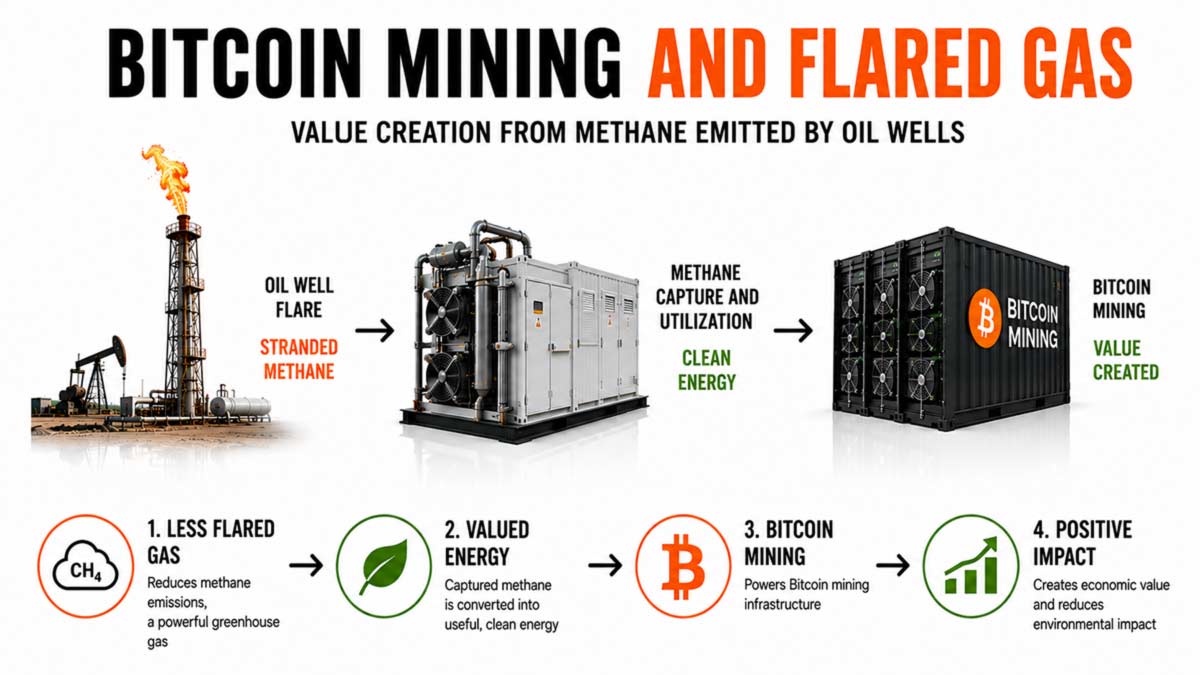
The idea is direct: instead of burning the gas in a flare without getting anything from it, it is burned in a generator that produces electricity. This electricity powers miningMiningProcess of validating blocks through proof of work. Consumes electricity by design : that is what secures the network.See in the lexicon → machines installed in containers on the site. The gas, which had no value, becomes the fuel of a revenue-generating activity.
The climate benefit lies in the quality of the combustion. A generator engine burns the methane in a closed, controlled chamber, far more completely than a flame exposed to the wind. For an equal volume of gas, more methane is therefore destroyed, the most warming gas, than with an ordinary flare. It is this point, and not a clean energy production, that constitutes the main environmental argument.
For the oil operator, the appeal is economic and logistical. Miners are mobile: containers are brought in, plugged, and moved when the well runs dry. This avoids building heavy infrastructure for a temporary deposit. Mining becomes a consumer of last resort, able to absorb a gas that would otherwise be burned to pure loss.
Limits and criticism
This use raises serious objections. The main one: by giving value to a gas that was a nuisance until then, miningMiningProcess of validating blocks through proof of work. Consumes electricity by design : that is what secures the network.See in the lexicon → could make oil extraction a little more profitable, and thus prolong activities that we otherwise seek to reduce. Turning waste into revenue is not neutral on the sector's incentives.
Second reservation: the announced benefits depend on rigorous measurements. Reducing methane emissions means honestly comparing engine combustion with what would have happened without mining, a well-tuned flare or venting. The figures put forward by operators must be verified by third parties, failing which the process is open to greenwashing.
Finally, this use remains a niche. It only concerns isolated sites producing lost gas, and represents only a fraction of global mining. It does not absolve the overall debate on Bitcoin's consumption, addressed in Misconceptions about Bitcoin. It only illustrates, like the power-grid use, that a mobile minerMinerComputer or farm of computers that solves the cryptographic puzzle required to add a new block to the blockchain, in exchange for a bitcoin reward.See in the lexicon →, free of any location constraint, can sometimes turn wasted energy into a service, where few other industries could.
Disclaimer
Educational and informational content only: not investment, tax or legal advice. Bitcoin carries significant risks, including high volatility and the possible loss of invested capital. Each reader remains responsible for their decisions; when in doubt, consult a qualified professional in your jurisdiction.
To go further
Neighbouring uses and context:
- Bitcoin mining and the power grid: the other energy use, the flexible load in Texas.
- Lesser-known uses of Bitcoin: the guide of the five uses.
- Misconceptions about Bitcoin: the overall debate on consumption and pollution.