
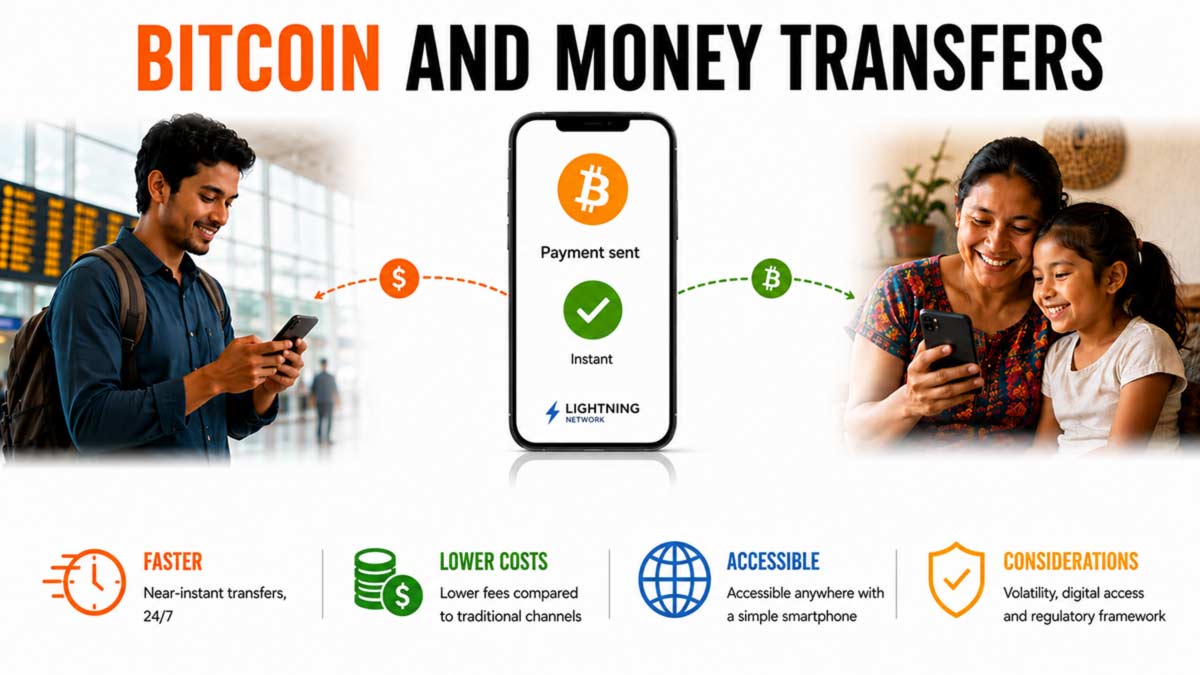
A labourer on a Gulf construction site, a home carer in Europe, a cook in North America: millions of people work abroad and send part of their salary back to their relatives every month. These transfers, called remittances, far exceed official development aid and support entire families in many countries.
The problem is that these transfers are expensive. Between the operator's fees, the margins on the exchangeExchangeService that lets you buy, sell and swap cryptocurrencies against fiat money. Examples : Kraken, Coinbase, Bitstamp, Bitvavo. Most are custodial.See in the lexicon → rate and the delays, a notable fraction of the money sent is lost along the way. The smaller the amount and the more poorly served the destination by banks, the heavier the levy, hitting precisely those who can least afford it.
Bitcoin was designed as a way to send value from one person to another, without an intermediary. Coupled with the Lightning NetworkLightning NetworkSecond-layer payment network on top of Bitcoin. Enables near-instant and near-free payments through channels opened between users.See in the lexicon →, it enables fast and cheap international transfers. This article explains the mechanism, gives concrete examples, and lays out without evasion the limits that prevent it from being a universal solution.
The cost of traditional channels
Sending money abroad through classic routes goes through transfer operators or banks. Each takes a commission, to which is added a hidden margin on the exchangeExchangeService that lets you buy, sell and swap cryptocurrencies against fiat money. Examples : Kraken, Coinbase, Bitstamp, Bitvavo. Most are custodial.See in the lexicon → rate applied. On small amounts and towards difficult destinations, the total cost frequently eats up several percent of the sum, and climbs further in the least competitive corridors.
To the cost is added slowness. A transfer can take several days, especially towards countries where the banking system is slow or scarcely present. The recipient often has to travel to a physical branch, present papers and wait, which assumes an accessible and open branch, a condition rarely met in rural areas.
Finally, part of the world's population has no bank account. For these people, receiving money from abroad is an obstacle course. It is precisely these frictions, fees, delays, banking exclusion, that Bitcoin-based solutions seek to reduce.
What Bitcoin and Lightning change
With Bitcoin, sending value amounts to transmitting data from one phone to another, without going through a bank or a branch. The sender only needs a walletWalletSoftware or device that manages your Bitcoin keys and lets you sign transactions. A wallet does not really « hold » your bitcoins, it holds the keys that prove you own them.See in the lexicon → app and an internet connection; so does the recipient. The transfer crosses borders like any message, indifferent to opening hours and public holidays.
On Bitcoin's base layer, a send can be slow and cost fees when there is congestion. This is where the Lightning NetworkLightning NetworkSecond-layer payment network on top of Bitcoin. Enables near-instant and near-free payments through channels opened between users.See in the lexicon → comes in, an overlay designed for fast, low-value payments. Via Lightning, transferring the equivalent of a few dozen euros happens in seconds, for often negligible fees, which matches exactly the profile of a remittance.
The result, in good cases, is a near-instant send, at any hour, at a cost far below classic channels, and without requiring the recipient to hold a bank account. For families that used to receive the money in several days and shorn of heavy fees, the difference is concrete.
Concrete examples
El SalvadorEl SalvadorFirst country to adopt Bitcoin as legal tender, in September 2021 under Nayib Bukele. Its status was amended in 2025 under IMF pressure.See in the lexicon → is the most publicised case. The country, a large part of whose income comes from transfers by its diaspora based in the United States, adopted Bitcoin as legal tender in 2021 and rolled out a national walletWalletSoftware or device that manages your Bitcoin keys and lets you sign transactions. A wallet does not really « hold » your bitcoins, it holds the keys that prove you own them.See in the lexicon →. The stated goal was precisely to cut the cost of remittances. Real adoption by the population remained limited, but the experience showed, at large scale, both the potential and the cultural and technical obstacles.
In sub-Saharan Africa, projects work around the absence of widespread mobile internet. Services make it possible to send and receive bitcoin through simple messages, on basic phones with no data connection, relying on the Lightning NetworkLightning NetworkSecond-layer payment network on top of Bitcoin. Enables near-instant and near-free payments through channels opened between users.See in the lexicon → in the background. The person receiving needs neither a smartphone nor a bank account, only an ordinary phone.
In the Philippines, Latin America or South Asia, consumer apps offer sending in bitcoin with immediate conversion into local currency on arrival. The user sometimes does not even see that they used Bitcoin: it is a transport rail, hidden behind a familiar interface, that carries value faster and cheaper than traditional circuits.
The limits to face honestly
The first limit is volatility. The price of bitcoin varies, and nobody wants to watch the rent money melt between sending and reception. In practice, this risk is bypassed by holding the bitcoin only for the duration of the transfer, with immediate conversion into local currency on arrival, or by using modest amounts sent frequently.
The second limit is conversion between bitcoin and local currency, the entry and exit points. If the recipient needs to spend in cash, they need a reliable way to exchangeExchangeService that lets you buy, sell and swap cryptocurrencies against fiat money. Examples : Kraken, Coinbase, Bitstamp, Bitvavo. Most are custodial.See in the lexicon → their bitcoin for the country's currency, whether an app, a local agent or a peer-to-peer market. Where these points are missing or take high margins, the cost advantage erodes.
Finally remain internet access, command of the tools, and a regulatory framework that is sometimes hostile or unclear. Holding your own bitcoin also imposes a responsibility: a lost key, lost funds. Bitcoin is therefore not a magic solution to remittances, but an additional option, sometimes clearly better, sometimes unsuitable, depending on the corridor, the equipment and the availability of local conversion.
Disclaimer
Educational and informational content only: not investment, tax or legal advice. Bitcoin carries significant risks, including high volatility and the possible loss of invested capital. Each reader remains responsible for their decisions; when in doubt, consult a qualified professional in your jurisdiction.
To go further
To dig into the payment use:
- The Lightning Network: the layer 2 that makes these transfers fast and cheap.
- Using Bitcoin day to day: paying, receiving and accepting, the guide of everyday uses.
- Lesser-known uses of Bitcoin: the guide of the five uses.