
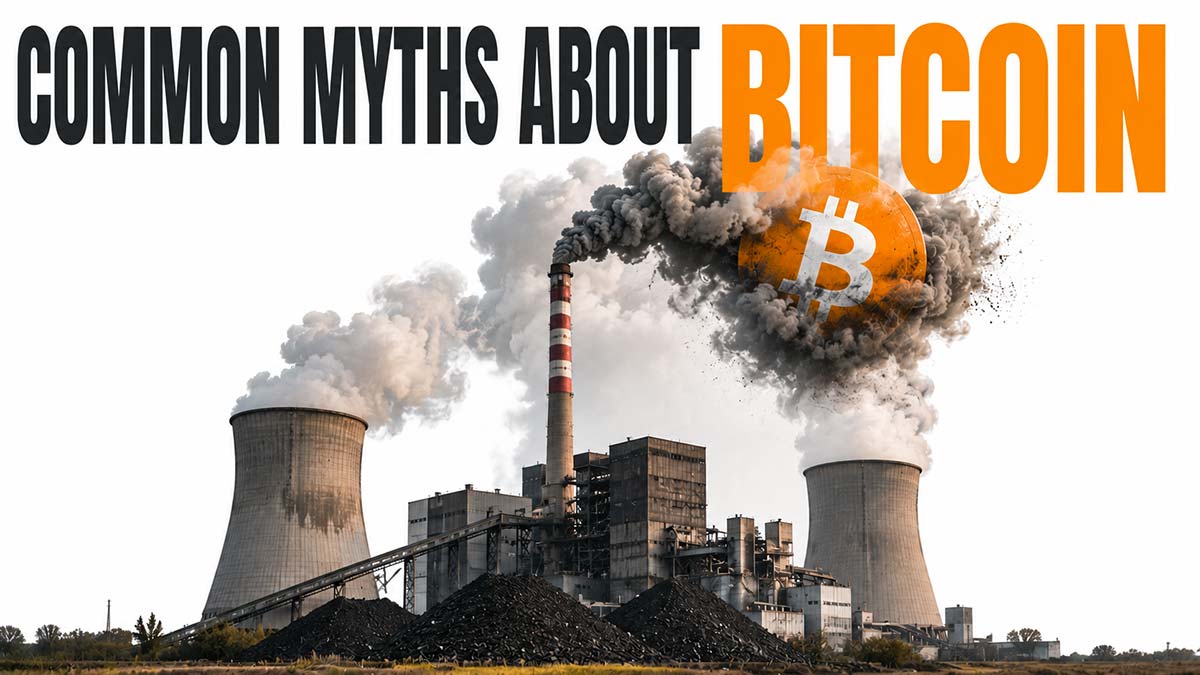
Bitcoin polarises. For its supporters it's the most important monetary invention since gold, for its critics it's a dangerous bubble or a pyramid scheme. Between the two, many shortcuts circulate, some dating from 2013 and never updated. Here are the 6 most widespread misconceptions, and what the 2026 reality says.
Myth 1: "Bitcoin is a bubble that will burst"
Bitcoin has already endured 5 crashes of more than 70% (2011, 2014, 2018, 2022, 2025). Each time, the press announced its death. CoinDesk has counted more than 470 "obituaries" of Bitcoin since 2010. Each time, it bounced back to higher highs.
A true bubble, like the 1637 tulip mania or the 2000 dotcom bubble, doesn't recover. Bitcoin goes through violent cycles but its long-term trend remains upward over 15 years. Its market cap surpassed that of Meta in 2024, and gold's could be crossed by 2030 if the trend holds.
This doesn't mean it will never fall again. It means calling it a "bubble" has become inappropriate: it's now a recognised asset class, held by BlackRockBlackRockWorld's largest asset manager. Launched its Bitcoin spot ETF IBIT in January 2024, which accumulated more than 500,000 BTC in 2 years.See in the lexicon →, Fidelity, and several states.
Myth 2: "Bitcoin pollutes more than an entire country"
The argument relies on real figures (Bitcoin uses around 150 TWh/year, equivalent to Poland) but ignores several important nuances:
- Energy mix: per recent studies (Cambridge, BitcoinMiningCouncil), 55-60% of Bitcoin miningMiningProcess of validating blocks through proof of work. Consumes electricity by design : that is what secures the network.See in the lexicon → now uses renewable or low-carbon energy, compared to ~38% for the global grid. Bitcoin is paradoxically greener than average.
- Stranded energy: a growing share of mining uses flared gas that would have been burned with no added value, or surplus hydro in the rainy season.
- Fair comparison: the global banking system uses about 260 TWh/year (data centers, branches, ATMs, cash transport). Gold, about 130 TWh/year (extraction). Bitcoin is not an isolated excess.
- Utility: Bitcoin's energy use secures a neutral, censorship-resistant monetary system for 600 million users. The utility/energy ratio can't be debated in absolute, only in relative terms.
The topic deserves serious discussion, but the "Bitcoin pollutes more than Poland" slogan is misleading because it hides the energy mix and the utility delivered.
Myth 3: "Bitcoin is mainly used by criminals"

The Chainalysis 2024 annual report is clear: less than 0.5% of Bitcoin transactions are linked to criminal activities. Compare with 2 to 5% in the traditional banking system per UNODC (UN Office on Drugs and Crime).
The fact is that Bitcoin is traceable. Every transaction is public on the blockchainBlockchainA public, shared ledger that records every Bitcoin transaction in blocks linked together cryptographically. Each participant in the network keeps a copy.See in the lexicon →, forever. Criminals who use Bitcoin get caught years later (Silk Road, Bitfinex Hack, Colonial Pipeline cases). Real criminal flows go through cash, tax havens, or less traceable stablecoins, not Bitcoin.
The myth dates from the media coverage of Silk Road in 2013, where Bitcoin was presented as the "Darknet currency". The image stuck. The 2026 reality is very different: Bitcoin is the most institutional, most regulated crypto asset, and the least favoured by criminals.
Myth 4: "Bitcoin has no intrinsic value"
Argument often raised by traditional economists: "Bitcoin is just a computer file, it's worth nothing."
Three answers. First, the euro and the dollar also have no intrinsic value since 1971 (end of the gold standard). They are only worth what we agree they're worth. That's exactly the same mechanism as Bitcoin.
Second, Bitcoin has concrete and measurable properties: programmed scarcity, decentralisation, censorship resistance, instant global transport, extreme divisibility. These properties have real economic utility for users.
Third, an asset's value comes from the meeting of limited supply and motivated demand. Bitcoin has fixed supply (21 million21 millionMaximum number of bitcoins that will ever exist, hard-coded in the protocol. This programmed scarcity is a founding feature. The last sat will be mined around the year 2140.See in the lexicon →) and growing demand (600 million users, spot ETFs, states). The formula works, and the market currently assigns it a ~2 trillion USD market cap.
Myth 5: "A better crypto will replace Bitcoin"
Classic argument: "Bitcoin is slow, newer cryptos are faster and more modern, they'll take its place."
The argument confuses technical performance with monetary value. A currency doesn't derive its value from its speed, but from its neutrality, security and trust. On these 3 criteria, no alternative has come close to Bitcoin in 17 years.
For fast payments, Bitcoin has its own Layer 2 (Lightning NetworkLightning NetworkSecond-layer payment network on top of Bitcoin. Enables near-instant and near-free payments through channels opened between users.See in the lexicon →), which handles millions of transactions per second at nearly zero cost. "Bitcoin is slow" is no longer a valid argument in 2026.
For novelty, recall that none of the 20,000 cryptocurrencies created since 2009 has managed to dethrone Bitcoin, despite billions of dollars in marketing and technical promises. The "Bitcoin killers" of previous cycles (Bitcoin Cash, EOS, Cardano, Solana) are all far behind in terms of market cap, security and adoption.
Myth 6: "Governments will ban Bitcoin"
Possible in theory, unlikely in practice for two reasons.
First, banning an open sourceOpen sourceSoftware whose source code is public and modifiable by anyone. A fundamental auditability guarantee in Bitcoin.See in the lexicon → protocol distributed across thousands of nodes worldwide is technically very hard. China tried in 2021 with limited success: hashrateHashrateTotal computing power deployed by miners, measured in hashes per second (EH/s, exahashes). The higher the hashrate, the more expensive the network is to attack.See in the lexicon → migrated to the US, Kazakhstan, and Paraguay within months. Bitcoin kept running without interruption.
Second, the government trend since 2024 has been the opposite. The US approved spot ETFs and created a strategic bitcoin reserveStrategic Bitcoin Reserve (SBR)United States strategic Bitcoin reserve created by executive order of Donald Trump in March 2025. Built from seized bitcoins.See in the lexicon →. The EU adopted MiCAMiCA (Markets in Crypto-Assets)European regulation 2023/1114 that frames crypto services across the EU since 2024. Creates the CASP status.See in the lexicon → to frame (not ban) crypto actors. Switzerland has had a stable FINMAFINMASwiss Financial Market Supervisory Authority. Frames crypto activities in Switzerland.See in the lexicon → framework since 2018. Several countries (UAE, El SalvadorEl SalvadorFirst country to adopt Bitcoin as legal tender, in September 2021 under Nayib Bukele. Its status was amended in 2025 under IMF pressure.See in the lexicon →, Hong Kong) actively seek to attract Bitcoin businesses.
The remaining risk: tighter taxation, stricter KYCKYC (Know Your Customer)Mandatory identification procedure that regulated platforms apply to their users : ID document, proof of address, and so on.See in the lexicon →/AMLAML (Anti-Money Laundering)Set of rules to fight money laundering. KYC is the first building block. Frames what exchanges can or cannot let you do.See in the lexicon →, restrictions on self-custodySelf-custodyModel in which you hold your own private keys. Your bitcoins depend on no third party. This is Bitcoin's founding promise.See in the lexicon →. It's a real topic to watch, but very different from an outright ban.
Disclaimer
Educational and informational content only: not investment, tax or legal advice. Bitcoin carries significant risks, including high volatility and the possible loss of invested capital. Each reader remains responsible for their decisions; when in doubt, consult a qualified professional in your jurisdiction.