
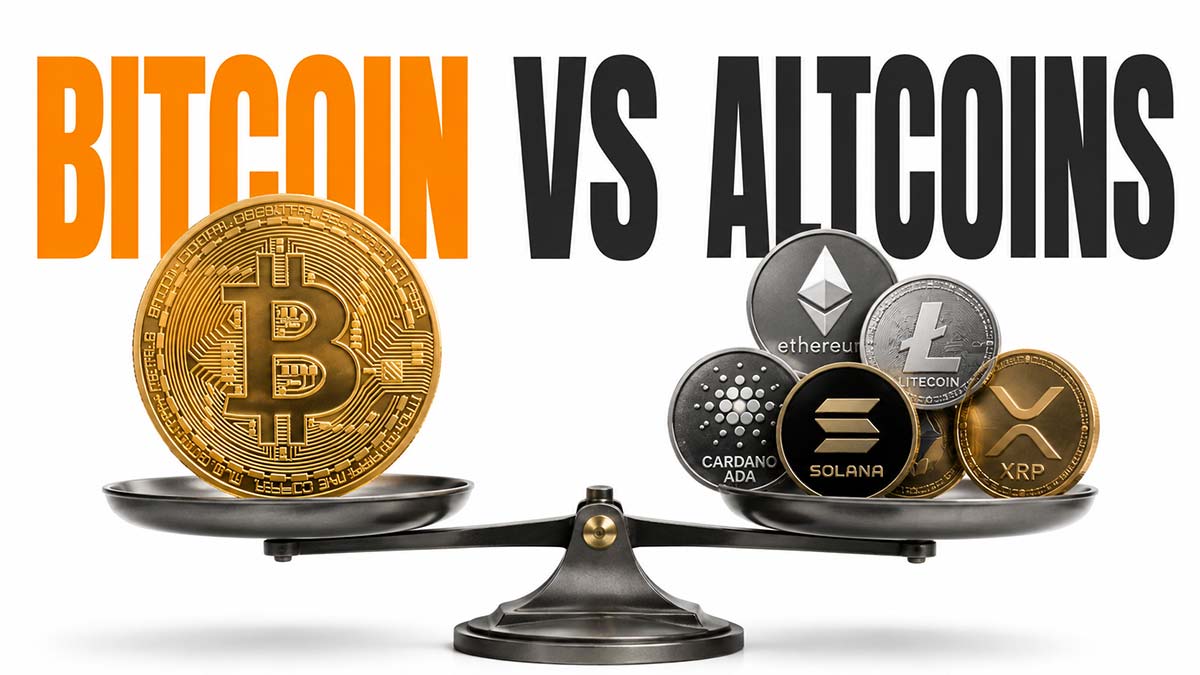
Turn on a financial TV channel or open a crypto news site: Bitcoin is almost always shown alongside Ethereum, Solana, Cardano and dozens of other "altcoins". The term covers all cryptocurrencies that are not Bitcoin. But this grouping hides an important reality: Bitcoin and altcoins play in completely different leagues.
What is an altcoin
The word "altcoinAltcoin (shitcoin, memecoin)Any cryptocurrency other than Bitcoin (Ethereum, Solana, etc.). The pejorative terms shitcoin and memecoin refer to projects with no real utility or purely speculative ones.See in the lexicon →" is short for "alternative coin". It refers to all cryptocurrencies created after Bitcoin, with the idea of offering a variant or a different use. The term covers:
- Bitcoin forks (Bitcoin Cash, Litecoin) that copy its code and tweak it.
- Smart contract platforms (Ethereum, Solana, Cardano) aiming to become a "world computer".
- Stablecoins (USDT, USDC) that mimic the dollar.
- Memecoins (Dogecoin, Shiba Inu) launched without a real technical project.
- The thousands of tokens created on Ethereum or Solana, often short-lived.
In total, there are more than 20,000 cryptocurrencies, the overwhelming majority of which have lost more than 90% of their value since launch, or no longer exist.
What sets Bitcoin apart from altcoins
No identified founder. Satoshi NakamotoSatoshi NakamotoPseudonym of the creator (or collective) behind Bitcoin. Active on forums from 2008 to 2011, then vanished without revealing any identity. Holds roughly 1.1 million BTC that have never moved.See in the lexicon → disappeared in 2011 and never returned. No one holds decision-making power over Bitcoin. By contrast, almost all altcoins have a founding team, a foundation, a CEO, who can make decisions, hold tokens in pre-mine, or be targeted by regulators.
Maximum security. Bitcoin's hashrateHashrateTotal computing power deployed by miners, measured in hashes per second (EH/s, exahashes). The higher the hashrate, the more expensive the network is to attack.See in the lexicon → (total computing power) is ~500 times higher than that of all other proof-of-work blockchains combined. This makes Bitcoin nearly impossible to attack, where smaller altcoins are regularly hit by 51% attacks.
No pre-mine. All bitcoins were distributed by public miningMiningProcess of validating blocks through proof of work. Consumes electricity by design : that is what secures the network.See in the lexicon →, open to all. Many altcoins (Ethereum included) reserved a large share for their founders and early investors before public launch.
Immutable rules. Bitcoin's key parameters (21 million21 millionMaximum number of bitcoins that will ever exist, hard-coded in the protocol. This programmed scarcity is a founding feature. The last sat will be mined around the year 2140.See in the lexicon →, 10 min/block, halvingHalvingScheduled event every 210,000 blocks (roughly every 4 years) that cuts the miner reward in half. This mechanism makes Bitcoin issuance decline towards the total cap of 21 million.See in the lexicon →) have never been changed and likely never will be without near-unanimous consensus. Altcoins regularly see their rules altered (forks, consensus changes, supply increases).
Why the "Bitcoin only" movement
A significant part of the Bitcoin community refuses to touch altcoins. This movement, called Bitcoin only or Bitcoin maximalism, rests on three beliefs:
1. Bitcoin has already won the digital scarcity race. No one can recreate an asset as decentralised, secure, and neutral. Altcoins try, but none has managed to reproduce these properties in 17 years.
2. Altcoins distract from the mission. As long as we speculate on dozens of cryptocurrencies, we dilute the Bitcoin message and lose the user in complexity. Maximalism sees this as a waste of time and energy.
3. Most altcoins are disguised scams. Statistically, 95% of altcoins have disappeared or lost more than 90% from their ATHATH (All-Time High)Highest historical price of an asset. Breaking the previous ATH is a strong psychological signal in Bitcoin cycles.See in the lexicon →. Many are opportunistic projects, worthless memecoins, or pump-and-dump tools.
Not all bitcoiners are maxis. Many hold a little Ethereum or Solana, either to experiment or to speculate. But the overwhelming majority of long-term bitcoiners consider Bitcoin the only crypto allocation needed.
Should you diversify into altcoins
The honest answer: it depends on your profile and risk tolerance.
If you're new to crypto, stick to Bitcoin. You already have a lot to learn (wallets, security, taxes). Adding altcoins multiplies complexity without really reducing risk. Statistically, a 100% Bitcoin portfolio has outperformed the majority of diversified crypto portfolios over 5 and 10 years.
If you're experienced and accept the risk, a marginal allocation (5-10% of your crypto) into a few established altcoins (Ethereum mainly) can be defended. But know that you're taking a substantially higher risk than Bitcoin alone.
Absolutely avoid: memecoins, recent ICOs, "100x next gem" promoted on YouTube or X, tokens with no clear utility. Almost all end up at zero.
Disclaimer
Educational and informational content only: not investment, tax or legal advice. Bitcoin carries significant risks, including high volatility and the possible loss of invested capital. Each reader remains responsible for their decisions; when in doubt, consult a qualified professional in your jurisdiction.