
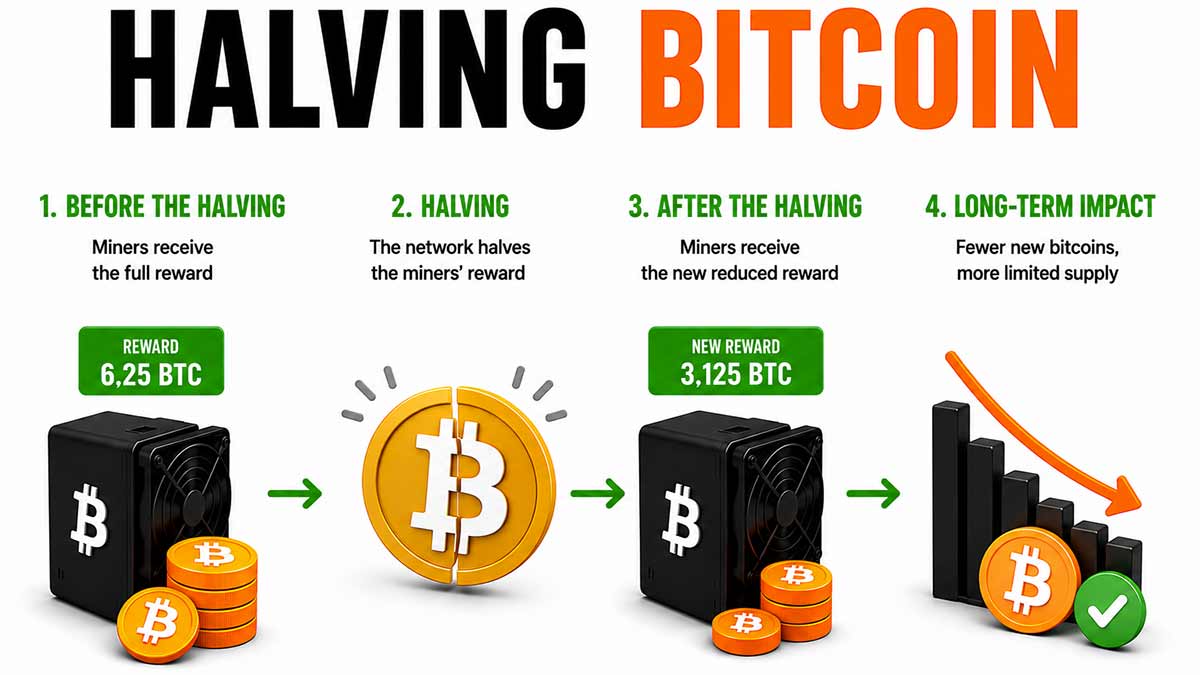
The halvingHalvingScheduled event every 210,000 blocks (roughly every 4 years) that cuts the miner reward in half. This mechanism makes Bitcoin issuance decline towards the total cap of 21 million.See in the lexicon → is arguably the most distinctive mechanism in Bitcoin. Hard-coded from the start by Satoshi NakamotoSatoshi NakamotoPseudonym of the creator (or collective) behind Bitcoin. Active on forums from 2008 to 2011, then vanished without revealing any identity. Holds roughly 1.1 million BTC that have never moved.See in the lexicon →, it guarantees that Bitcoin's supply slows down over time, until it stops entirely around 2140. Roughly every four years, a scheduled event cuts the amount of new bitcoins issued per block in half. This is the foundation of programmed scarcity.
What the halving is in one sentence
The halvingHalvingScheduled event every 210,000 blocks (roughly every 4 years) that cuts the miner reward in half. This mechanism makes Bitcoin issuance decline towards the total cap of 21 million.See in the lexicon → is the event scheduled every 210,000 blocks (roughly 4 years) that cuts in half the reward paid to Bitcoin miners for validating a block.
How it works technically
For every new block mined, the Bitcoin protocol awards its author a block reward in newly minted bitcoins. This reward compensates the computational work performed to secure the network.
At launch in 2009, this reward was 50 BTC per block. Every 210,000 blocks (roughly 4 years), it is cut in half. That's all there is to it, but it's hard-coded and no one can change it without the agreement of the whole network.
Bitcoin's source code literally contains the line that computes this decrease:
- Block 0 to 209,999: reward 50 BTC
- Block 210,000 to 419,999: reward 25 BTC (first halvingHalvingScheduled event every 210,000 blocks (roughly every 4 years) that cuts the miner reward in half. This mechanism makes Bitcoin issuance decline towards the total cap of 21 million.See in the lexicon →, 2012)
- Block 420,000 to 629,999: reward 12.5 BTC (second halving, 2016)
- Block 630,000 to 839,999: reward 6.25 BTC (third halving, 2020)
- Block 840,000 to 1,049,999: reward 3.125 BTC (fourth halving, 2024)
- And so on, until it drops below 1 satoshiSatoshi (sat)The smallest unit of bitcoin. 1 BTC = 100 million satoshis. Named after the creator. In 2026, talking in sats becomes common as the price of one BTC rises.See in the lexicon → around 2140.
Once that limit is reached, no new bitcoins will ever be issued. Miners will then be paid solely from transaction feesTransaction feesAmount paid to miners so they include your transaction in a block. Expressed in satoshis per virtual byte (sat/vB). Varies with network congestion.See in the lexicon →.
Why the halving exists: programmed scarcity
To understand the purpose of the halvingHalvingScheduled event every 210,000 blocks (roughly every 4 years) that cuts the miner reward in half. This mechanism makes Bitcoin issuance decline towards the total cap of 21 million.See in the lexicon →, you need to compare Bitcoin with a traditional currency. The euro or the dollar see their supply grow at the discretion of central banks. When more money is in circulation for an equivalent quantity of goods, the purchasing power of each unit decreases: this is inflation.
Bitcoin made the opposite bet. Its maximum supply is set at 21 million21 millionMaximum number of bitcoins that will ever exist, hard-coded in the protocol. This programmed scarcity is a founding feature. The last sat will be mined around the year 2140.See in the lexicon →, and its issuance rate slows over time thanks to the halving. This makes Bitcoin a disinflationary asset: not because bitcoins disappear, but because fewer and fewer new ones arrive.
This property creates what economists call a high stock-to-flow ratio: the existing stock (bitcoins already issued) is very large compared to the annual flow (newly created bitcoins). This is also gold's profile, hence Bitcoin's nickname of digital gold.
The halving is therefore the tool that turns a simple promise ("there will never be more than 21 million") into operable reality: it ensures issuance follows a strict schedule, known in advance by everyone, and impossible to change in secret.
The 4 past halvings
| No. | Date | Block | Reward after | Price at the time |
|---|---|---|---|---|
| 1 | 28 November 2012 | 210,000 | 25 BTC | ~12 USD |
| 2 | 9 July 2016 | 420,000 | 12.5 BTC | ~650 USD |
| 3 | 11 May 2020 | 630,000 | 6.25 BTC | ~8,700 USD |
| 4 | 20 April 2024 | 840,000 | 3.125 BTC | ~64,000 USD |
At each halvingHalvingScheduled event every 210,000 blocks (roughly every 4 years) that cuts the miner reward in half. This mechanism makes Bitcoin issuance decline towards the total cap of 21 million.See in the lexicon →, the annual supply of new bitcoins was cut in half. In 2024, around 164,000 new BTC are issued per year, compared with 328,000 BTC before the halving.
The halving's impact on price
Historically, each halvingHalvingScheduled event every 210,000 blocks (roughly every 4 years) that cuts the miner reward in half. This mechanism makes Bitcoin issuance decline towards the total cap of 21 million.See in the lexicon → has been followed by a bullish cycle that took Bitcoin to new highs in the 12 to 18 months that followed. The economic logic is simple: if demand stays constant while new supply is cut in half, the equilibrium price tends to rise.
Beware of hasty conclusions, however. Several factors limit this reasoning:
- The market has become more mature and more institutional with each cycle. The spot ETFs launched in 2024 changed the demand picture.
- Effective daily supply doesn't depend only on new bitcoins but also on selling from existing holders.
- Previous cycles guarantee nothing about future ones: past performance is no guide to future results.
- Spectacular rises were also followed by sharp drops (drawdowns of 70 to 85% in bear markets).
What we can safely state: the halving is a structural event that mechanically reduces minerMinerComputer or farm of computers that solves the cryptographic puzzle required to add a new block to the blockchain, in exchange for a bitcoin reward.See in the lexicon → selling pressure, since they have fewer new bitcoins to sell to cover their costs. The effect on price then depends on demand, macro conditions and market psychology.
The next halving
The fifth Bitcoin halvingHalvingScheduled event every 210,000 blocks (roughly every 4 years) that cuts the miner reward in half. This mechanism makes Bitcoin issuance decline towards the total cap of 21 million.See in the lexicon → is expected in spring 2028, around block 1,050,000. The reward will drop from 3.125 BTC to 1.5625 BTC per block.
The exact date isn't known in advance, as it depends on the actual time miners take to produce blocks. The target is 10 minutes per block on average, but difficulty is adjusted every 2,016 blocks (roughly 2 weeks) to maintain this pace.
To follow the countdown live, several sites publish a real-time counter based on the blockchainBlockchainA public, shared ledger that records every Bitcoin transaction in blocks linked together cryptographically. Each participant in the network keeps a copy.See in the lexicon → height. CapBitcoin will also offer its own counter in the tools section.
Disclaimer
Educational and informational content only: not investment, tax or legal advice. Bitcoin carries significant risks, including high volatility and the possible loss of invested capital. Each reader remains responsible for their decisions; when in doubt, consult a qualified professional in your jurisdiction.