
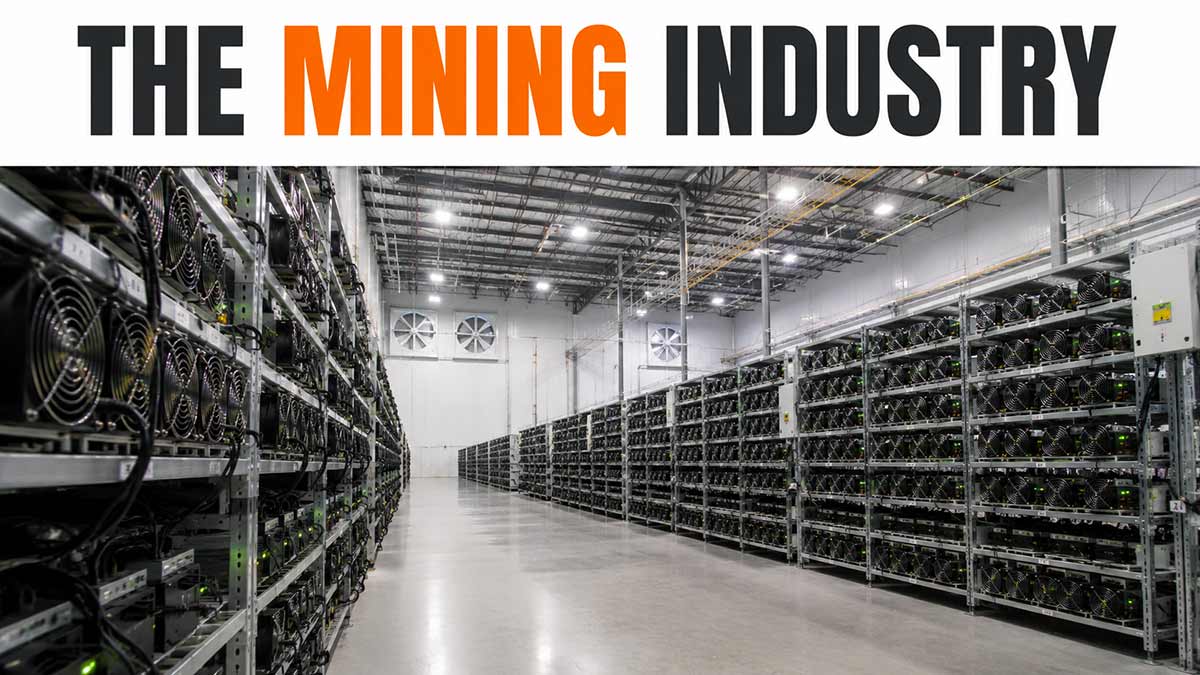
People often talk about "miningMiningProcess of validating blocks through proof of work. Consumes electricity by design : that is what secures the network.See in the lexicon →" as if it meant extracting gold, and the image is not absurd: mining Bitcoin takes real effort, costs energy, and now and then yields a reward. But the comparison stops there. What miners really do is not dig, it is secure a shared ledgerLedger, Trezor, Coldcard, BitBoxMain hardware wallet brands. Ledger Nano S Plus / X (French, the best-seller), Trezor Model T (Czech, open source), Coldcard Mk4 (Canadian, ultra-secure, Bitcoin-only), BitBox02 (Swiss, open source).See in the lexicon → by proving they have spent work.
Mining fills two roles at once. It puts new bitcoins into circulation, on a fixed schedule that the halving cuts in half roughly every four years. And it makes the history of transactions practically impossible to rewrite, which is the true purpose of all this spending.
This article starts from the principle and works down to the concrete: what mining is for, why dedicated machines, the ASICs, had to be invented, how the network self-regulates to keep a steady pace, and what the figures say about the economics and the criticism of this industry.
What mining is really for
Every Bitcoin transaction is gathered into blocks, added one after another roughly every ten minutes. The question the network must solve is simple to state: who has the right to add the next block, and how do you stop someone from cheating by rewriting the past? Bitcoin's answer is called proof of workProof of Work (PoW)Bitcoin's consensus mechanism: miners spend energy to find a valid hash, which makes falsifying the history economically prohibitive. This work is what secures the blockchain.See in the lexicon →.
To propose a block, a minerMinerComputer or farm of computers that solves the cryptographic puzzle required to add a new block to the blockchain, in exchange for a bitcoin reward.See in the lexicon → must find a number that, combined with the block's content, produces a digital fingerprint meeting a condition that is very hard to satisfy. There is no trick: you have to try billions of combinations per second, at random, until you hit the right one. This work is costly to produce but instant to check for every other participant.
Therein lies the genius of the system. Rewriting an old block would force you to redo that work for that block and every later one, faster than the entire honest network. On a global scale, that means an amount of energy out of reach. Bitcoin's security therefore rests not on a trusted authority, but on the fact that attacking the ledgerLedger, Trezor, Coldcard, BitBoxMain hardware wallet brands. Ledger Nano S Plus / X (French, the best-seller), Trezor Model T (Czech, open source), Coldcard Mk4 (Canadian, ultra-secure, Bitcoin-only), BitBox02 (Swiss, open source).See in the lexicon → would cost more than anyone could gain from it.
From processor to ASIC
In Bitcoin's early days, miningMiningProcess of validating blocks through proof of work. Consumes electricity by design : that is what secures the network.See in the lexicon → was done with the processor of an ordinary computer. Competition was light, and a simple PC was enough to win whole blocks. Very soon, enthusiasts realised that graphics cards, built to compute in parallel, were far more efficient for this kind of repetitive task.
This race for efficiency reached a decisive stage: the arrival of ASICs, application-specific integrated circuits. Unlike a general-purpose processor, an ASIC can do only one thing, the exact calculation Bitcoin mining requires, but it does it thousands of times faster while using far less electricity per calculation. Any other use is impossible for it.
Since then, hobby mining on consumer hardware has all but vanished. Modern ASICs are industrial machines, loud and power-hungry, grouped by the thousand in farms set up where electricity is cheapest. This extreme specialisation cuts both ways: it makes the network formidably powerful, but it also concentrates mining in the hands of those who can buy these machines and pay for their power.
The difficulty that keeps the pace
If more and more machines join the network, blocks should be found faster and faster. Bitcoin avoids this with an elegant mechanism: every 2016 blocks, roughly every two weeks, the network measures the time actually elapsed and automatically adjusts the difficulty of the problem to solve.
If blocks came too fast, difficulty rises; if they lagged, it falls. The goal is always the same: bring the average interval back to ten minutes per block, whatever the total power plugged into the network. This is what lets the issuance of bitcoins follow a predictable schedule over decades.
The network's total computing power has a name, the hashrateHashrateTotal computing power deployed by miners, measured in hashes per second (EH/s, exahashes). The higher the hashrate, the more expensive the network is to attack.See in the lexicon →. The higher it is, the safer the network, because attacking the ledgerLedger, Trezor, Coldcard, BitBoxMain hardware wallet brands. Ledger Nano S Plus / X (French, the best-seller), Trezor Model T (Czech, open source), Coldcard Mk4 (Canadian, ultra-secure, Bitcoin-only), BitBox02 (Swiss, open source).See in the lexicon → would require matching that power. Watching the hashrate and difficulty evolve means observing, live, the health and robustness of Bitcoin, independently of its price.
The economics of mining
A minerMinerComputer or farm of computers that solves the cryptographic puzzle required to add a new block to the blockchain, in exchange for a bitcoin reward.See in the lexicon → gains two things when it finds a block: a reward of new bitcoins, created for the occasion, and the sum of the fees paid by the transactions included in that block. The reward in fresh bitcoins halves at every halving, so that in the very long run, transaction feesTransaction feesAmount paid to miners so they include your transaction in a block. Expressed in satoshis per virtual byte (sat/vB). Varies with network congestion.See in the lexicon → are set to become miners' main pay.
Against this, costs are heavy: buying the machines, which age fast, and above all the electricity bill, which dominates everything else. This is why miners chase the cheapest energy on the planet, even settling in remote places. A miner is profitable only if the value of what it collects durably exceeds the cost of its power.
Since a single ASIC has a tiny chance of finding a block, miners group into "pools": they add up their power and share rewards in proportion to their contribution. This smooths their income, but raises a concentration question, because a few large pools coordinate a sizeable share of the world hashrateHashrateTotal computing power deployed by miners, measured in hashes per second (EH/s, exahashes). The higher the hashrate, the more expensive the network is to attack.See in the lexicon →. The network stays safe as long as these players have more to gain by playing fair than by cheating.
Centralisation, energy and criticism
Two reproaches come up again and again about miningMiningProcess of validating blocks through proof of work. Consumes electricity by design : that is what secures the network.See in the lexicon →. The first concerns concentration: costly machines, dominant pools, few manufacturers and giant farms would put decentralisation at risk. It is a genuine point of vigilance, but it needs nuance. Miners propose blocks, they do not set the rules alone: it is the thousands of nodes spread across the world that validate or reject what they produce.
The second reproach is about energy. Yes, Bitcoin consumes electricity, and that is by design: this spending is precisely what makes the ledgerLedger, Trezor, Coldcard, BitBoxMain hardware wallet brands. Ledger Nano S Plus / X (French, the best-seller), Trezor Model T (Czech, open source), Coldcard Mk4 (Canadian, ultra-secure, Bitcoin-only), BitBox02 (Swiss, open source).See in the lexicon → costly to attack. The real question is not the raw amount of energy, but its source and its usefulness. A growing share of mining plugs into renewable surpluses or into otherwise wasted energy, such as the power grid in balancing or the flared gas of oil wells.
None of these arguments settles the debate on its own, and that is healthy. Keeping the essentials is enough here: mining is not free waste, it is the price of securing a system with no leader. What remains is to make it ever cleaner and better distributed, an open project that neither Bitcoin's defenders nor its critics can honestly declare finished.
Disclaimer
Educational and informational content only: not investment, tax or legal advice. Bitcoin carries significant risks, including high volatility and the possible loss of invested capital. Each reader remains responsible for their decisions; when in doubt, consult a qualified professional in your jurisdiction.
To go further
To carry on reading:
- The Bitcoin halving: why the minerMinerComputer or farm of computers that solves the cryptographic puzzle required to add a new block to the blockchain, in exchange for a bitcoin reward.See in the lexicon → reward is cut in half every four years.
- Understand Bitcoin: the overall guide to how it works.
- Bitcoin mining and the power grid: how miners help balance a grid.