
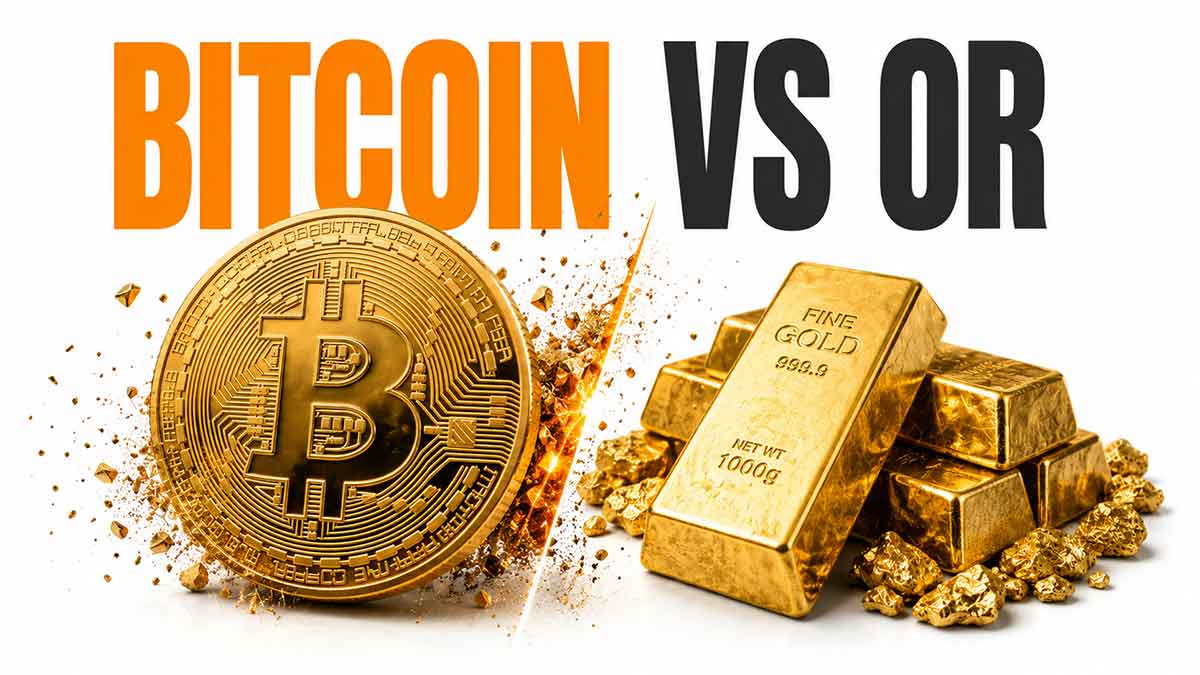
Gold has been used as a store of value for more than 5,000 years. Bitcoin is only 17 years old. Yet both assets are regularly compared today by institutional investors, central banks and the financial press. Why this comparison, and where are the real differences?
Why compare Bitcoin to gold
Gold owes its monetary status to a cocktail of rare properties. It's durable (doesn't oxidise), divisible, fungible, transportable, verifiable, and above all naturally scarce. No one can create it artificially, extracting it requires decades of work and enormous industrial investment.
Bitcoin was designed to tick the same boxes, but in digital form. It's durable (never physically damaged), divisible (down to 100 million satoshis per bitcoin), fungible, transportable (at internet speed), verifiable (anyone can check the chain), and programmed to be scarce (21 million21 millionMaximum number of bitcoins that will ever exist, hard-coded in the protocol. This programmed scarcity is a founding feature. The last sat will be mined around the year 2140.See in the lexicon → max).
The comparison is therefore not marketing, it's structural. Bitcoin applied to the digital what gold applies to the physical.
Comparison table
| Criterion | Gold | Bitcoin |
|---|---|---|
| Scarcity | Natural (~3,000 t/year mined) | Programmed (21 million21 millionMaximum number of bitcoins that will ever exist, hard-coded in the protocol. This programmed scarcity is a founding feature. The last sat will be mined around the year 2140.See in the lexicon → max) |
| Transport | Costly, heavy, physical security | Instant, global, nearly free |
| Divisibility | Limited (grams) | 100 million satoshis per bitcoin |
| Verification | Physical expertise needed | Verifiable by any network nodeNodeComputer that runs the Bitcoin software and takes part in the network by validating blocks and transactions. A « full node » keeps a complete copy of the blockchain.See in the lexicon → |
| Storage | VaultVaultCustody setup for long-term storage, often multisig, kept offline and touched rarely.See in the lexicon →, bank | Hardware walletHardware walletSmall dedicated device (Ledger, Trezor, Coldcard, BitBox, etc.) that keeps the private key away from a potentially compromised computer. Signs transactions inside the device itself.See in the lexicon →, multisigMultisig (multi-signature)Configuration where a transaction must be signed by several independent keys to be valid (for example 2 of 3). Reduces the risk that a single key theft causes loss of funds.See in the lexicon → |
| Confiscable | Yes (physical seizure) | Very hard if well protected |
| History | 5,000+ years | ~17 years |
| Volatility | Low | High |
| Market cap 2025 | ~20 trillion USD | ~2 trillion USD |
| 10-year performance | ~+80% | ~+5,000% |
As of today, the block reward stands at 3.125 BTC per block, and 95.6 % of the maximum supply of 21 million bitcoins has already been issued (that is 20,084,700 BTC).
Strengths and limits of each
Gold's strengths: 5,000 years of history, no dependence on electricity or internet, universally accepted, low volatility, recognised by all central banks.
Gold's limits: heavy, costly transport, hard to verifyDon't trust, verifyBitcoiner mantra. Trust no one (bank, government, exchange, influencer), verify on your own through your own node.See in the lexicon →, limited divisibility, can be physically seized, modest performance over recent decades.
Bitcoin's strengths: instant transport, trivial verification, extreme divisibility, resistance to confiscation, exceptional historical performance, depends on no state infrastructure.
Bitcoin's limits: only 17 years old, depends on internet, high volatility, definitive loss if keys are lost, still poorly understood by the general public and by some institutions.
Does Bitcoin replace gold
Probably not, and probably not necessary. Gold has its place in portfolios for its own qualities: age, stability, independence from any electronic system. Bitcoin has its place for its own: performance, transport, programmability.
Modern institutional portfolios are starting to include an allocation to both. BlackRockBlackRockWorld's largest asset manager. Launched its Bitcoin spot ETF IBIT in January 2024, which accumulated more than 500,000 BTC in 2 years.See in the lexicon →, the world's largest asset manager, now recommends 1 to 2% in Bitcoin, alongside gold. The debate is no longer "Bitcoin or gold" but "how to balance both".
Disclaimer
Educational and informational content only: not investment, tax or legal advice. Bitcoin carries significant risks, including high volatility and the possible loss of invested capital. Each reader remains responsible for their decisions; when in doubt, consult a qualified professional in your jurisdiction.