
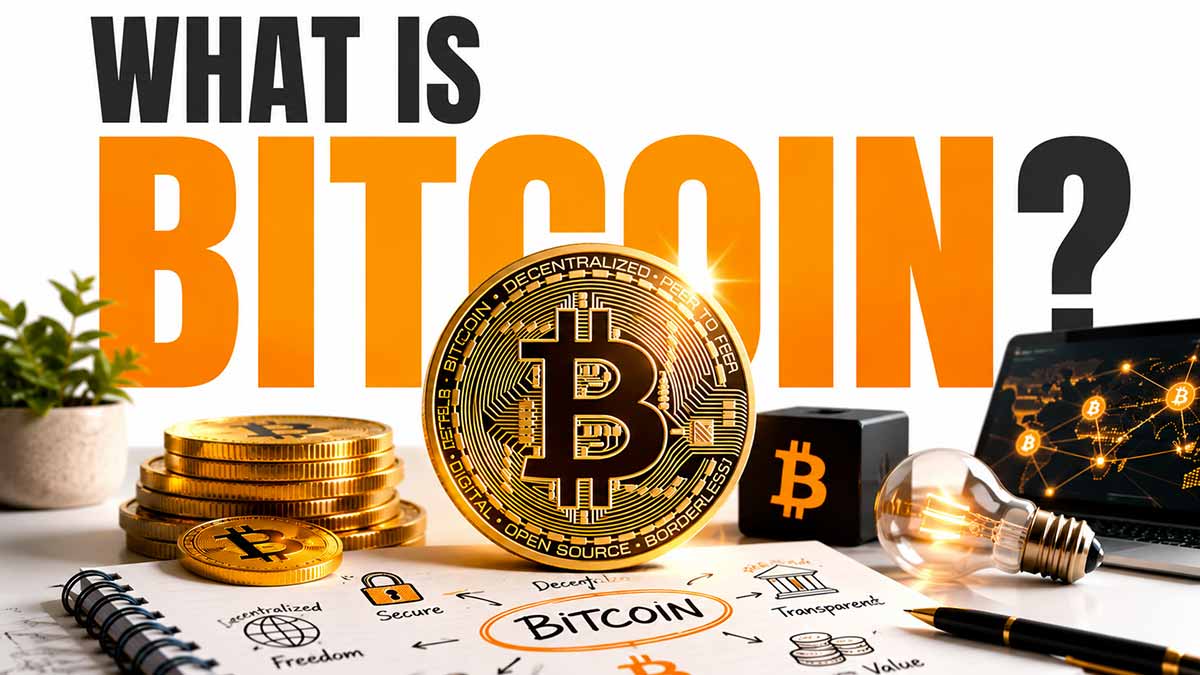
You've probably heard about Bitcoin. Its price makes headlines, states use it as a strategic reserve, companies put it on their balance sheets. Yet Bitcoin remains widely misunderstood. It's not a stock, not an online bank account, not a passing speculative fad.
Bitcoin is first and foremost a monetary protocol, comparable in ambition to the move from paper mail to email. Here's what you need to know to form a precise view, without unnecessary jargon and without hype.
Bitcoin in one sentence
Bitcoin is a global digital currency, whose issuance is capped at 21 million21 millionMaximum number of bitcoins that will ever exist, hard-coded in the protocol. This programmed scarcity is a founding feature. The last sat will be mined around the year 2140.See in the lexicon → units, and whose rules are verified by a network of computers with no central authority.
Four elements to remember in that sentence:
- Digital currency: not a bill, not a coin. A bitcoin only exists as numbers recorded in a shared ledgerLedger, Trezor, Coldcard, BitBoxMain hardware wallet brands. Ledger Nano S Plus / X (French, the best-seller), Trezor Model T (Czech, open source), Coldcard Mk4 (Canadian, ultra-secure, Bitcoin-only), BitBox02 (Swiss, open source).See in the lexicon →, accessible to anyone.
- Global: Bitcoin depends on no country. Whether you're in Geneva, Tokyo, Lagos or Buenos Aires, you access exactly the same network, with the same rules.
- Capped at 21 million: this number has been written in the code since 2008. No one can change it without near-unanimous agreement of the network, which has never happened.
- No central authority: no central bank, no company decides how much to create or who can use the network. The rules are enforced by software run simultaneously by tens of thousands of machines.
Once these four points are in mind, the rest of how Bitcoin works becomes much easier to follow.
Why a currency without banks
Bitcoin wasn't born from a technological whim. The project was published on October 31, 2008, during the global banking collapse. Its author, a pseudonym named Satoshi NakamotoSatoshi NakamotoPseudonym of the creator (or collective) behind Bitcoin. Active on forums from 2008 to 2011, then vanished without revealing any identity. Holds roughly 1.1 million BTC that have never moved.See in the lexicon →, offered a precise answer to a historical problem: since 1971 and the end of the dollar's convertibility into gold, all major currencies have been promises issued by states, without tangible backing. Their quantity can be adjusted by political decision.
The idea behind Bitcoin is to propose an alternative: a currency whose rules are written in public code, identical for everyone, and enforceable without a trusted intermediary. You don't need to trust a bank, a state or a company. You trust mathematics that anyone can verifyDon't trust, verifyBitcoiner mantra. Trust no one (bank, government, exchange, influencer), verify on your own through your own node.See in the lexicon →.
This stance explains many of the protocol's technical choices: the hard cap at 21 million21 millionMaximum number of bitcoins that will ever exist, hard-coded in the protocol. This programmed scarcity is a founding feature. The last sat will be mined around the year 2140.See in the lexicon →, the extreme decentralisation of the network, the transparency of the ledgerLedger, Trezor, Coldcard, BitBoxMain hardware wallet brands. Ledger Nano S Plus / X (French, the best-seller), Trezor Model T (Czech, open source), Coldcard Mk4 (Canadian, ultra-secure, Bitcoin-only), BitBox02 (Swiss, open source).See in the lexicon →. Bitcoin isn't meant to replace the euro or the franc tomorrow morning. It offers a parallel system, neutral by design, for those who need it or who simply want the guarantee.
How it actually works
Imagine a great ledgerLedger, Trezor, Coldcard, BitBoxMain hardware wallet brands. Ledger Nano S Plus / X (French, the best-seller), Trezor Model T (Czech, open source), Coldcard Mk4 (Canadian, ultra-secure, Bitcoin-only), BitBox02 (Swiss, open source).See in the lexicon →, readable by anyone, in which every Bitcoin transaction in the world is written in real time. This ledger is called the blockchainBlockchainA public, shared ledger that records every Bitcoin transaction in blocks linked together cryptographically. Each participant in the network keeps a copy.See in the lexicon →.
About every ten minutes, a new block of transactions is added to the ledger. Once written, the block is cryptographically sealed: impossible to modify without redoing all the computational work, which would require more computing power than the entire planet combined. This is called immutability.
To send bitcoins, you sign a transaction with a private cryptographic key, which you keep secret. The network verifies in seconds that the signature is valid and that the bitcoins being sent actually exist. Once included in a block, the transfer is considered confirmed. After six blocks (about an hour), it is practically irreversible.
Three properties follow:
- Transparency: every transaction since January 2009 remains viewable, up to today.
- Pseudonymity: transactions are linked to addresses, not directly to civil identities.
- Finality: a confirmed payment cannot be reversed by any authority, nor charged back like a bank transfer.
The programmed scarcity of 21 million
The 21 million21 millionMaximum number of bitcoins that will ever exist, hard-coded in the protocol. This programmed scarcity is a founding feature. The last sat will be mined around the year 2140.See in the lexicon → figure is not symbolic. It follows from an issuance schedule strictly programmed in the code, which halves the amount of new bitcoins created every four years or so.
| Period | Block reward | Event |
|---|---|---|
| 2009-2012 | 50 BTC | launch |
| 2012-2016 | 25 BTC | first halvingHalvingScheduled event every 210,000 blocks (roughly every 4 years) that cuts the miner reward in half. This mechanism makes Bitcoin issuance decline towards the total cap of 21 million.See in the lexicon → |
| 2016-2020 | 12.5 BTC | second halving |
| 2020-2024 | 6.25 BTC | third halving |
| 2024-2028 | 3.125 BTC | fourth halving (current) |
| 2028-2032 | 1.5625 BTC | fifth halving scheduled |
| ... until around 2140 | tending to 0 | end of issuance |
In May 2026, about 19.7 million bitcoins have been issued. Less than 1.3 million remain to be issued, spread over more than a century. This programmed scarcity is one of the main reasons for the "digital gold" nickname.
Important: this figure is not a discretionary decision, it's a rule of the protocol. Changing it would require near-unanimous agreement from network participants, which realistically will never happen. Every bitcoin holder has a financial incentive to reject any proposal that would expand supply, since it would dilute their own holdings.
The network actors
Bitcoin has no CEO, no board, no headquarters. Yet it's been running without interruption since January 3, 2009. Four categories of actors interact constantly:
Users send and receive bitcoins through software called wallets. They can be individuals or institutions. In 2026, active users worldwide are estimated at 250 to 300 million.
Full nodes store a complete copy of the blockchainBlockchainA public, shared ledger that records every Bitcoin transaction in blocks linked together cryptographically. Each participant in the network keeps a copy.See in the lexicon → and verifyDon't trust, verifyBitcoiner mantra. Trust no one (bank, government, exchange, influencer), verify on your own through your own node.See in the lexicon → every transaction. More than 17,000 public nodes are active worldwide, plus tens of thousands of private nodes. A Raspberry PiRaspberry PiSmall credit-card-sized computer at a low price (60 to 100 EUR). Lets you run a Bitcoin node at home.See in the lexicon → costing 80 francs is enough to run one, and it's the ultimate sovereignty guarantee for one's bitcoins: you trust no one but yourself.
Miners provide the computing power that seals the blocks. They're paid in new bitcoins (the subsidy) and in fees from the transactions they include. The global hashrateHashrateTotal computing power deployed by miners, measured in hashes per second (EH/s, exahashes). The higher the hashrate, the more expensive the network is to attack.See in the lexicon → exceeds 700 exahashes per second in 2026, placing the Bitcoin network among the most powerful computing infrastructures in the world.
Developers maintain the reference software (Bitcoin CoreBitcoin CoreReference implementation of the Bitcoin software, written in C++ and maintained by an open-source community. This is the software that most nodes run.See in the lexicon →) and propose improvements. But no developer can impose a change: they must convince an overwhelming majority of nodes and users to adopt it. Several independent implementations coexist (Bitcoin Core, Bitcoin Knots, btcd, libbitcoin).
This spread of power is the main safeguard against unilateral rule changes. No one can, alone or in a small committee, modify the 21 million21 millionMaximum number of bitcoins that will ever exist, hard-coded in the protocol. This programmed scarcity is a founding feature. The last sat will be mined around the year 2140.See in the lexicon → cap, censor a valid transaction, or freeze holdings.
What Bitcoin is not
Many misconceptions persist. A few useful clarifications before going further:
- Bitcoin is not a stock. You're not buying a share of a company. You're buying a unit of a monetary protocol. There's no dividend, no annual report, no shareholder meeting. The value of one bitcoin doesn't depend on corporate earnings, but on market supply and demand.
- Bitcoin is not anonymous. All transactions are public. If an address is linked to your civil identity (a purchase on a regulated platform, for example), your history becomes traceable. It's pseudonymous, not anonymous. For those who want more privacy, dedicated techniques exist, but they require conscious effort.
- Bitcoin is not free. Every transaction pays a fee, which varies with network congestion. In 2026, a standard transaction typically costs between a few cents and a few francs. Fees do not depend on the amount sent: sending 10 francs costs the same as sending 10 million.
- Bitcoin is not instant on its base layer. A confirmation takes about ten minutes on average, and six confirmations are advised for large amounts. For everyday payments, second-layer solutions like the Lightning NetworkLightning NetworkSecond-layer payment network on top of Bitcoin. Enables near-instant and near-free payments through channels opened between users.See in the lexicon → enable instant settlement.
- Bitcoin is not the same as blockchainBlockchainA public, shared ledger that records every Bitcoin transaction in blocks linked together cryptographically. Each participant in the network keeps a copy.See in the lexicon → in general. The word blockchain has become a marketing catch-all. Bitcoin is a specific protocol with specific choices: proof of workProof of Work (PoW)Bitcoin's consensus mechanism: miners spend energy to find a valid hash, which makes falsifying the history economically prohibitive. This work is what secures the blockchain.See in the lexicon →, 21 million21 millionMaximum number of bitcoins that will ever exist, hard-coded in the protocol. This programmed scarcity is a founding feature. The last sat will be mined around the year 2140.See in the lexicon → cap, decentralised governance. These choices set it radically apart from other networks that borrow the word blockchain.
Disclaimer
Educational and informational content only: not investment, tax or legal advice. Bitcoin carries significant risks, including high volatility and the possible loss of invested capital. Each reader remains responsible for their decisions; when in doubt, consult a qualified professional in your jurisdiction.
Going further
Once these foundations are in place, the logical topics to explore next:
- Understand Bitcoin
- How Bitcoin works: the technical detail of the protocol.
- The Bitcoin halving: focus on the scarcity mechanism.
- Bitcoin vs fiat money: structured comparison with the euro, dollar and franc.
- Bitcoin in numbers: a current snapshot of the network.
- Bitcoin misconceptions: debunking the most stubborn myths.