
Bitcoin wasn't born from a sudden revelation in 2008. It's the culmination of forty years of work in cryptography, monetary theory and distributed computing, condensed into a nine-page white paper published anonymously a few weeks after the Lehman Brothers collapse.
Seventeen years later, Bitcoin has become a strategic reserve for the United States, a balance sheet line for hundreds of listed companies, an asset accessible through spot ETFs of the world's largest banks. Here's the chronological story of that trajectory, in six broad periods.
The precursors (1980-2007)
Bitcoin has very concrete ancestors. In the 1980s, US cryptographer David Chaum theorised anonymous electronic cash and founded DigiCash, which offered eCasheCash (Cashu, Fedimint)Bearer tokens backed by Bitcoin, issued by a mint (Cashu) or a federation (Fedimint). Maximum privacy, but trust in the issuer; a complement to Lightning.See in the lexicon →. It's one of the first real digital payment systems, but it remained centralised and went bankrupt in 1998.
In 1992, around Tim May, Eric Hughes and John Gilmore, the cypherpunkCypherpunkMovement born in the 1980s-90s advocating privacy protection through cryptography. Bitcoin is its direct heir: Satoshi announced the project on a mailing list descended from this movement.See in the lexicon → movement emerged on a mailing list of the same name. Common belief: cryptography is a political lever to preserve privacy in the digital age. Eric Hughes published the Cypherpunk Manifesto in 1993.
Several technical building blocks appeared in that decade:
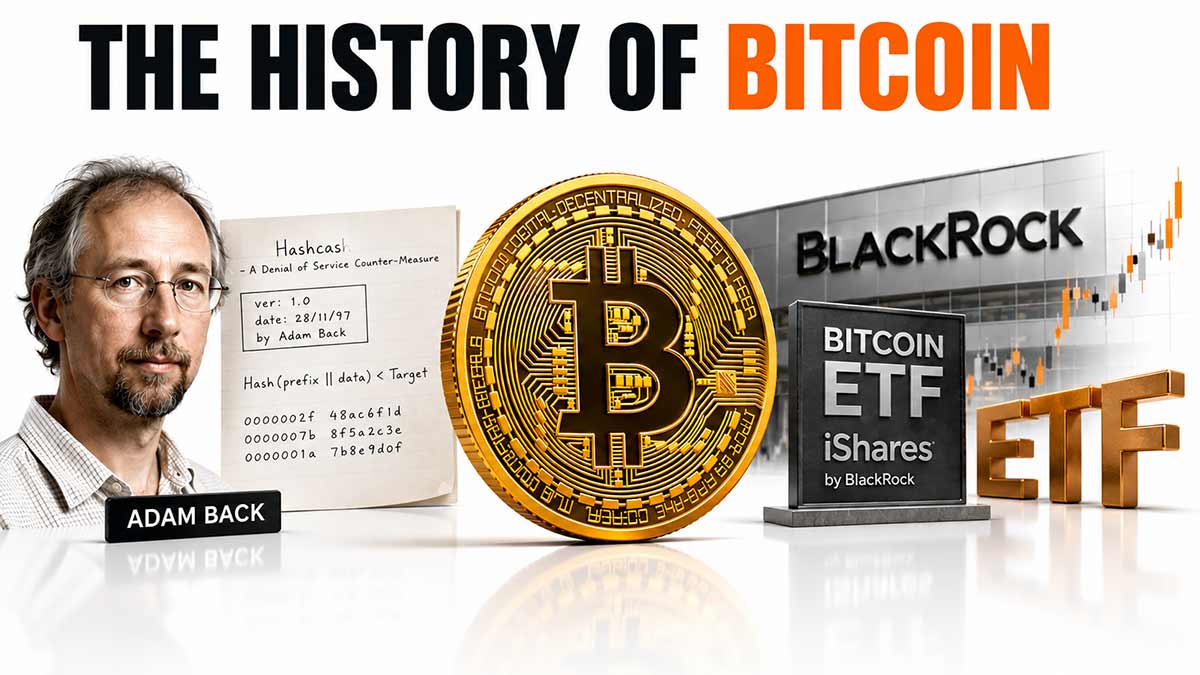
- 1997 - Hashcash by Adam Back: a proof-of-work scheme to limit email spam. A brick directly reused by Bitcoin.
- 1998 - b-money by Wei Dai: a proposal for a distributed digital cash system, never implemented.
- 1998 - Bit Gold by Nick Szabo: a digital money project based on proof of workProof of Work (PoW)Bitcoin's consensus mechanism: miners spend energy to find a valid hash, which makes falsifying the history economically prohibitive. This work is what secures the blockchain.See in the lexicon →. Conceptually very close to Bitcoin.
- 2004 - RPOW by Hal Finney: reusable proof of work, a technical prototype.
All these projects failed on the same obstacle: double spending. How do you stop a digital unit from being copied and spent twice, without resorting to a central authority? This problem, formalised as the Byzantine generals problem by Leslie Lamport in 1982, would remain open for 26 years.
The genesis (2008-2010)
On October 31, 2008, in the middle of the global financial crisis, a message landed on a cryptography mailing list. Signed by an unknown pseudonym, Satoshi NakamotoSatoshi NakamotoPseudonym of the creator (or collective) behind Bitcoin. Active on forums from 2008 to 2011, then vanished without revealing any identity. Holds roughly 1.1 million BTC that have never moved.See in the lexicon →, it announced a nine-page paper: "Bitcoin: A Peer-to-Peer Electronic Cash System". The white paper finally solved the Byzantine generals problem through an original combination of proof of workProof of Work (PoW)Bitcoin's consensus mechanism: miners spend energy to find a valid hash, which makes falsifying the history economically prohibitive. This work is what secures the blockchain.See in the lexicon →, chain of blocks and economic incentives.
On January 3, 2009, SatoshiSatoshi (sat)The smallest unit of bitcoin. 1 BTC = 100 million satoshis. Named after the creator. In 2026, talking in sats becomes common as the price of one BTC rises.See in the lexicon → mined the very first block, the genesis blockGenesis blockThe very first block mined on the Bitcoin chain, on 3 January 2009. Contains a famous message from Satoshi : « The Times 03/Jan/2009 Chancellor on brink of second bailout for banks ».See in the lexicon → (number 0). They embedded a symbolic message taken from the front page of The Times in London: "The Times 03/Jan/2009 Chancellor on brink of second bailout for banks". A political signature aimed at the banking system in crisis.
On January 12, 2009, Satoshi sent 10 BTC to Hal Finney: the first transaction in history. On May 22, 2010, Laszlo Hanyecz paid for two pizzas in Jacksonville for 10,000 BTC: the famous Bitcoin Pizza DayBitcoin Pizza Day22 May. Anniversary of the first documented commercial transaction : Laszlo Hanyecz paid 10,000 BTC for 2 pizzas on 22 May 2010.See in the lexicon →, the first physical purchase with bitcoin. At the time, those 10,000 BTC were worth about 41 dollars. At the 2024 peak, they would exceed one billion.
In December 2010, Satoshi posted their last public message, handed the keys to the software repository to Gavin Andresen, and disappeared. No formal proof has ever identified them. They are credited with about 1 million BTC, never moved since. This organised retreat is one of the founding acts of Bitcoin's decentralised credibility.
Childhood and trials (2011-2014)
From 2011 to 2014, Bitcoin grew in the shadows then under the spotlights. Mt. GoxMt. GoxFormer Japanese exchange that lost 850,000 BTC in 2014. Textbook case of custodial risk. Partial creditor compensation has been under way since 2024.See in the lexicon →, an exchangeExchangeService that lets you buy, sell and swap cryptocurrencies against fiat money. Examples : Kraken, Coinbase, Bitstamp, Bitvavo. Most are custodial.See in the lexicon → based in Tokyo, became within months the mandatory gateway to buy and sell bitcoins. In February 2011, BTC reached parity with the dollar for the first time.
The shadows came too: Silk Road, an online black market accessible through Tor, accepted bitcoin exclusively and gave the currency a sulfurous reputation. The FBI shut Silk Road and arrested its founder Ross Ulbricht in October 2013. The 144,000 BTC seized then would later be auctioned by the US government, and partly seeded the strategic reserve announced in 2025.
March 2013: the Cyprus crisis and the partial confiscation of bank deposits in Cyprus pushed BTC above 260 dollars for the first time. The general public began to talk about Bitcoin.
December 2013: first real bull cycle, BTC topped 1,150 dollars. A long bear marketBear market, bull marketProlonged falling market (bear) or rising market (bull). Bitcoin cycles have historically alternated between the two around halvings, with 70 to 85 percent drops in bear markets.See in the lexicon → followed. In February 2014, Mt. Gox filed for bankruptcy after the theft (or accounting disappearance) of 850,000 BTC. The episode remains one of the largest hacks in crypto history and illustrates the fragility of centralised platforms. Lesson learned: not your keysNot your keys, not your coinsMantra. If you do not hold the private keys to your bitcoins, you do not truly own them. Echoes of FTX, Mt. Gox, Celsius, and others.See in the lexicon →, not your coinsNot your keys, not your coinsMantra. If you do not hold the private keys to your bitcoins, you do not truly own them. Echoes of FTX, Mt. Gox, Celsius, and others.See in the lexicon →.
Adolescence and scaling battles (2015-2018)
2015 saw the birth of Ethereum, the first network to introduce smart contracts at scale. Bitcoin remained the market cap leader, but now had to coexist with a broader ecosystem of digital assets.
2016-2017: the block size debate deeply divided the community. One faction wanted to raise block size to 8 then 32 MB (faster chain but heavier nodes). The other wanted to activate SegWitSegWit (Segregated Witness)Upgrade activated in 2017 that separates signature data from the rest of the transaction. Lowered fees and paved the way for Lightning Network.See in the lexicon → (Segregated Witness), a more conservative software optimisation. The SegWit compromise won in August 2017. The big-block faction forked and created Bitcoin Cash (BCH).
December 2017: Bitcoin reached nearly 19,800 dollars, an all-time high. The first Bitcoin futuresFutures (futures contracts)Standardised contracts to buy or sell BTC at a future date. Basis of the first ETFs (2021); contango (futures price above spot) erodes their performance compared with spot ETFs.See in the lexicon → contracts launched on the CME (Chicago Mercantile ExchangeExchangeService that lets you buy, sell and swap cryptocurrencies against fiat money. Examples : Kraken, Coinbase, Bitstamp, Bitvavo. Most are custodial.See in the lexicon →), the first major recognition by traditional finance.
2018: brutal bear marketBear market, bull marketProlonged falling market (bear) or rising market (bull). Bitcoin cycles have historically alternated between the two around halvings, with 70 to 85 percent drops in bear markets.See in the lexicon →, BTC lost 84% from its peak. The ecosystem came out cleaner. Several technical advances materialised: Lightning NetworkLightning NetworkSecond-layer payment network on top of Bitcoin. Enables near-instant and near-free payments through channels opened between users.See in the lexicon → (near-instant layer-2 payments), hardware wallets (LedgerLedger, Trezor, Coldcard, BitBoxMain hardware wallet brands. Ledger Nano S Plus / X (French, the best-seller), Trezor Model T (Czech, open source), Coldcard Mk4 (Canadian, ultra-secure, Bitcoin-only), BitBox02 (Swiss, open source).See in the lexicon →, TrezorLedger, Trezor, Coldcard, BitBoxMain hardware wallet brands. Ledger Nano S Plus / X (French, the best-seller), Trezor Model T (Czech, open source), Coldcard Mk4 (Canadian, ultra-secure, Bitcoin-only), BitBox02 (Swiss, open source).See in the lexicon →) became widespread, the first futures-based Bitcoin ETFs launched in Canada in 2021.
Institutionalisation (2019-2023)
The 2019-2023 period tipped Bitcoin into the financial mainstream. The COVID-19 pandemic and the money-creation waves that followed reinforced the case for Bitcoin as an inflation hedge.
August 2020: MicroStrategyMicroStrategy (Strategy)US company led by Michael Saylor, which has made bitcoin its main treasury asset since 2020. More than 400,000 BTC accumulated by 2025.See in the lexicon →, driven by its CEO Michael Saylor, became the first large listed company to convert a meaningful share of its treasury into bitcoin. Over the following years it accumulated more than 600,000 BTC.
February 2021: Tesla announced a 1.5 billion USD bitcoin investment. BTC crossed 64,000 dollars in April. Square (Block) and several hedge funds followed.
June 2021: El SalvadorEl SalvadorFirst country to adopt Bitcoin as legal tender, in September 2021 under Nayib Bukele. Its status was amended in 2025 under IMF pressure.See in the lexicon → adopted bitcoin as legal tender, a world first. The country gradually accumulated more than 6,000 BTC in reserve.
November 2021: new high at about 69,000 dollars.
2022-2023: cascading collapses in riskier crypto-finance (Terra/Luna in May 2022, Celsius, Three Arrows Capital, FTXFTXCentralised exchange that collapsed spectacularly in November 2022. Sam Bankman-Fried was convicted. Dragged Blockfolio and many funds down with it.See in the lexicon → in November 2022). Bitcoin held up better than average but suffered a 77% drawdownDrawdownDecline from a previous peak. Bitcoin has gone through several drawdowns of more than 75 percent in its history. To factor into your psychological planning.See in the lexicon →. On the positive side, the TaprootTaprootMajor Bitcoin upgrade activated in November 2021 (BIP 341). Brings more privacy, scripting flexibility and the efficiency of Schnorr signatures.See in the lexicon → upgrade (November 2021) improved privacy and smart contract flexibility on Bitcoin. The MiCAMiCA (Markets in Crypto-Assets)European regulation 2023/1114 that frames crypto services across the EU since 2024. Creates the CASP status.See in the lexicon → regulation was adopted by the European Union in 2023, creating the first harmonised crypto framework in Europe.
The ETF and state era (2024-2026)
January 10, 2024 marked a turning point: the US SEC approved the first spot Bitcoin ETFs. BlackRockBlackRockWorld's largest asset manager. Launched its Bitcoin spot ETF IBIT in January 2024, which accumulated more than 500,000 BTC in 2 years.See in the lexicon → (IBIT), Fidelity (FBTC), Ark (ARKB), Bitwise and several others launched their products the next day. Within months, they gathered tens of billions of dollars in inflows. Bitcoin officially entered standard portfolios.
April 2024: fourth halvingHalvingScheduled event every 210,000 blocks (roughly every 4 years) that cuts the miner reward in half. This mechanism makes Bitcoin issuance decline towards the total cap of 21 million.See in the lexicon →. Block reward cut in half, from 6.25 to 3.125 BTC.
November 2024: US presidential election won by an openly pro-Bitcoin candidate. BTC crossed 100,000 dollars in December, topping 108,000 dollars at year-end. Market cap reached 2 trillion USD for the first time.
March 2025: US executive order establishing a strategic bitcoin reserveStrategic Bitcoin Reserve (SBR)United States strategic Bitcoin reserve created by executive order of Donald Trump in March 2025. Built from seized bitcoins.See in the lexicon →, built from judicial seizures (estimated at about 200,000 BTC). An unprecedented move at the scale of a sovereign state of that size. Several US states (Texas, Pennsylvania, Arkansas) announced similar projects.
| Date | Event |
|---|---|
| Jan 10, 2024 | SEC approves first US spot Bitcoin ETFs |
| Apr 19, 2024 | Fourth halving (reward 6.25 -> 3.125 BTC) |
| Nov 2024 | Pro-crypto US election, BTC crosses 100,000 USD |
| Dec 2024 | Interim peak ~108,000 USD, market cap > 2T USD |
| Mar 2025 | US strategic reserve executive order (~200,000 seized BTC) |
| 2025-2026 | Swiss banks (UBS, ZKB, Sygnum) and US (JPM, MS, GS) open BTC access to wealthy clients |
| May 2026 | ~20.03 million BTC issued (95.4% of cap), ~700 EH/s |
This period completed the anchoring of Bitcoin in the global financial landscape. It's no longer a niche asset, nor an experiment. It's now a reserve asset, studied by central banks, integrated into institutional portfolios and accessible to retail investors with one click through their bank or brokerBrokerIntermediary that sells bitcoins to an end customer at a fixed price, with no visible order book. Coinhouse, Bull Bitcoin and Pocket Bitcoin are brokers.See in the lexicon →.
Disclaimer
Educational and informational content only: not investment, tax or legal advice. Bitcoin carries significant risks, including high volatility and the possible loss of invested capital. Each reader remains responsible for their decisions; when in doubt, consult a qualified professional in your jurisdiction.
Going further
To extend the historical narrative:
- Understand Bitcoin
- What is Bitcoin?: the basic definition.
- How Bitcoin works: the technical detail.
- The Bitcoin halving: the driver of the issuance schedule, a central milestone in the history.
- Bitcoin in numbers: the current numeric snapshot.
- Bitcoin misconceptions: useful to answer classic objections based on misunderstood historical episodes.