
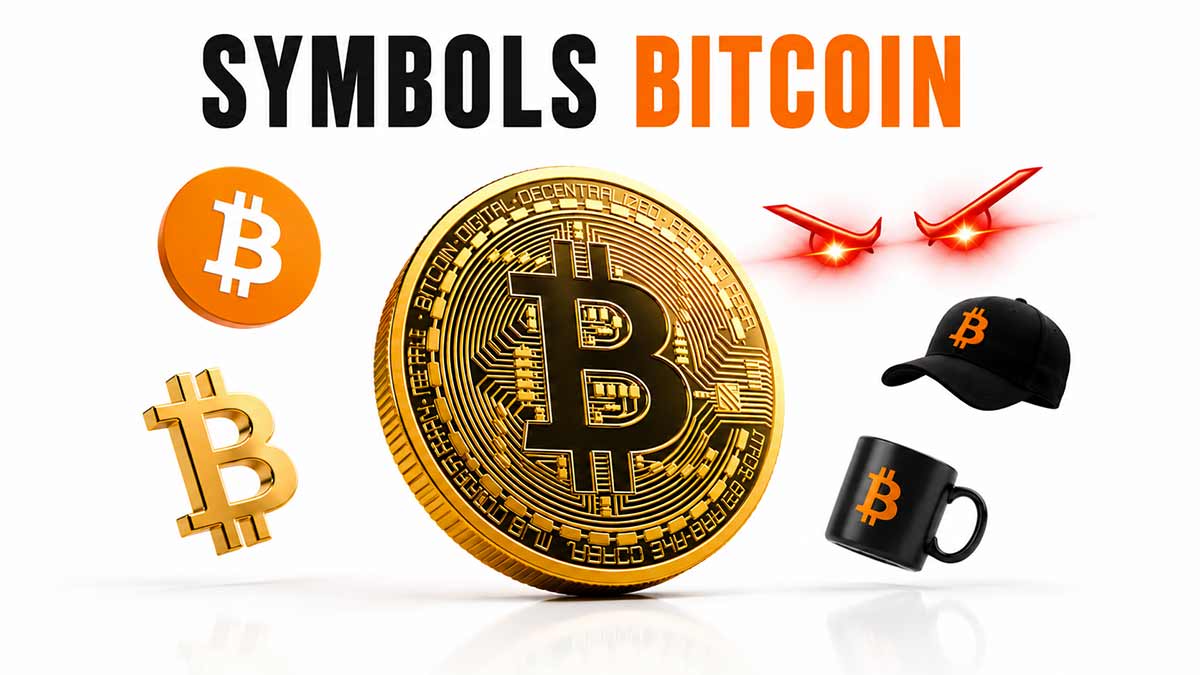
Bitcoin has few symbols, but those symbols have become universally recognisable. The ₿ glyph encoded in Unicode U+20BF since 2017. The orange #F7931A taken from the original Bitcoin logo. The word satoshiSatoshi (sat)The smallest unit of bitcoin. 1 BTC = 100 million satoshis. Named after the creator. In 2026, talking in sats becomes common as the price of one BTC rises.See in the lexicon → for the smallest unit. The 21 million21 millionMaximum number of bitcoins that will ever exist, hard-coded in the protocol. This programmed scarcity is a founding feature. The last sat will be mined around the year 2140.See in the lexicon → counter on ATMs. The mempool.spacemempool.spaceReference open-source Bitcoin explorer in 2026. Visualisation of blocks, fees and the mempool. Launched by Wiz and the mempool.space team.See in the lexicon → map coloured by fee. The 2021 Twitter laser eyesLaser eyes2021 Twitter trend where bitcoiners added laser eyes to their profile picture to signal their conviction that BTC would reach 100,000 USD.See in the lexicon →. Together they form a visual and lexical kit the community shares without central coordination.
This aesthetic is more minimalist than rival cryptos (multiple logos, gradients, animations). The minimalism is almost ideological : everything is reduced to simple, robust, easy-to-reproduce markers (a barred B on a sign, an orange neon, a laser-eyes sticker). Bitcoin culture signals itself by subtraction rather than accumulation.
This article retraces the history of the ₿ glyph (from the forum to Unicode 10.0), addresses the orange #F7931A colour code and its origin, exposes the lexical units (satoshi, sat, msat on Lightning), comments on the semiotics of 21 million and the 21M clock counter, examines the mempool.space map as a cultural tool, and discusses the 2021 laser eyes and their second life in 2025 around the spot ETFs.
The ₿ glyph, from forum to Unicode
The ₿ character is an uppercase Latin B crossed by two short vertical bars above and below, slightly extending past the letter. The design derives from the Thai baht symbol (฿), which uses a Latin B with a single vertical bar, but Bitcoin deliberately doubled the bar to differentiate the two currencies. The design's authorship goes back to SatoshiSatoshi (sat)The smallest unit of bitcoin. 1 BTC = 100 million satoshis. Named after the creator. In 2026, talking in sats becomes common as the price of one BTC rises.See in the lexicon → himself : in November 2010, he posts on Bitcointalk an .ico file with the logo, which will be picked up as a base by community designers (notably Bitboy in 2011 for the vector version).
The glyph long suffered from a technical problem : it did not exist in Unicode, forcing the use of images or custom fonts. This absence made ₿ a pariah character on the web, poorly rendered, impossible to copy-paste. On 23 June 2017, Unicode 10.0 officially adds the character under code point U+20BF, in the « Currency Symbols » block. The formal proposal had been filed in October 2015 by Ken Shirriff (author of several Bitcoin technical analyses), with a 25-page dossier documenting the symbol's use.
Since 2017, ₿ is rendered natively by most modern fonts (San Francisco on macOS and iOS from macOS 11 onwards, Segoe UI on Windows since Windows 10 build 17134 from April 2018, Noto Sans, DejaVu, Roboto). A few old fonts do not render it correctly and display an empty box, but those cases shrink as old systems get updated. For Lena, the character's native availability simplified her work : she uses ₿ directly in Figma without going through a separate SVG file.
The community typographic usage rule is clear. ₿ goes before the value, like the continental European euro (₿0.4 and not 0.4₿). In English the usage is the same (₿0.4). For sats amounts, the « sats » abbreviation goes after the value (250,000 sats). ₿ is not used for satoshi amounts, only for whole or decimal BTC. This typographic discipline distinguishes content taken seriously from content written by outsiders.
The #F7931A orange, unofficial colour code
Bitcoin orange has a precise hexadecimal value : #F7931A. In RGB, that is 247, 147, 26. In CMYK, that is roughly 0, 50, 92, 0. This colour code is officially validated by no authority (there is no Bitcoin foundation equivalent to the Ethereum foundation), but it has imposed itself by usage from 2010 on, and the whole community uses it as reference since. The code emerges from the original logo posted on Bitcointalk in February 2010 by a user known under the bitboy handle, who chose this hue because it evoked gold without imitating it directly.
Three readings coexist on the meaning of this orange. The first is metallurgic : it is the orange of melting metal, recalling gold and copper. Bitcoin positions itself as a digital metallic asset, conceptual heir to gold, and the colour supports this filiation. The second is solar : the orange of sunrise over desert horizons (like El SalvadorEl SalvadorFirst country to adopt Bitcoin as legal tender, in September 2021 under Nayib Bukele. Its status was amended in 2025 under IMF pressure.See in the lexicon →'s flag). The third, later, plays on complementarity with the institutional blue of traditional banks : Bitcoin orange against Bank of America blue, even against the euro blue of the ECB. This chromatic opposition became deliberate in post-2017 visuals.
The community typographic usage sets a few rules. Orange #F7931A is reserved for accent or signature elements (the ₿, calls to action, progress bars). For extended backgrounds, neutral tones are preferred (deep black #0F0F0F, off-white #FAFAFA, dark grey #1A1A1A) that set the orange off. Combining Bitcoin orange with purple or turquoise is considered a broad crypto signal, hence to avoid if you want to mark a maximalistMaximalistBitcoiner who considers that Bitcoin alone is legitimate among cryptos, and that the others (Ethereum, Solana, and so on) are distractions or scams.See in the lexicon → Bitcoin identity.
Lena uses this palette in all her posters. Deep black background, ₿ glyph in orange #F7931A, secondary text in white, practical info in light grey. The chromatic discipline is strict : no yellow (which suggests Binance), no blue (which suggests Coinbase), no purple (which suggests Ethereum). This deliberate restriction forces creativity in composition and gives coherence to all her output.
The satoshi, smallest Bitcoin unit
One bitcoin is divisible into 100 million satoshis, or « sats » in common usage. This divisibility is not a technical detail : it is inscribed in the protocol from the start, in SatoshiSatoshi (sat)The smallest unit of bitcoin. 1 BTC = 100 million satoshis. Named after the creator. In 2026, talking in sats becomes common as the price of one BTC rises.See in the lexicon →'s January 2009 code. The name « satoshi » as a unit was proposed in November 2010 on Bitcointalk by user ribuck, and adopted by community consensus within a few months. The Bitcoin CoreBitcoin CoreReference implementation of the Bitcoin software, written in C++ and maintained by an open-source community. This is the software that most nodes run.See in the lexicon → source code officially integrated the denomination in 2011.
The abbreviation « sat » is used in the singular (1 sat), « sats » in the plural (250,000 sats). In 2026, a sat is worth roughly 0.00095 EUR at average rate, less than a hundredth of a cent. This granularity allows handling very small amounts on Lightning NetworkLightning NetworkSecond-layer payment network on top of Bitcoin. Enables near-instant and near-free payments through channels opened between users.See in the lexicon →, where typical payments are made in a few thousand sats (for example 1,200 sats for a pizza at the Room 77 pizzaiolo, about 1.15 EUR).
The satoshi's importance as a unit has grown since 2017, when Bitcoin's price crossed the psychological threshold beyond which thinking in whole BTC became uncomfortable. A community campaign named « stack satsStack satsAccumulating satoshis over time. A classic HODL mantra.See in the lexicon → » developed from 2018 : the idea is to think in monthly accumulated satoshis rather than in decimal fraction of BTC. For Lena, who holds 0.4 BTC in May 2026, this comes to 40 million sats. The phrasing changes the psychological experience : 40 million sounds more solid than 0.4.
The typographic usage of sat is more flexible than that of ₿. It is written in lowercase letters, without a dedicated symbol, after the value (250,000 sats and not sats 250,000). A few attempts at a specific glyph for sat have emerged (barred S, barred exclamation mark), but none has imposed itself. The word « sats » alone suffices. This absence of a symbol paradoxically reinforces the authority of ₿ as the unique official visual sign of Bitcoin.
The 21 million clock
The ceiling of 21 million21 millionMaximum number of bitcoins that will ever exist, hard-coded in the protocol. This programmed scarcity is a founding feature. The last sat will be mined around the year 2140.See in the lexicon → bitcoins is engraved in the protocol since 2009. This limit is obtained by a simple mechanic : a new emission per block (the coinbase reward) that halves every 210,000 blocks (about four years), starting from 50 BTC in 2009, dropping to 25 in 2012, 12.5 in 2016, 6.25 in 2020, 3.125 in April 2024. The geometric sum converges towards 21 million, theoretically reached around 2140. In May 2026, about 19.8 million BTC are already mined, that is 94 percent of the total.
The 21 million clock is the visual representation of this countdown. In its most common version, it displays in real time : number of blocks mined, number of BTC in circulation, BTC left to mine, estimated date of the next halvingHalvingScheduled event every 210,000 blocks (roughly every 4 years) that cuts the miner reward in half. This mechanism makes Bitcoin issuance decline towards the total cap of 21 million.See in the lexicon →. Several community sites offer this clock live (clark.moe, bitbo.io, blockchainBlockchainA public, shared ledger that records every Bitcoin transaction in blocks linked together cryptographically. Each participant in the network keeps a copy.See in the lexicon →.com), and many Bitcoin dashboards integrate it. Its visual simplicity (two or three numbers updated in real time) makes it instantly recognisable.
The clock has a strong pedagogical role. It makes tangible to newcomers what is otherwise abstract : Bitcoin has a programmed scarcity, verifiable, mathematical, contrasting with fiatFiat (fiat currency)State currency with legal tender status (euro, Swiss franc, dollar), issued by a central bank and not backed by a physical asset. By contrast, Bitcoin has an issuance capped at 21 million units, with no central issuer.See in the lexicon → currencies whose creation can be discretionarily adjusted by central banks. At each halving, the community organises watch parties (BTC PragueBTC PragueBiggest European Bitcoin conference, held every summer in Prague since 2023. A showcase for the ecosystem.See in the lexicon → 2024, Plan B LuganoLugano (Plan ₿)Swiss city that launched a Bitcoin adoption programme in 2022 (tax payments, shops, events). The annual Plan B Forum has become a European fixture.See in the lexicon → 2024) where the large displayed clock serves as signal for the countdown of the last blocks before coinbase reduction. It has become a quadrennial ceremony.
The clock's design varies by implementation. The minimalist Bitbo version displays three lines in monospace typography. The denser mempool.spacemempool.spaceReference open-source Bitcoin explorer in 2026. Visualisation of blocks, fees and the mempool. Launched by Wiz and the mempool.space team.See in the lexicon → version combines the clock, current block height, fee market and hashrateHashrateTotal computing power deployed by miners, measured in hashes per second (EH/s, exahashes). The higher the hashrate, the more expensive the network is to attack.See in the lexicon →. Lena included in her April 2026 poster a stylised version of the 21 million clock, in orange on black background, with only the number of bitcoins left to mine. The visual is instantly recognisable to anyone familiar with the community.
The mempool visualizer
The mempoolMempoolWaiting area where Bitcoin transactions sit before being included in a block. The fuller the mempool, the higher the fees required.See in the lexicon → is the waiting zone where Bitcoin transactions wait before being included in a block. When you send 0.01 BTC to a friend, your transaction enters the mempool until a minerMinerComputer or farm of computers that solves the cryptographic puzzle required to add a new block to the blockchain, in exchange for a bitcoin reward.See in the lexicon → includes it in the next mined block (on average ten minutes, sometimes more if the fees you attached are low). The mempool visualizer makes this waiting zone visually readable, as coloured blocks representing transactions by their fees.
The site mempool.spacemempool.spaceReference open-source Bitcoin explorer in 2026. Visualisation of blocks, fees and the mempool. Launched by Wiz and the mempool.space team.See in the lexicon →, launched in 2019 by Wiz and his team, has become the absolute reference. It offers a real-time visualisation : coloured squares matching pending transactions, size proportional to transaction weight, colour proportional to fee rate in sats per vbyte. Low-fee transactions appear in purple, moderate ones in blue, high ones in yellow and orange, very high ones in red. On the left, the stack of estimated future blocks ; on the right, recent mined blocks with their detailed content.
The mempool visualizer's cultural importance goes beyond the practical tool. It has become a visual signature of technical Bitcoin, and appears in almost every conference presentation, video podcast, in-depth article. For Lightning developers and nodeNodeComputer that runs the Bitcoin software and takes part in the network by validating blocks and transactions. A « full node » keeps a complete copy of the blockchain.See in the lexicon → operators, it is a daily tool. For the broader public, it is a window onto what happens on the blockchainBlockchainA public, shared ledger that records every Bitcoin transaction in blocks linked together cryptographically. Each participant in the network keeps a copy.See in the lexicon → in real time, with a pixelated aesthetic that recalls 1980s arcade video games.
Lena uses stylised mempool screenshots in some of her posters and stickers, notably to flag Lightning workshops at her meetup. The coloured grid of transactions, even very simplified, triggers immediate recognition in the Bitcoin community. She also has a decorative wall hanging at home, printed from a mempool.space screenshot of a halvingHalvingScheduled event every 210,000 blocks (roughly every 4 years) that cuts the miner reward in half. This mechanism makes Bitcoin issuance decline towards the total cap of 21 million.See in the lexicon → day (April 2024), which she considers an unpretentious digital artwork.
Laser eyes, the birth of a political meme
Laser eyesLaser eyes2021 Twitter trend where bitcoiners added laser eyes to their profile picture to signal their conviction that BTC would reach 100,000 USD.See in the lexicon → were born on Twitter in February 2021. The context : Bitcoin had just crossed 30,000 USD for the first time in January, and the community was eyeing the symbolic 100,000 USD level by year-end. A user (Cory Klippsten, later CEO of Swan Bitcoin) suggests Bitcoiners add a red laser eyes effect to their profile pictures, until 100,000 USD is reached. The movement catches on within days. By March 2021, Elon Musk, Michael Saylor, Tom Brady, Mike Novogratz, tens of thousands of anonymous have laser eyes.
The visual effect is codified : two red laser beams shooting from the pupils, as in Cyclops from X-Men or Superman. Several mobile filters offer it in one click (Snapchat, several dedicated apps). The aesthetic is deliberately excessive, almost parodic, and that is precisely what made its success : it is a belonging signal assumed as mildly ridiculous, saying in the background « I know it is exaggerated, and that is precisely the point ».
Politically, laser eyes marked a turning point. Before 2021, Bitcoin iconography stayed sober, technical, almost grey. With laser eyes, the community owns a militant and joyful stance, comparable to traditional political memes (Pepe, Wojak). When Bitcoin reaches 60,000 USD in April 2021 then drops to 30,000 USD over the summer, laser eyes persist despite the fall. When the 100,000 USD threshold is firmly crossed in December 2024, the community keeps laser eyes as a permanent identity trait, not just a price counter.
The current use of laser eyes in 2026 has evolved. Many institutional Bitcoiners (company CEOs, elected officials, journalists) removed them since 2024 for public neutrality reasons. Active communities on Nostr keep them as a technical and cultural identity signal. Lena uses them sporadically, mostly for her meetup evening profile pictures, never for her freelance designer professional profile. This modulation has become typical : laser eyes are an evening costume, not a daily uniform.
Practical resources to use the symbols
For those who want to use Bitcoin symbols properly in their own content, several resources are freely available. The ₿ glyph is inserted directly from the keyboard on all modern systems : on macOS via the character picker (ctrl-cmd-space), on Windows by alt-codes or via the emoji keyboard (Win + .), on Linux through the standard Unicode table. For vector logos, the bitcoin/bitcoin-org GitHubGitHubWeb platform that hosts most of the world's open-source projects, including Bitcoin Core, electrs, BDK and LDK. Lets you read the code, browse change history and submit contributions.See in the lexicon → repository contains the official SVG files of the glyph in several variants (orange only, black glyph, orange circular background).
For the orange #F7931A colour, the exact value is documented in the brand guidelines file of bitcoin.org. No licence is required, the code is free by usage. For complementary nuances (light orange for backgrounds, dark orange for texts), Lena uses a palette generated on Coolors.co from #F7931A, respecting a 15 percent luminosity variation.
For mempoolMempoolWaiting area where Bitcoin transactions sit before being included in a block. The fuller the mempool, the higher the fees required.See in the lexicon → and 21M clock visuals, two options. For personal or meetup use, screenshots from mempool.spacemempool.spaceReference open-source Bitcoin explorer in 2026. Visualisation of blocks, fees and the mempool. Launched by Wiz and the mempool.space team.See in the lexicon → and bitbo.io are allowed without restriction (the sites even encourage this use). For commercial use, it is better to generate your own visuals from the public mempool.space APIAPI (Application Programming Interface)Interface that lets one program query another program or service. mempool.space exposes a public API for querying the chain.See in the lexicon → data (free, no authentication). Laser eyesLaser eyes2021 Twitter trend where bitcoiners added laser eyes to their profile picture to signal their conviction that BTC would reach 100,000 USD.See in the lexicon → are not branded, there are hundreds of free mobile filters, and Photoshop or Affinity Photo lets you make one in five minutes with a red layer in overlay mode.
On the typography side, several fonts have been created specifically for Bitcoin and are available open sourceOpen sourceSoftware whose source code is public and modifiable by anyone. A fundamental auditability guarantee in Bitcoin.See in the lexicon →. Bitcoin Sans (by designer Bitboy) is a sans-serif variant specifically optimised for ₿ rendering. Cousine and Inconsolata, free monospace fonts, render transaction codes and block heights very well. For long text bodies, Lena privileges Inter or Source Sans Pro, two free fonts with excellent ₿ support and European diacritic characters.
Disclaimer
Educational and informational content only: not investment, tax or legal advice. Bitcoin carries significant risks, including high volatility and the possible loss of invested capital. Each reader remains responsible for their decisions; when in doubt, consult a qualified professional in your jurisdiction.
See also
To continue the cultural exploration of Bitcoin :
- Bitcoin culture (guide) : the complete map of symbols, dates, events and communities.
- History of the Bitcoin logo: from the first icons to brand guidelines.
- Bitcoin Pizza Day : the first commercial transaction, 22 May 2010.
- Satoshi Nakamoto, the mystery : the anonymous founding figure of the protocol.
- The history of Bitcoin : 2008-2026, the full protocol context.
And the bridges to the technical notions mentioned :
- Understand Bitcoin : the fundamentals guide, to frame the glyph and the sat.
- The Bitcoin halving : the mechanic behind the 21M clock.
- Buy Bitcoin : to move from theoretical sats to real sats.