
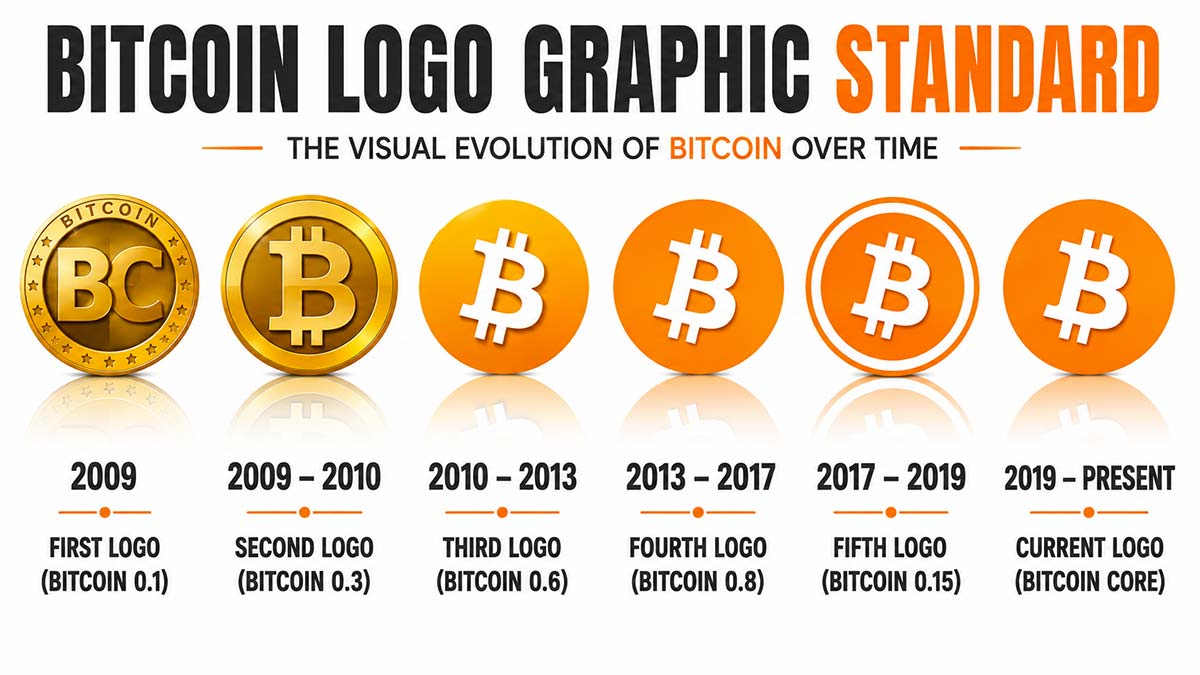
The Bitcoin logo has no official author and no owner. It was built on a forum, over a few months, between the release of the first software in January 2009 and the autumn of 2010. The orange roundel crossed by a tilted B became a global visual landmark, reproduced on ATMs, magazine covers and exchangeExchangeService that lets you buy, sell and swap cryptocurrencies against fiat money. Examples : Kraken, Coinbase, Bitstamp, Bitvavo. Most are custodial.See in the lexicon → screens, while no entity controls it.
This story reads in three moments. First the gold coin bearing the letters BC, present in Satoshi NakamotoSatoshi NakamotoPseudonym of the creator (or collective) behind Bitcoin. Active on forums from 2008 to 2011, then vanished without revealing any identity. Holds roughly 1.1 million BTC that have never moved.See in the lexicon →'s original client. Then the shift to orange #F7931A and to the ₿ glyph, proposed in February 2010 by an anonymous contributor known under the bitboy handle. Finally the gradual standardisation, with usage rules, reference files and the entry of the ₿ character into the Unicode standard in 2017.
This article traces this graphic genealogy and details the rules that frame the logo's use today : the geometry of the B, the exact colour, the clear space, the allowed variants and the royalty-free files where to obtain everything.
The gold BC coin, first logo (2009)
The first Bitcoin software, released by Satoshi NakamotoSatoshi NakamotoPseudonym of the creator (or collective) behind Bitcoin. Active on forums from 2008 to 2011, then vanished without revealing any identity. Holds roughly 1.1 million BTC that have never moved.See in the lexicon → on 9 January 2009, already carried an icon. It depicted a coin seen from the front, gold, slightly tilted, bearing the two letters BC in relief. The choice of the coin was not trivial : it anchored Bitcoin in the imagery of gold and metallic money, while the project had only just produced its genesis blockGenesis blockThe very first block mined on the Bitcoin chain, on 3 January 2009. Contains a famous message from Satoshi : « The Times 03/Jan/2009 Chancellor on brink of second bailout for banks ».See in the lexicon → on 3 January 2009.
This first identity remained rudimentary. The icon mainly dressed the executable and the walletWalletSoftware or device that manages your Bitcoin keys and lets you sign transactions. A wallet does not really « hold » your bitcoins, it holds the keys that prove you own them.See in the lexicon → window under Windows. The word Bitcoin itself was written in a generic font, without particular treatment. Nothing was formalised, not the exact colour, not the proportions, not the usage rules. At this stage the project had a handful of users and the graphic question came far behind the robustness of the protocol.
The letters BC simply abbreviated Bitcoin, without pointing to a recognised monetary symbol. It is precisely this limit that would push the nascent community to look for something better. A currency that wants to be taken seriously needs a short sign, legible at small size, and able to work like the dollar or the euro. The BC coin did not fill that role, and it was replaced as soon as 2010.
2010: the orange and the shift to the B
The turning point happens on the Bitcointalk forum. In February 2010, a user known under the bitboy pseudonym proposes a complete redesign of the logo. The detailed gold coin gives way to a flat orange disc, and the letters BC are replaced by a single B crossed by two vertical bars, in the manner of the dollar or the euro. The contributor publishes several variations and invites the community to use them freely.
The choice of orange is not justified by a specification, but it evokes gold without imitating it directly. The hue, later fixed at #F7931A in hexadecimal, that is 247, 147, 26 in RGB, imposed itself by simple reuse of bitboy's files. Nobody voted on it nor patented it. It became the reference colour because everyone copied the same source, and this transmission by usage explains why it remains stable sixteen years later.
The move from two letters to a single letter marked with two bars is the decisive gesture. It turns a mere acronym into a monetary symbol. The B with its bars reads instantly as a unit of account, on the same visual rank as the major currencies. In the autumn of 2010, bitboy distributes vector versions and an icon file that become the basis of almost all later uses.
The creator stayed anonymous, faithful to the forum culture. He explicitly placed his work in the public domain, without claiming rights. This choice had a lasting consequence : the Bitcoin logo belongs to everyone and to no one, which favoured its spread but also let approximate variants proliferate, against which usage rules eventually formed.
The geometry of the logo and the tilted B
The standard logo is made of two simple elements. A perfectly circular disc in orange #F7931A, and over it a white B in knockout, meaning cut out in the background colour. The B carries two vertical bars that slightly extend at the top and bottom, a signature that distinguishes it from an ordinary letter. This knockout construction guarantees a strong contrast and legibility at very small size, down to the scale of a favicon.
The most characteristic detail is the tilt. The B is not upright : it is rotated by about 14 degrees clockwise. This rotation gives an impression of movement and dynamism, and avoids the static look of an administrative acronym. It has become a marker of authenticity : a logo where the B is perfectly vertical sounds wrong to a trained eye, even if the difference seems minimal at first glance.
The proportions matter as much as the shapes. The B occupies a defined share of the disc, with constant inner margins, so that the whole stays balanced whatever the display size. The vertical bars follow the tilt of the letter, and their overshoot length is calibrated to remain visible without weighing the form down. Redrawing these proportions by hand almost always produces a wobbly result, which is why starting from existing vector files is recommended.
From logo to Unicode character ₿ (U+20BF)
Two objects often confused must be distinguished. The logo is the orange roundel with the knockout B, an image. The ₿ glyph is a typographic character, the monetary sign that fits into a line of text the way the dollar or the euro do. The glyph derives visually from the two-bar B of the logo, but it lives in fonts, not in image files.
For years this character did not exist in the Unicode standard. To display a ₿ in text, you had to insert an image or resort to a custom font, which made the symbol impossible to copy-paste and poorly rendered on the web. The character takes up the logic of the Thai baht ฿, which uses a B with a single vertical bar, but Bitcoin doubled the bar to avoid any confusion between the two currencies.
The formal proposal to add it to Unicode was filed in October 2015 by Ken Shirriff, with a dossier documenting the real use of the symbol. On 20 June 2017, Unicode version 10.0 officially adds the character at code point U+20BF, in the currency symbols block. From there, ₿ becomes a standard sign, rendered natively by modern fonts such as San Francisco on Apple devices or Segoe UI on Windows.
On the typography side, the convention places the ₿ before the value, like the continental euro, for example ₿0.5. For very small amounts, one speaks in satoshis, abbreviated sats, placed after the number. The logo and the glyph thus complement each other : the first serves as a brand emblem on visuals and products, the second serves as a unit in sentences and tables. Confusing the two uses is a frequent mistake among newcomers.
The brand usage rules
Bitcoin has no owner, hence no charter imposed by an authority. But shared conventions have formed, documented notably by the bitcoin.design collective and by the resource pages of bitcoin.org. They are not mandatory in the legal sense, they serve as a reference to produce visuals consistent with what the community recognises.
The first rule is the clear space. Around the logo, an empty space proportional to the disc diameter is reserved, so that no text or graphic element touches it. The second rule sets a minimum size below which the B becomes illegible. The third frames the backgrounds : the orange logo works on light as well as dark backgrounds, and monochrome variants exist, in black or white, for cases where orange is not usable, for example an engraving or a one-colour print.
The list of what not to do is just as important. You do not distort the disc into an oval, you do not rotate the roundel, you do not change the orange colour for another hue, you do not add a drop shadow, a gradient or an outline to the B, and you do not replace the two-bar B with an ordinary B. An approximate orange, of the close-but-different from #F7931A kind, is enough to signal an amateur visual to a knowledgeable audience.
For the word itself, the convention writes Bitcoin with a capital B when speaking of the network and the protocol, and bitcoin in lowercase when speaking of the unit of account. This distinction is not universally respected, but it is common in careful writing and is part of the codes that the brand transmits through usage rather than through a regulation.
Reference files and free use
 Download the logo
To use the logo cleanly, it is better to start from reference files rather than redrawing. The bitcoin.design collective provides a brand guide and vector files in SVG format, in several variants : orange disc with white B, orange B alone, black version, white knockout version. Public repositories on GitHubGitHubWeb platform that hosts most of the world's open-source projects, including Bitcoin Core, electrs, BDK and LDK. Lets you read the code, browse change history and submit contributions.See in the lexicon → host the same resources, which lets you fetch a clean SVG rather than a pixelated image grabbed at random on the web.
The colour is provided in its different forms : #F7931A in hexadecimal, 247, 147, 26 in RGB, and a CMYK equivalence for printing. Keeping these values at hand avoids drifting towards an approximate orange. For the ₿ character, no file is needed : it inserts directly from the keyboard via the system character picker, or is copied from a reference page, since it belongs to the Unicode standard since 2017.
On the legal side, the logo and the glyph are freely usable. The creator placed his work in the public domain, and there is no central entity holding a registered trademark on the Bitcoin symbol on a global scale. Attempts to register the name took place in some countries, without ever leading to global control. In practice you can therefore put the logo on a website, a teaching material, a product, provided you respect the usage rules described above.
This freedom has a flip side : quality depends entirely on whoever produces. A careful visual starts from the right files, respects the exact orange, the clear space and the tilt of the B. A sloppy visual immediately betrays its author. The Bitcoin brand does not protect itself by law, it protects itself by the rigour of those who lay it out.
Disclaimer
Educational and informational content only: not investment, tax or legal advice. Bitcoin carries significant risks, including high volatility and the possible loss of invested capital. Each reader remains responsible for their decisions; when in doubt, consult a qualified professional in your jurisdiction.
See also
To extend the cultural and historical exploration :
- Bitcoin symbols : the ₿ glyph, the orange, the satoshiSatoshi (sat)The smallest unit of bitcoin. 1 BTC = 100 million satoshis. Named after the creator. In 2026, talking in sats becomes common as the price of one BTC rises.See in the lexicon →, the 21M clock and the laser eyesLaser eyes2021 Twitter trend where bitcoiners added laser eyes to their profile picture to signal their conviction that BTC would reach 100,000 USD.See in the lexicon →.
- Bitcoin culture (guide) : the map of symbols, dates, events and communities.
- The history of Bitcoin : 2008-2026, the full protocol context.
- Understand Bitcoin : the fundamentals guide, to frame the B and the sat.