
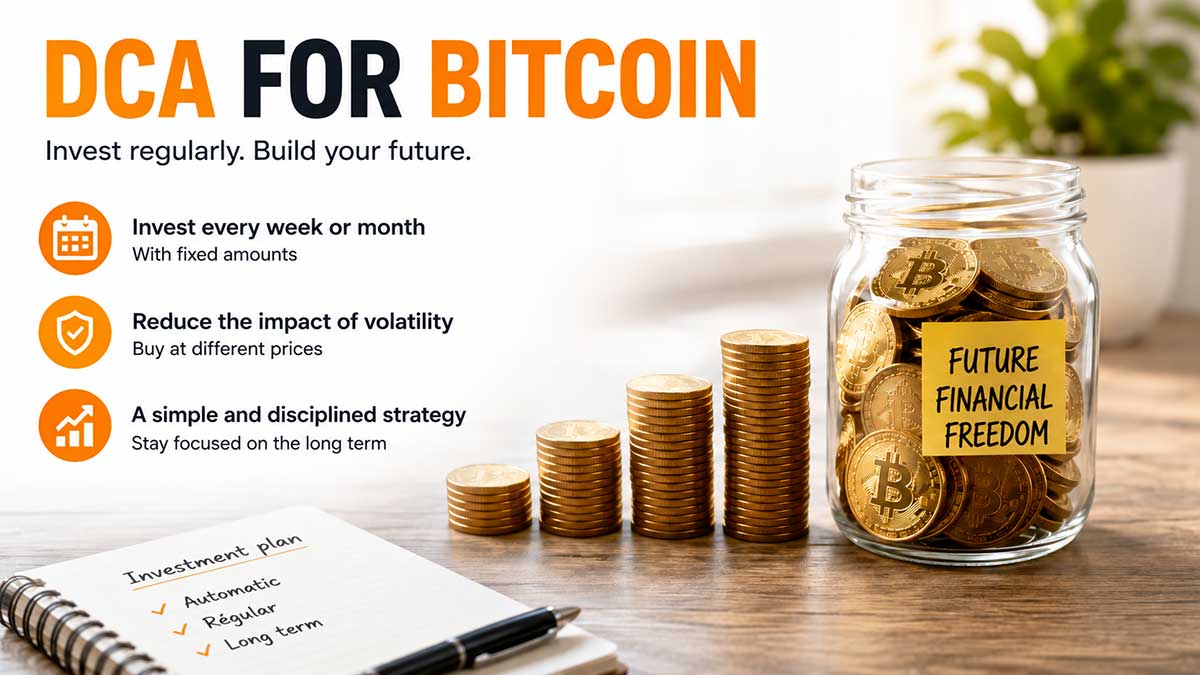
DCADCA (Dollar Cost Averaging)Buying a small fixed amount at regular intervals (for example 100 EUR a week), regardless of price. Smooths the average purchase cost and neutralises timing bias.See in the lexicon → (Dollar Cost Averaging) means buying a fixed amount at regular intervals, whatever the market does. 100 EUR every Monday, 500 EUR on the 1st of the month, 50 EUR per week : the mechanic is price-insensitive and disciplines the investor against themselves. The method comes from Benjamin Graham (1949, The Intelligent Investor) applied to equities, and was picked up for Bitcoin as early as 2013.
The point is not mathematical : on the long run, a lump-sumLump-sumInvesting all available capital at once rather than spreading it out. Mathematically better on average historically on Bitcoin, but psychologically harder to bear.See in the lexicon → statistically beats DCA in about two-thirds of historical equity cases. But Bitcoin is not an equity. Its volatility (drawdowns of 70 to 80 %) makes timing humanly untenable, and DCA neutralises the psychological bias of buying at the top (FOMOFOMO (Fear Of Missing Out)Fear of missing the rally, which pushes people to buy at the worst moment, near the tops. DCA is the classic antidote.See in the lexicon →) and waiting for the bottom (paralysis). It is an anti-behaviour method, not an anti-return one.
This article lays out the origin of the method, the maths of variance, a retroactive 2019-2026 table comparing weekly, monthly and lump-sum on Bitcoin, a comparison of 5 DCA services (Relai, Pocket Bitcoin, Swan, Coinbase, manual exchangeExchangeService that lets you buy, sell and swap cryptocurrencies against fiat money. Examples : Kraken, Coinbase, Bitstamp, Bitvavo. Most are custodial.See in the lexicon → buying), the variants (Value AveragingValue AveragingVariant of DCA where the amount invested varies depending on whether the portfolio is below or above its target value.See in the lexicon →, aggressive DCA in bear marketBear market, bull marketProlonged falling market (bear) or rising market (bull). Bitcoin cycles have historically alternated between the two around halvings, with 70 to 85 percent drops in bear markets.See in the lexicon →), and the pitfalls (cumulative fees, monthly withdrawal to hardware walletHardware walletSmall dedicated device (Ledger, Trezor, Coldcard, BitBox, etc.) that keeps the private key away from a potentially compromised computer. Signs transactions inside the device itself.See in the lexicon →).
What DCA is and where the method comes from
DCADCA (Dollar Cost Averaging)Buying a small fixed amount at regular intervals (for example 100 EUR a week), regardless of price. Smooths the average purchase cost and neutralises timing bias.See in the lexicon → (Dollar Cost Averaging) is a systematic investment method in four parameters:
- Fixed fiatFiat (fiat currency)State currency with legal tender status (euro, Swiss franc, dollar), issued by a central bank and not backed by a physical asset. By contrast, Bitcoin has an issuance capped at 21 million units, with no central issuer.See in the lexicon → amount (e.g. 100 EUR), not in BTC. Crucial: if you DCA in fixed BTC (e.g. 0.001 BTC weekly), you neutralise the smoothing effect. DCA buys more BTC when price is low and less when high, not the reverse.
- Regular interval: weekly, bi-monthly, monthly. Frequency depends on budget and fees.
- Over a long period: minimum 12 months to start smoothing, ideally 4-10+ years to capture Bitcoin cycles.
- No timing attempt: the buy triggers automatically on a fixed date, independent of any market analysis. That is the very principle.
Historical origin in two steps.
- 1949: Benjamin Graham, in The Intelligent Investor, formalises the concept under the name "dollar averaging" for individual investors in US stocks. Main idea: avoid destructive timing psychology by imposing mechanical discipline. Widely adopted by US savers in 401(k) plans (automatic monthly retirement contributions) from the 1980s.
- 2014-2015: Bitcoin adoption. Early Bitcoiners discover the method works particularly well on such a volatile asset. First automated services appear (Coinbase auto-buy 2014, institutional GBTC 2015, then Swan 2019, Strike 2020, Relai 2020, Bitcoin Reserve 2023). In 2026, DCA is the dominant investment method among retail Bitcoiners (~60 % of new investors per community surveys).
Three useful terminological clarifications.
- DCA is not "opportunistic progressive investing". Buying when price drops but not when it rises is a variant ("buy the dip"), not pure DCA. Classic DCA buys whatever the market context.
- "Stack satsStack satsAccumulating satoshis over time. A classic HODL mantra.See in the lexicon →" is the BitcoinerBitcoinerPerson interested in Bitcoin, who holds some and adheres more or less to its values (individual sovereignty, sound money, decentralisation).See in the lexicon → expression for DCA. Stacking = accumulating. Sats = satoshis (1/100 millionth of BTC). "Stack sats" translates as "regularly accumulate satoshis", typically via DCA.
- DCA ≠ lump-sumLump-sumInvesting all available capital at once rather than spreading it out. Mathematically better on average historically on Bitcoin, but psychologically harder to bear.See in the lexicon →. Lump-sum is investing a large amount at once (e.g. a 50,000 EUR inheritance invested in full at time T). DCA fragments that amount over time. The comparison between the two is the subject of a dedicated article (Lump-sum vs DCA).
Why DCA works: math and psychology
DCADCA (Dollar Cost Averaging)Buying a small fixed amount at regular intervals (for example 100 EUR a week), regardless of price. Smooths the average purchase cost and neutralises timing bias.See in the lexicon → rests on two reinforcing mechanisms: a mathematical argument (variance reduction) and a psychological argument (timing bias elimination).
Mathematical argument: variance reduction.
- Imagine an asset whose price oscillates between 80 and 120 over 4 periods: period 1 price = 100, period 2 price = 80, period 3 price = 120, period 4 price = 100. You invest 100 EUR per period.
- Period 1: 100 EUR buys 1.00 BTC. Period 2: 100 EUR at 80 = 1.25 BTC. Period 3: 100 EUR at 120 = 0.833 BTC. Period 4: 100 EUR at 100 = 1.00 BTC.
- Total invested: 400 EUR. Total BTC accumulated: 1 + 1.25 + 0.833 + 1 = 4.083 BTC. Weighted average purchase price: 400 / 4.083 = 97.97 EUR per BTC.
- But the arithmetic mean price of the 4 periods is (100 + 80 + 120 + 100) / 4 = 100 EUR per BTC. DCA allowed buying at a weighted average price below the arithmetic mean, because it mechanically bought more when price was low.
- This property is mathematically guaranteed for any fluctuating asset. The higher the volatility, the more marked the benefit. Bitcoin, with its ~70 % annualised historical volatility, is an ideal candidate.
Psychological argument: timing bias elimination.
- The investor's worst enemy is themselves. Behavioural studies (Daniel Kahneman, Robert Shiller) show retail buys at bull marketBear market, bull marketProlonged falling market (bear) or rising market (bull). Bitcoin cycles have historically alternated between the two around halvings, with 70 to 85 percent drops in bear markets.See in the lexicon → top from FOMOFOMO (Fear Of Missing Out)Fear of missing the rally, which pushes people to buy at the worst moment, near the tops. DCA is the classic antidote.See in the lexicon → and sells at bear marketBear market, bull marketProlonged falling market (bear) or rising market (bull). Bitcoin cycles have historically alternated between the two around halvings, with 70 to 85 percent drops in bear markets.See in the lexicon → bottom from capitulationCapitulationFinal phase of a bear market where the last sellers give in to panic, often on record volume. Frequently marks the cycle bottom.See in the lexicon →. Pattern observed in all markets (stocks, real estate, crypto), with average cost of ~3-5 % annual return lost.
- DCA neutralises this bias by automating the buy decision. When price rises, the machine keeps buying at the same pace (no enhanced FOMO). When price drops, the machine keeps buying (no capitulation). Investor no longer has to make an emotional decision.
- Practical consequence: the DCAer no longer looks at price daily. No longer reads tactical analyses. Frees mental time for something else. This "mental hygiene" is the most underestimated DCA advantage.
Mathematical limit to know. DCA is inferior to lump-sumLump-sumInvesting all available capital at once rather than spreading it out. Mathematically better on average historically on Bitcoin, but psychologically harder to bear.See in the lexicon → in a monotonically rising market. If price only rises without dropping, lump-sum captures all the rise from the start, while DCA buys at ever-higher prices. On Bitcoin, over 2020-2021 for example (very few drops), lump-sum beat DCA by ~30 % in final return. But over periods including bear markets (2018, 2022), DCA largely beats lump-sum in psychological stability and often in final return. The rigorous comparison is in the dedicated article.
2019-2026 Bitcoin DCA retroactive comparison
Numbers speak louder than principles. The table below compares 3 strategies applied retroactively over January 1, 2019 - May 1, 2026 (~7 years, crossing 2 complete cycles: 2020-2021 bull, 2022 bear, 2023 accumulation, 2024-2025 bull).
| Strategy | Cumulative invested | BTC accumulated | Weighted avg price | Value at 01/05/2026 (rate ~100k EUR) | Total return |
|---|---|---|---|---|---|
| Weekly DCADCA (Dollar Cost Averaging)Buying a small fixed amount at regular intervals (for example 100 EUR a week), regardless of price. Smooths the average purchase cost and neutralises timing bias.See in the lexicon → 50 EUR/week | ~19,110 EUR (382 weeks) | ~0.470 BTC | ~40,660 EUR/BTC | ~47,000 EUR | ~+146 % |
| Monthly DCA 200 EUR/month | ~17,600 EUR (88 months) | ~0.432 BTC | ~40,740 EUR/BTC | ~43,200 EUR | ~+145 % |
| Lump-sumLump-sumInvesting all available capital at once rather than spreading it out. Mathematically better on average historically on Bitcoin, but psychologically harder to bear.See in the lexicon → 19,110 EUR on 01/01/2019 | 19,110 EUR | ~5.30 BTC (rate ~3,600 EUR at the time) | ~3,600 EUR/BTC | ~530,000 EUR | ~+2,675 % |
| Lump-sum 19,110 EUR on 01/11/2021 (top) | 19,110 EUR | ~0.29 BTC (rate ~66,000 EUR at the time) | ~66,000 EUR/BTC | ~29,000 EUR | ~+52 % |
Three lessons from this table.
- Weekly DCA and monthly DCA give very close results (~145 % total return). Frequency matters little long term: what counts is regularity. Monthly DCA largely suffices for a retail investor, and saves weekly purchase fees.
- Lump-sum at the right moment widely beats DCA, lump-sum at the wrong moment loses to DCA. Investing 19,110 EUR on January 1, 2019 (near the 2018 bear bottom) gave an astronomical +2,675 % return. The same amount on November 1, 2021 (bull top) gave only +52 %. The difficulty: no one knows in advance when the top or bottom is. DCA guarantees a predictable average result (~+145 %), lump-sum is a timing bet.
- DCA's psychological advantage is invisible in the table but huge in real life. The 2019 lump-sum-at-bottom saw its portfolio go from 19,110 to 530,000 EUR at the 2021 top, then fall to 95,000 EUR at the 2022 bottom (-82 %). How many retail investors psychologically hold an -82 % drawdownDrawdownDecline from a previous peak. Bitcoin has gone through several drawdowns of more than 75 percent in its history. To factor into your psychological planning.See in the lexicon → on already significant wealth? Very few. DCA never had a drawdown above -30 % because new purchases continuously smooth the entry cost.
Pattern to anticipate for next cycles: DCA must traverse at least one complete cycle (4 years) to show its full value. Over just 12 months, DCA can underperform a lucky lump-sum or outperform an unlucky lump-sum, without real statistical significance. It is over 5-10+ years that DCA deploys its full potential.
5 Bitcoin DCA services in 2026
Choosing the right DCADCA (Dollar Cost Averaging)Buying a small fixed amount at regular intervals (for example 100 EUR a week), regardless of price. Smooths the average purchase cost and neutralises timing bias.See in the lexicon → service in 2026 depends on jurisdiction, amount, desired features (auto-withdrawal to self-custodySelf-custodyModel in which you hold your own private keys. Your bitcoins depend on no third party. This is Bitcoin's founding promise.See in the lexicon →, Lightning, sats payroll). The table below compares the 5 dominant services in DACH / French-speaking Switzerland / France zones.
| Service | Country | Min amount | Fees | Frequencies | Auto self-custody withdrawal? | Specifics |
|---|---|---|---|---|---|---|
| Strike | USA, El SalvadorEl SalvadorFirst country to adopt Bitcoin as legal tender, in September 2021 under Nayib Bukele. Its status was amended in 2025 under IMF pressure.See in the lexicon →, Argentina, UK, EU (partial) | 1 USD | 0 % (spread included ~0.3 %) | Daily, weekly, monthly | Yes via Lightning | Lightning NetworkLightning NetworkSecond-layer payment network on top of Bitcoin. Enables near-instant and near-free payments through channels opened between users.See in the lexicon → origin, BTC or USDT withdrawal |
| Bitcoin Reserve | EU (DE, AT, FR, NL...) | 10 EUR | ~1.5 % per buy | Weekly, bi-monthly, monthly | Yes via monthly on-chain | Direct SEPASEPA (Single Euro Payments Area)Single euro payments area: standardised bank transfers, free or nearly so, within one business day (a few seconds for the instant version). The cheapest deposit method on European exchanges.See in the lexicon →, DACH focus, auto-withdrawal included |
| Relai | Switzerland, EU partial | 10 CHF | 1.25 % per buy | Weekly, bi-monthly, monthly | Yes via monthly on-chain | Direct Swiss IBAN, mandatory withdrawal (no default custodyCustodyThe custody of funds. See self-custody and custodial in the dedicated section below.See in the lexicon →) |
| Pocket Bitcoin | Switzerland, AT, DE, IT | 10 CHF | 1.5 % per buy | When wire received | Mandatory (no custody) | Bank wire = buy. No KYCKYC (Know Your Customer)Mandatory identification procedure that regulated platforms apply to their users : ID document, proof of address, and so on.See in the lexicon → below 1000 CHF/month |
| Bitwise / Swan | USA | 10 USD | 0.99 % | Daily to monthly | Yes Swan, partial Bitwise | Historical US player, tied to Bitcoin analysts |
Three criteria for choosing.
- Bank account jurisdiction. Strike available US/UK/partial EU. Bitcoin Reserve excellent in EU zone (notably DE/AT/FR). Relai and Pocket Bitcoin ideal for Switzerland. Bitwise and Swan are essentially US.
- Self-custody intent. Pocket Bitcoin and Relai force auto-withdrawal to a personal address (no custody possible with them). Strike and Bitcoin Reserve allow optional auto-withdrawal. If you want to "stack and chill" without managing self-custody, Strike leaves you in custody (to transfer manually later). If you want maximum sovereignty from the first buy, Pocket Bitcoin enforces good practice.
- Fee tolerance. Strike is cheapest (~0.3 % spread). Bitcoin Reserve, Relai, Pocket Bitcoin at 1.25-1.5 %. Over 5 years of DCA, the gap between 0.3 % and 1.5 % fees represents ~1,200 EUR difference on 100,000 EUR invested. Not negligible.
Note: classic exchanges (Binance, Kraken, Coinbase) also offer DCA via their "recurring buy" features. Advantage: often very low fees (~0.1-0.5 % of amount). Major drawback: bitcoins stay on exchangeExchangeService that lets you buy, sell and swap cryptocurrencies against fiat money. Examples : Kraken, Coinbase, Bitstamp, Bitvavo. Most are custodial.See in the lexicon →, FTXFTXCentralised exchange that collapsed spectacularly in November 2022. Sam Bankman-Fried was convicted. Dragged Blockfolio and many funds down with it.See in the lexicon → risk. Discouraged for long-term DCA unless you manually withdraw every month to self-custody. Dedicated DCA services (those in the table) are designed for regular automatic withdrawal, which makes them superior in practice for a long-term BitcoinerBitcoinerPerson interested in Bitcoin, who holds some and adheres more or less to its values (individual sovereignty, sound money, decentralisation).See in the lexicon →.
Optimal frequency, automation and security
Three practical questions structure setting up a durable Bitcoin DCADCA (Dollar Cost Averaging)Buying a small fixed amount at regular intervals (for example 100 EUR a week), regardless of price. Smooths the average purchase cost and neutralises timing bias.See in the lexicon →.
Which frequency to pick? Three typical cases.
- Low budget (10-50 EUR/month): monthly DCA. Purchase fees (often 1.25-1.5 %) are already high relative to amount, increasing frequency proportionally raises fees without significant smoothing gain. Monthly DCA at 50 EUR/month over 5 years = 3,000 EUR invested, cumulative fees ~45 EUR.
- Medium budget (200-500 EUR/month): weekly DCA. Increased frequency smooths weekly volatility better. Weekly DCA at 50 EUR/week over 5 years = 13,000 EUR invested, cumulative fees ~200 EUR. The return gap vs monthly DCA stays marginal (~1-3 % of final capital) but positioning comfort is better.
- High budget (1000+ EUR/month): bi-monthly or weekly DCA depending on service. Above 1000 EUR/month, relative fees become negligible and frequency can be increased. Some market-close players go to daily DCA (Bitcoin Reserve with premium account), but marginal gain is near zero beyond weekly frequency.
What automation level to aim?
- Level 1: standing bank order to DCA service. Bank sends X EUR at frequency Y to Strike/Bitcoin Reserve/Relai/Pocket. The DCA service buys and holds (or auto-withdraws per policy). Zero monthly effort after initial setup.
- Level 2: auto-withdrawal to self-custodySelf-custodyModel in which you hold your own private keys. Your bitcoins depend on no third party. This is Bitcoin's founding promise.See in the lexicon →. DCA service configured to automatically send accumulated BTC to a personal address (BitBoxLedger, Trezor, Coldcard, BitBoxMain hardware wallet brands. Ledger Nano S Plus / X (French, the best-seller), Trezor Model T (Czech, open source), Coldcard Mk4 (Canadian, ultra-secure, Bitcoin-only), BitBox02 (Swiss, open source).See in the lexicon →, LedgerLedger, Trezor, Coldcard, BitBoxMain hardware wallet brands. Ledger Nano S Plus / X (French, the best-seller), Trezor Model T (Czech, open source), Coldcard Mk4 (Canadian, ultra-secure, Bitcoin-only), BitBox02 (Swiss, open source).See in the lexicon →, ColdcardLedger, Trezor, Coldcard, BitBoxMain hardware wallet brands. Ledger Nano S Plus / X (French, the best-seller), Trezor Model T (Czech, open source), Coldcard Mk4 (Canadian, ultra-secure, Bitcoin-only), BitBox02 (Swiss, open source).See in the lexicon →) every week or month per threshold. A few services (Bitcoin Reserve, Strike via Lightning) automate this natively.
- Level 3: DCA + Lightning + partial sats payroll. More advanced configuration for those wanting to receive part of salary directly in sats (via Bitwage e.g.) and increase automatic accumulation. To consider after 12 successful DCA months.
What security risks to anticipate? Five key points.
- Mandatory KYCKYC (Know Your Customer)Mandatory identification procedure that regulated platforms apply to their users : ID document, proof of address, and so on.See in the lexicon → at all regulated services in 2026 (MiCAMiCA (Markets in Crypto-Assets)European regulation 2023/1114 that frames crypto services across the EU since 2024. Creates the CASP status.See in the lexicon → Europe). Your personal data (passport, residency proof) is stored at the provider. Pick a service with good cybersecurity reputation (SOC 2 audits, no historical data breach). Pocket Bitcoin is the exception: no KYC below 1000 CHF/month.
- CustodyCustodyThe custody of funds. See self-custody and custodial in the dedicated section below.See in the lexicon → risk. If your BTC stays on Strike/Bitwise (centralised custody), you are exposed to service bankruptcy (FTXFTXCentralised exchange that collapsed spectacularly in November 2022. Sam Bankman-Fried was convicted. Dragged Blockfolio and many funds down with it.See in the lexicon → 2022 case). Above 5,000 EUR cumulative, withdraw to self-custody.
- Bank account blocking risk. Some banks block wires to crypto exchanges. Test with a small amount first. Postfinance in Switzerland, BoursoBank and Revolut in France, N26 in Germany are historically compatible with Bitcoin DCA services.
- Tax non-declaration risk. All DCA buys must be traced for declaration. Most services generate an annual CSV export to feed Koinly or Cointracker. Anticipate from the first buy (Fiscality topic sprint 6 upcoming).
- Seed phraseSeed phraseSequence of 12 or 24 words (usually in English) that encodes your master key. Universal wallet backup : with these words, you can restore your funds on any compatible software.See in the lexicon → backup. If you withdraw to self-custody, your seed phrase becomes the absolute key to your accumulated Bitcoin wealth. Backup procedures (cf. Store Bitcoin topic) imperative from first withdrawals.
DCA limits and advanced variants
DCADCA (Dollar Cost Averaging)Buying a small fixed amount at regular intervals (for example 100 EUR a week), regardless of price. Smooths the average purchase cost and neutralises timing bias.See in the lexicon → is not a miracle strategy. Three concrete limits deserve to be known before committing. And three advanced variants emerge in 2026 for those wanting to go beyond basic DCA.
Classic DCA limits.
- Return loss vs lump-sumLump-sumInvesting all available capital at once rather than spreading it out. Mathematically better on average historically on Bitcoin, but psychologically harder to bear.See in the lexicon → in monotonically rising market. Demonstrated section 4: a well-timed lump-sum (at bear bottom) widely beats DCA. DCA is designed to handle timing uncertainty, not maximise absolute return. It is an assumed trade-off.
- Heavy tax constraint in jurisdictions with progressive capital gains. In France, each DCA buy is a new line in the Cerfa 2086Cerfa 2086French tax form (Cerfa) used to declare crypto capital gains.See in the lexicon → fiscal form, to trace at disposal. A weekly DCA over 5 years = 260 lines to trace. Fortunately tools (Koinly, Cointracker) automate. In Switzerland, no capital gains for individuals, so less heavy. In Germany, exemption after 1-year HODLHODLHolding bitcoins without selling, despite the volatility. The word comes from a typo, « I AM HODLING », posted on a forum in 2013 that turned into a joke and then a mantra.See in the lexicon → individual also facilitates.
- DCA service dependence. If Strike, Relai or Bitcoin Reserve fails (bankruptcy, market exit, regulatory block), your DCA flow stops. Resilience implies either (a) diversifying across 2-3 services in parallel, or (b) accepting temporary pause and migrating quickly.
Advanced variants in 2026.
- Value AveragingValue AveragingVariant of DCA where the amount invested varies depending on whether the portfolio is below or above its target value.See in the lexicon → (Edleson 1991). Instead of investing a fixed amount each period, adjust the amount to reach a growing target portfolio value. Example: portfolio +1000 EUR target per month. If market is rising and portfolio at +1300 without doing anything, buy only 700 EUR. If at -200 (drop), buy 1200 EUR. More performant than DCA in theory on cyclical markets, more complex to set up. 2026 implementations: no native Bitcoin service, to do manually with a spreadsheet.
- Dynamic DCA on realised volatility. Variant observed in some advanced 2022-2024 Bitcoiners: double the amount when the Fear & Greed Index is below 30 (deep bear marketBear market, bull marketProlonged falling market (bear) or rising market (bull). Bitcoin cycles have historically alternated between the two around halvings, with 70 to 85 percent drops in bear markets.See in the lexicon →, extreme fear), normalise between 30-70, halve when above 70 (euphoria, bull marketBear market, bull marketProlonged falling market (bear) or rising market (bull). Bitcoin cycles have historically alternated between the two around halvings, with 70 to 85 percent drops in bear markets.See in the lexicon →). Logic: buy more when market capitulates, less when euphoric. Risk: requires discipline to follow rules, no native automation.
- Geographic fractional DCA. Split DCA flow across several services in several jurisdictions for resilience. Example: 30 % Strike (USA), 30 % Bitcoin Reserve (DE), 40 % Relai (CH). Advantage: if one service falls, the other 2 continue. Drawback: multiplied KYCs, accounts, tax complexity.
The final word: DCA is not optimisation, it is discipline. The best DCA is the one you hold 5+ years without interruption. All advanced variants that add complexity raise abandonment risk. For 90 % of Bitcoiners, weekly or monthly DCA via a simple service largely suffices to reach the patient accumulation goal.
Disclaimer
Educational and informational content only: not investment, tax or legal advice. Bitcoin carries significant risks, including high volatility and the possible loss of invested capital. Each reader remains responsible for their decisions; when in doubt, consult a qualified professional in your jurisdiction.
Going further
DCADCA (Dollar Cost Averaging)Buying a small fixed amount at regular intervals (for example 100 EUR a week), regardless of price. Smooths the average purchase cost and neutralises timing bias.See in the lexicon → is one brick of the Invest topic. To dig the other dimensions:
- Invest Bitcoin guide: overview of strategies, asset allocation, psychology.
- Lump-sum vs DCA: the math of the entry decision, upcoming.
- Bitcoin spot ETF: alternative to direct DCA, upcoming.
- Volatility psychology: why DCA frees mentally, upcoming.
For the buy and store context:
- Buy Bitcoin guide: how to concretely place buy orders on exchangeExchangeService that lets you buy, sell and swap cryptocurrencies against fiat money. Examples : Kraken, Coinbase, Bitstamp, Bitvavo. Most are custodial.See in the lexicon → or via DCA.
- Store Bitcoin guide: self-custodySelf-custodyModel in which you hold your own private keys. Your bitcoins depend on no third party. This is Bitcoin's founding promise.See in the lexicon →, hardware wallets, seed phraseSeed phraseSequence of 12 or 24 words (usually in English) that encodes your master key. Universal wallet backup : with these words, you can restore your funds on any compatible software.See in the lexicon → to secure accumulated DCA.
DCA tax (recurring buy declaration, capital gains, registry preservation) will be covered in the Fiscalité topic (sprint 6 upcoming).