
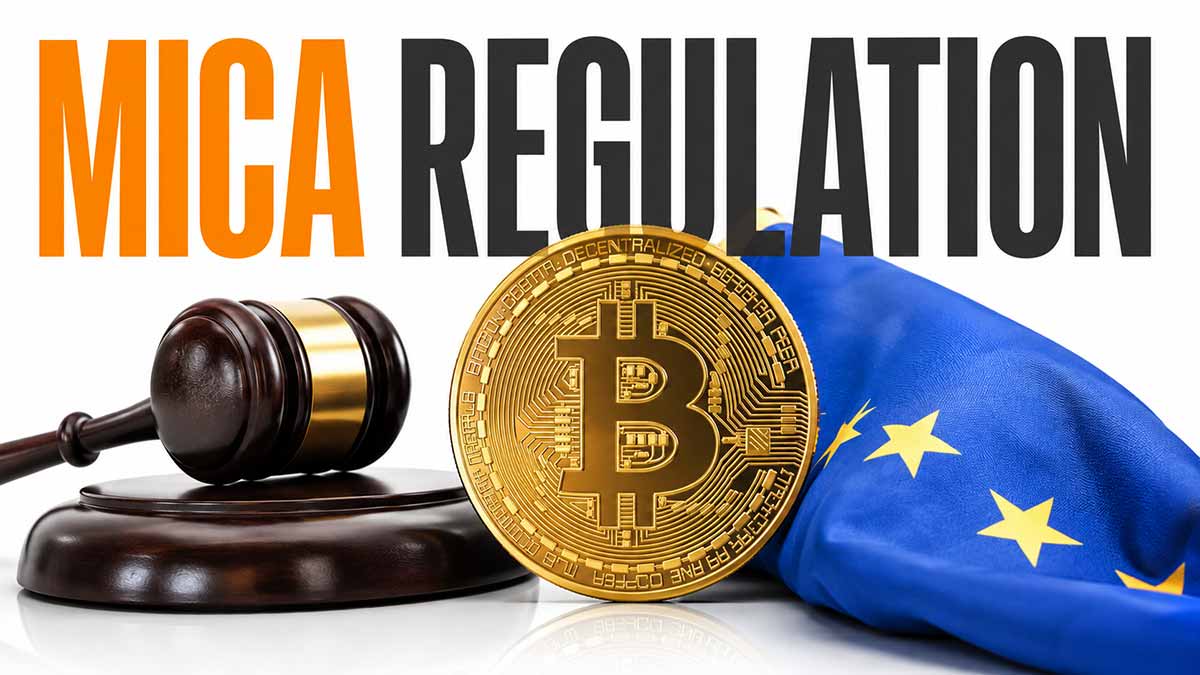
The MiCAMiCA (Markets in Crypto-Assets)European regulation 2023/1114 that frames crypto services across the EU since 2024. Creates the CASP status.See in the lexicon → Regulation (Markets in Crypto-Assets, EU 2023/1114) is the unified crypto legal framework for the 27 member states. Adopted in June 2023, fully applicable from 30 December 2024 for CASPs (Crypto-Asset Service Providers), it harmonises licensing, conduct, investor protection and stablecoinStablecoinCrypto pegged to a fiat currency (USDT, USDC, EURI) or to a basket of assets, designed to stay stable around 1 USD or 1 EUR.See in the lexicon → rules at European level.
For a European bitcoin holder, MiCA mostly impacts the platform side. EU-active exchanges (Binance EU, Kraken EU, Coinbase EU) must obtain a CASPCASP (Crypto-Asset Service Provider)Crypto service provider authorised under MiCA. Must obtain a licence in its home country, valid throughout the EU.See in the lexicon → licence, implement strict client fund segregation, publish white papers for the offered assets, and comply with MiCA market abuse and transparency rules. On the non-intermediated private holding side (self-custodySelf-custodyModel in which you hold your own private keys. Your bitcoins depend on no third party. This is Bitcoin's founding promise.See in the lexicon →), MiCA does not directly apply.
This article exposes the MiCA 2023/1114 framework and its calendar, distinguishes the CASP / ART / EMT categories, addresses coordination with DAC8DAC8European directive that requires crypto platforms to share tax data on their users with European tax administrations. Applicable from 2026.See in the lexicon → (automatic tax reporting, operational 2026) and TFRTFR (Transfer of Funds Regulation)European regulation that requires exchanges to share information on sender and beneficiary for crypto transfers above 1,000 EUR.See in the lexicon → (Travel Rule), exposes the obligations on exchanges and their user consequences (reinforced KYCKYC (Know Your Customer)Mandatory identification procedure that regulated platforms apply to their users : ID document, proof of address, and so on.See in the lexicon →, withdrawal limits, closure of non-compliant accounts), and lists the open questions (private stablecoins, DeFi).
MiCA legal framework: regulation 2023/1114 and calendar
The EU 2023/1114 regulation was published in the Official Journal of the European Union on 9 June 2023 and structures the European crypto framework into three pillars. Title III: asset-referenced tokens (ART). Title IV: e-money tokens (EMT, typically stablecoins backed by a single fiatFiat (fiat currency)State currency with legal tender status (euro, Swiss franc, dollar), issued by a central bank and not backed by a physical asset. By contrast, Bitcoin has an issuance capped at 21 million units, with no central issuer.See in the lexicon → currency such as USDC or EURC). Title V: services on crypto-assets (CASPCASP (Crypto-Asset Service Provider)Crypto service provider authorised under MiCA. Must obtain a licence in its home country, valid throughout the EU.See in the lexicon →), namely exchangeExchangeService that lets you buy, sell and swap cryptocurrencies against fiat money. Examples : Kraken, Coinbase, Bitstamp, Bitvavo. Most are custodial.See in the lexicon → platforms, brokers, custodyCustodyThe custody of funds. See self-custody and custodial in the dedicated section below.See in the lexicon →-as-a-service, advisers, market makers.
Application calendar. Titles III and IV (stablecoins) entered into force on 30 June 2024. Titles I, II and V (general framework and CASP) entered into force on 30 December 2024. An 18-month transitional period until 30 June 2026 allows actors already active (French PSANPSAN (French crypto registration)French mandatory registration status with the AMF for crypto platforms. Progressively replaced by the European CASP authorisation under MiCA.See in the lexicon →, Italian OAM, German BaFin) to request their MiCAMiCA (Markets in Crypto-Assets)European regulation 2023/1114 that frames crypto services across the EU since 2024. Creates the CASP status.See in the lexicon → authorisation. Beyond that date, providing a CASP service in EU without MiCA authorisation becomes an administrative offence with possible platform blocking and sanctions up to 7.5 % of annual turnover.
European passport. A platform authorised in one Member State can operate in the 27 EU States without requesting an additional local authorisation. Bitstamp (Luxembourg), Bitvavo (Netherlands), Bitpanda (Austria), Coinbase Europe (Ireland) and Kraken Europe (Ireland) have opted for optimised headquarters. This is a sharp break with the previous PSAN/OAM regime which was strictly national.
Out of MiCA scope. The regulation excludes four categories: (a) services provided on a non-professional basis by a natural person on their own account (pure self-custodySelf-custodyModel in which you hold your own private keys. Your bitcoins depend on no third party. This is Bitcoin's founding promise.See in the lexicon →), (b) unique and non-fungible NFTs (but included if fractionalised or issued in series), (c) tokens recognised as securities under MiFID II (governed by other texts), (d) central bank CBDCs (which will have their own framework). Bitcoin, as a decentralised non-issued crypto-asset, is excluded from the ART and EMT regimes (Title III/IV) but its intermediary services fall under Title V.
National competent authorities. Each Member State designates an authority in charge of applying MiCA. France: AMF (Autorité des Marchés Financiers), with ACPR consultation for banking aspects. Germany: BaFin. Italy: Consob in coordination with Banca d'Italia, OAM keeping its transitional registration role. For Switzerland, outside EU, the FINMAFINMASwiss Financial Market Supervisory Authority. Frames crypto activities in Switzerland.See in the lexicon → regime applies with a national MiCA equivalent under discussion since 2024 (Swiss DLT Act of 2021 already extended in 2023, without strict MiCA alignment).
CASP: who are they and how to verify an authorisation
A CASPCASP (Crypto-Asset Service Provider)Crypto service provider authorised under MiCA. Must obtain a licence in its home country, valid throughout the EU.See in the lexicon → (Crypto-Asset Service Provider) is an entity providing on a professional basis one or more of the 10 services listed in MiCAMiCA (Markets in Crypto-Assets)European regulation 2023/1114 that frames crypto services across the EU since 2024. Creates the CASP status.See in the lexicon → article 3: custodyCustodyThe custody of funds. See self-custody and custodial in the dedicated section below.See in the lexicon → on behalf of third parties, operation of a trading platform, exchangeExchangeService that lets you buy, sell and swap cryptocurrencies against fiat money. Examples : Kraken, Coinbase, Bitstamp, Bitvavo. Most are custodial.See in the lexicon → against fiatFiat (fiat currency)State currency with legal tender status (euro, Swiss franc, dollar), issued by a central bank and not backed by a physical asset. By contrast, Bitcoin has an issuance capped at 21 million units, with no central issuer.See in the lexicon →, exchange against other crypto-assets, order execution, order reception and transmission, placement, investment advice, portfolio management, transfer service provision. Most known platforms fall into several categories.
How to verifyDon't trust, verifyBitcoiner mantra. Trust no one (bank, government, exchange, influencer), verify on your own through your own node.See in the lexicon → a platform is authorised CASP. ESMA (European Securities and Markets Authority) maintains a consolidated public register of CASP authorised in all EU countries. Free access via esma.europa.eu, « Registers » section. Search by company name, jurisdiction of authorisation, services authorised. As of 30 May 2026, 134 CASP are authorised under MiCA, including 38 in Germany (BaFin), 27 in France (AMF), 24 in Italy (Consob), 18 in Ireland, 12 in the Netherlands, 8 in Spain and 7 distributed among Luxembourg, Austria, Estonia and Malta.
Whitelist / blacklist. National authorities also publish non-authorised platforms whose access is forbidden to European residents. The AMF maintains a public « blacklist ». Typically listed platforms: Binance Global (but Binance France and Binance Italia are distinct and authorised), Bybit, OKX, KuCoin, Bitget, plus most platforms of Asian origin not established in EU. A French resident using a non-listed platform may, in case of dispute (loss of funds, bankruptcy), not be protected by the guarantee and resolution mechanism provided by MiCA.
What to do in practice for Pierre. Pierre verifies on esma.europa.eu that Bitvavo (Netherlands) is indeed CASP authorised: confirmation. The KYCKYC (Know Your Customer)Mandatory identification procedure that regulated platforms apply to their users : ID document, proof of address, and so on.See in the lexicon → update request he received is legitimate. He completes the procedure (5 minutes online), even if he does not use the account, to avoid freezing. If he had preferred to close his account instead of keeping it, Bitvavo would have asked him to transfer his funds to his self-custodySelf-custodyModel in which you hold your own private keys. Your bitcoins depend on no third party. This is Bitcoin's founding promise.See in the lexicon → walletWalletSoftware or device that manages your Bitcoin keys and lets you sign transactions. A wallet does not really « hold » your bitcoins, it holds the keys that prove you own them.See in the lexicon →, an operation subject to the Travel Rule (information exchange to the recipient wallet). Once the account is closed, no MiCA constraint weighs on his BTC in self-custody.
ART and EMT stablecoins: USDC, USDT, EURC
MiCAMiCA (Markets in Crypto-Assets)European regulation 2023/1114 that frames crypto services across the EU since 2024. Creates the CASP status.See in the lexicon → Title III and IV impose specific authorisation on stablecoinStablecoinCrypto pegged to a fiat currency (USDT, USDC, EURI) or to a basket of assets, designed to stay stable around 1 USD or 1 EUR.See in the lexicon → issuers, with two distinct regimes. ART (asset-referenced tokens) for stablecoins backed by a basket of assets (currencies, commodities, other crypto-assets). EMT (e-money tokens) for stablecoins backed by a single fiatFiat (fiat currency)State currency with legal tender status (euro, Swiss franc, dollar), issued by a central bank and not backed by a physical asset. By contrast, Bitcoin has an issuance capped at 21 million units, with no central issuer.See in the lexicon → currency (USDC, USDT, EURC).
Main requirements. Minimum initial capital (350,000 EUR for EMT, 1 million EUR for big ART), full and segregated coverage reserves (1 EUR of reserve per 1 EUR of stablecoin issued), quarterly public audit, authorisation as electronic money or credit institution. For « big » ART (capitalisation > 5 billion EUR or > 10 million users), direct supervision by EBA (European Banking Authority) with reinforced requirements.
Consequence for USDT (Tether). Tether did not request the MiCA authorisation. In January 2025, Coinbase Europe, Crypto.com Europe and several other platforms removed USDT from their offer for EU residents. Binance Europe maintains it temporarily but with restrictions. For an EU resident holding USDT on an EU platform, two options: convert to USDC or EURC (authorised alternatives) or withdraw to self-custodySelf-custodyModel in which you hold your own private keys. Your bitcoins depend on no third party. This is Bitcoin's founding promise.See in the lexicon →. On native Bitcoin, the effect is null since Bitcoin is neither ART nor EMT.
USDC and EURC. Circle (issuer of USDC and EURC) obtained an EMT authorisation from the French ACPR in July 2024, making USDC the first major MiCA-compliant stablecoin. EURC, its EUR equivalent, is also authorised. USDC Europe capitalisation at 31 May 2026: ~38 billion EUR, EURC capitalisation: ~620 million EUR. EU CASPCASP (Crypto-Asset Service Provider)Crypto service provider authorised under MiCA. Must obtain a licence in its home country, valid throughout the EU.See in the lexicon → platforms primarily offer these authorised stablecoins.
Implications for pure Bitcoin. Bitcoin is neither ART nor EMT. No MiCA Title III/IV constraint weighs on the issuance of Bitcoin (which has no identifiable issuer). But the CASP services that trade it (Title V) are regulated. Concretely, Pierre can continue to buy, sell and keep BTC on authorised platforms without disruption. The only limit: avoid converting his BTC to USDT (or other non-authorised stablecoin) on an EU platform, which could refuse the operation.
5 practical MiCA impacts for an end user
The table below condenses the five practical impacts of MiCAMiCA (Markets in Crypto-Assets)European regulation 2023/1114 that frames crypto services across the EU since 2024. Creates the CASP status.See in the lexicon → in 2026 for an EU resident end user, Pierre Lyon type. Constraints apply to CASPCASP (Crypto-Asset Service Provider)Crypto service provider authorised under MiCA. Must obtain a licence in its home country, valid throughout the EU.See in the lexicon → platforms, not to self-custodySelf-custodyModel in which you hold your own private keys. Your bitcoins depend on no third party. This is Bitcoin's founding promise.See in the lexicon →.
| Impact | Before MiCA (2023) | With MiCA (since 30/12/2024) |
|---|---|---|
| 1. KYCKYC (Know Your Customer)Mandatory identification procedure that regulated platforms apply to their users : ID document, proof of address, and so on.See in the lexicon → on platform | Variable by country (PSANPSAN (French crypto registration)French mandatory registration status with the AMF for crypto platforms. Progressively replaced by the European CASP authorisation under MiCA.See in the lexicon → FR strict, OAM IT light) | Strong harmonised: passport + proof + source of funds |
| 2. Available stablecoins | USDT, USDC, BUSD, DAI, others | USDC, EURC authorised; USDT progressively withdrawn |
| 3. Outgoing transfer to external walletWalletSoftware or device that manages your Bitcoin keys and lets you sign transactions. A wallet does not really « hold » your bitcoins, it holds the keys that prove you own them.See in the lexicon → | Free, just blockchainBlockchainA public, shared ledger that records every Bitcoin transaction in blocks linked together cryptographically. Each participant in the network keeps a copy.See in the lexicon → fee | Travel Rule: recipient name if > 1000 EUR |
| 4. Self-custody (BitBoxLedger, Trezor, Coldcard, BitBoxMain hardware wallet brands. Ledger Nano S Plus / X (French, the best-seller), Trezor Model T (Czech, open source), Coldcard Mk4 (Canadian, ultra-secure, Bitcoin-only), BitBox02 (Swiss, open source).See in the lexicon →, LedgerLedger, Trezor, Coldcard, BitBoxMain hardware wallet brands. Ledger Nano S Plus / X (French, the best-seller), Trezor Model T (Czech, open source), Coldcard Mk4 (Canadian, ultra-secure, Bitcoin-only), BitBox02 (Swiss, open source).See in the lexicon →) | Free | Free, explicitly out of MiCA scope |
| 5. Access non-EU platforms (Binance Global, OKX) | Tolerated, grey | Blocked for EU residents since 30/06/2026 |
Comments. Impact 1 explains Bitvavo's email to Pierre. Platforms align their KYC to banking level: official identity, recent proof of address, source-of-funds declaration. Impact 2 essentially affects DeFi or trading users who used USDT to transit between positions. For a pure Bitcoin investor in self-custody, no effect. Impact 3 concerns the Travel Rule (TFRTFR (Transfer of Funds Regulation)European regulation that requires exchanges to share information on sender and beneficiary for crypto transfers above 1,000 EUR.See in the lexicon → regulation 2023/1113): any outgoing transfer from a CASP to an external wallet for an amount > 1,000 EUR must come with recipient identification. Concretely, Pierre transferring 0.2 BTC (~21,000 EUR) from Bitvavo to his BitBox02 must provide the receiving address and confirm he is the beneficiary. Impact 4 confirms the central guarantee: pure self-custody stays free, out of MiCA scope. Impact 5 closes access to non-authorised platforms: since 30 June 2026, a French or German resident can no longer legally use Binance Global, OKX or Bybit. Consequence: EU crypto liquidity concentrates on ~10 large authorised platforms.
MiCA, DAC8 and Travel Rule (TFR) articulation
Three European texts form an integrated regime for crypto-assets since 2024-2026: MiCAMiCA (Markets in Crypto-Assets)European regulation 2023/1114 that frames crypto services across the EU since 2024. Creates the CASP status.See in the lexicon → (professional framework), DAC8DAC8European directive that requires crypto platforms to share tax data on their users with European tax administrations. Applicable from 2026.See in the lexicon → (fiscal exchangeExchangeService that lets you buy, sell and swap cryptocurrencies against fiat money. Examples : Kraken, Coinbase, Bitstamp, Bitvavo. Most are custodial.See in the lexicon →), TFRTFR (Transfer of Funds Regulation)European regulation that requires exchanges to share information on sender and beneficiary for crypto transfers above 1,000 EUR.See in the lexicon → (transfer traceability). MiCA (EU 2023/1114, in force 30/12/2024) regulates professional services on crypto-assets and targets platforms and issuers. DAC8 (EU 2023/2226, applicable 01/01/2026) extends the DAC directive on automatic exchange of fiscal information to crypto-assets and obliges CASPCASP (Crypto-Asset Service Provider)Crypto service provider authorised under MiCA. Must obtain a licence in its home country, valid throughout the EU.See in the lexicon → to annually transmit to tax authorities identity, 31/12 balances, total acquisitions, total disposals, interest and rewards. TFR (EU 2023/1113, in force 30/12/2024) extends Travel Rule obligations to crypto transfers between CASP and to external wallets, with sender and recipient identification for amounts > 1,000 EUR.
Practical articulation for Pierre. In 2026, Pierre buys 0.05 BTC on Bitvavo then transfers them to his BitBox02. Three texts apply simultaneously. MiCA: Bitvavo must be authorised CASP (verified). TFR: Bitvavo records the BitBox02 address as beneficiary and associates with Pierre. DAC8: in March 2027, Bitvavo transmits to AMF the list of Pierre's 2026 operations, including this purchase and this withdrawal, cross-checked with his French tax declaration. A discrepancy between declaration and received DAC8 data triggers an audit. Pierre declares his BTC patrimony on his 2026 tax return (simplified EU CASP form for Bitvavo) and any later fiatFiat (fiat currency)State currency with legal tender status (euro, Swiss franc, dollar), issued by a central bank and not backed by a physical asset. By contrast, Bitcoin has an issuance capped at 21 million units, with no central issuer.See in the lexicon → sale at 30 % PFUPFU (Prélèvement Forfaitaire Unique)French 30 percent tax on capital gains, including crypto gains. Also called the « flat tax ». Made up of 12.8 percent income tax and 17.2 percent social levies.See in the lexicon →.
Out of MiCA + DAC8 + TFR scope. Three zones remain outside the automatic regime. (a) Pure self-custodySelf-custodyModel in which you hold your own private keys. Your bitcoins depend on no third party. This is Bitcoin's founding promise.See in the lexicon → without interaction with a CASP. (b) Transfers between two self-hosted wallets without a CASP. (c) Cold storageCold storageStoring bitcoins on an offline wallet that is not connected to the Internet. Maximum security for amounts you are not spending.See in the lexicon → holding on disconnected paper. These situations stay outside automatic traceability but remain declarable fiscally by the user (Italian Quadro RWQuadro RT, Quadro RWSections of the Italian tax return covering crypto capital gains (RT) and holdings of foreign accounts (RW).See in the lexicon →, French 3916-bis3916-bisFrench tax form used to declare crypto accounts held abroad. Omitting it is fined at 750 EUR per undeclared account.See in the lexicon →, German Anlage SO). The essential frontier: every time an operation goes through a CASP, it enters the traced perimeter; in pure self-custody, it stays outside automatic radar but under declarative obligation.
Special cases: Switzerland outside EU, DeFi, NFT, hardware wallet
Switzerland outside EU. Switzerland is not subject to MiCAMiCA (Markets in Crypto-Assets)European regulation 2023/1114 that frames crypto services across the EU since 2024. Creates the CASP status.See in the lexicon →. Bitcoin Suisse SA, Sygnum Bank, AMINA Bank and Relai operate under FINMAFINMASwiss Financial Market Supervisory Authority. Frames crypto activities in Switzerland.See in the lexicon → regime (Swiss FinSA and FinIA, plus 2021 DLT Act). A French resident can continue using Bitcoin Suisse, but the service is treated as « non-EU »: mandatory French 3916-bis3916-bisFrench tax form used to declare crypto accounts held abroad. Omitting it is fined at 750 EUR per undeclared account.See in the lexicon → declaration for foreign account (1,500 EUR fine if forgotten), no MiCA protection in case of bankruptcy. Marc, Swiss resident until September 2027, stays in the full Swiss regime; on his France move 2027, he tips under MiCA + French declaration.
DeFi (decentralised finance). MiCA does not regulate pure DeFi protocols (Uniswap, Aave) which are non-issued and without identifiable intermediary. But it regulates centralised « front-ends » offering these protocols to EU residents (hosted Uniswap interface, aggregators). ESMA position late 2025: pure DeFi remains out of scope, unless an identifiable entity promotes access to a service. Ambiguity remains and is subject to a MiCA 2 review planned for 2027.
NFT. MiCA excludes « unique and non-fungible » NFTs from its scope (recital 11). But NFTs issued in series (collections like Bored Ape, CryptoPunks) are considered fungible and enter MiCA. Unique art NFTs remain free. For Bitcoin OrdinalsOrdinals (inscriptions)Protocol (2023) that numbers each satoshi and allows inscribing data (images, text) directly on-chain via Tapscript. At the origin of the debate on block space usage.See in the lexicon → (inscriptions on Bitcoin), same logic: a unique art Ordinal stays out of scope, a serialised collection enters MiCA.
Hardware wallets and open-source software. Manufacturers BitBoxLedger, Trezor, Coldcard, BitBoxMain hardware wallet brands. Ledger Nano S Plus / X (French, the best-seller), Trezor Model T (Czech, open source), Coldcard Mk4 (Canadian, ultra-secure, Bitcoin-only), BitBox02 (Swiss, open source).See in the lexicon →, LedgerLedger, Trezor, Coldcard, BitBoxMain hardware wallet brands. Ledger Nano S Plus / X (French, the best-seller), Trezor Model T (Czech, open source), Coldcard Mk4 (Canadian, ultra-secure, Bitcoin-only), BitBox02 (Swiss, open source).See in the lexicon →, TrezorLedger, Trezor, Coldcard, BitBoxMain hardware wallet brands. Ledger Nano S Plus / X (French, the best-seller), Trezor Model T (Czech, open source), Coldcard Mk4 (Canadian, ultra-secure, Bitcoin-only), BitBox02 (Swiss, open source).See in the lexicon →, ColdcardLedger, Trezor, Coldcard, BitBoxMain hardware wallet brands. Ledger Nano S Plus / X (French, the best-seller), Trezor Model T (Czech, open source), Coldcard Mk4 (Canadian, ultra-secure, Bitcoin-only), BitBox02 (Swiss, open source).See in the lexicon →, as well as software Sparrow, Electrum, Specter, stay out of MiCA scope as long as they do not provide custodyCustodyThe custody of funds. See self-custody and custodial in the dedicated section below.See in the lexicon → services within MiCA (the customer keeps his private keys). Confirmed by ESMA 2024 opinion. Nuance: if a manufacturer adds a centralised seed recovery service (« if you lose your seed, we will restore it »), it potentially tips to CASPCASP (Crypto-Asset Service Provider)Crypto service provider authorised under MiCA. Must obtain a licence in its home country, valid throughout the EU.See in the lexicon → custody and must get authorisation. Ledger Recover (launched 2023) was subject to controversy on this point; the service stayed optional and managed by third parties (Coincover, EscrowTech), avoiding CASP status for Ledger itself.
Disclaimer
Educational and informational content only: not investment, tax or legal advice. Bitcoin carries significant risks, including high volatility and the possible loss of invested capital. Each reader remains responsible for their decisions; when in doubt, consult a qualified professional in your jurisdiction.
For further reading
MiCAMiCA (Markets in Crypto-Assets)European regulation 2023/1114 that frames crypto services across the EU since 2024. Creates the CASP status.See in the lexicon → harmonises the European market and confirms that pure Bitcoin in self-custodySelf-custodyModel in which you hold your own private keys. Your bitcoins depend on no third party. This is Bitcoin's founding promise.See in the lexicon → stays out of the regulatory regime, unlike stablecoins and platforms. To extend understanding, several complementary resources.
On the fiscal and jurisdictional framework. The Bitcoin Taxation guide gives the overview and complements MiCA with the national fiscal angle. The articles France, Switzerland, Germany and Italy detail the 4 national regimes that articulate with MiCA and DAC8DAC8European directive that requires crypto platforms to share tax data on their users with European tax administrations. Applicable from 2026.See in the lexicon →.
On investment strategy. The Bitcoin Investment Strategy guide and the article Bitcoin DCA Method detail accumulation practices compatible with the MiCA framework. The article Bitcoin Exit Strategy covers progressive sale techniques in a tracing DAC8 environment.
Official sources. ESMA (esma.europa.eu): authorised CASPCASP (Crypto-Asset Service Provider)Crypto service provider authorised under MiCA. Must obtain a licence in its home country, valid throughout the EU.See in the lexicon → register, MiCA Q&A, position papers. European Commission (finance.ec.europa.eu): full text of regulation 2023/1114 in the 24 official languages. AMF (amf-france.org): technical positions for France. BaFin (bafin.de): MiCA guides for Germany. Consob (consob.it): information for Italy. FINMAFINMASwiss Financial Market Supervisory Authority. Frames crypto activities in Switzerland.See in the lexicon → (finma.ch): Swiss regime outside MiCA for comparison.
The next article in the Taxation topic (Bitcoin tax optimisation, planned under number 060) will cover legal optimisation strategies combining timing, residence, transmission and structures, within the fiscal and MiCA framework described in previous articles.