
Bitcoin itself remains slow and public : blocks every 10 minutes on average, amounts visible to all, transactions traceable forever. For uses requiring more speed or privacy, two solution families emerged. Lightning NetworkLightning NetworkSecond-layer payment network on top of Bitcoin. Enables near-instant and near-free payments through channels opened between users.See in the lexicon → is the payment-channels layer, ideal for daily payments but limited to small amounts. Sidechains are parallel blockchains anchored to Bitcoin through peg mechanisms.
Liquid Network is the most used Bitcoin sidechainSidechainIndependent parallel chain linked to Bitcoin through a peg-in / peg-out mechanism. Liquid Network is the main Bitcoin sidechain.See in the lexicon → in production in 2026. Launched by Blockstream in 2018 as a federationFederation (sidechain)Group of entities (exchanges, companies) that co-sign the operations of a sidechain like Liquid. A trust model halfway between a single company and Bitcoin.See in the lexicon → of 15 initial actors (Bitfinex, BitMEX, OKCoin, Xapo, several OTCOTC (Over The Counter)Large-size trade executed off the order book, between two parties via a broker. Typically used for volumes above 100,000 EUR.See in the lexicon → desks), it has expanded its federation to about thirty members since. Its economic model : settle masked Bitcoin transactions in 1 minute (amounts and recipients not observable), host issued assets (USDT/EURT stablecoins, tokenised Microsoft/Apple stocks, OTC instruments), and serve as custodyCustodyThe custody of funds. See self-custody and custodial in the dedicated section below.See in the lexicon → layer for exchanges.
This article dissects the federated model, the peg-inPeg-in, peg-outTransfer of BTC to a sidechain (peg-in, e.g. BTC to L-BTC on Liquid) and the reverse operation (peg-out). On Liquid, the operation is signed by the federation.See in the lexicon →/peg-outPeg-in, peg-outTransfer of BTC to a sidechain (peg-in, e.g. BTC to L-BTC on Liquid) and the reverse operation (peg-out). On Liquid, the operation is signed by the federation.See in the lexicon → linking Liquid to the main Bitcoin chain, native Confidential Transactions, reference Liquid assets in 2026, and the comparison with Lightning and BIPBIP (Bitcoin Improvement Proposal)Standard document that describes a proposed improvement to the Bitcoin protocol. Numbered (BIP 32, BIP 39, BIP 174, and so on). Open, public process on GitHub.See in the lexicon → 300 DrivechainsDrivechains (BIP 300/301)Proposal by Paul Sztorc: sidechains without a federation, secured by the Bitcoin miners themselves. Highly debated in the community.See in the lexicon →. Reading for those who want to understand the Bitcoin ecosystem beyond Layer 1.
The federated model : 15 functionaries to 30
Liquid Network runs on a federationFederation (sidechain)Group of entities (exchanges, companies) that co-sign the operations of a sidechain like Liquid. A trust model halfway between a single company and Bitcoin.See in the lexicon → model, halfway between Bitcoin's pure decentralisation and a classic custodialCustodialModel in which a third party (exchange, broker, neobank) holds your private keys for you. You have a claim, not a bitcoin. « Not your keys, not your coins ».See in the lexicon → service. Twenty to thirty companies (the functionaries) each operate a block-producer Liquid nodeNodeComputer that runs the Bitcoin software and takes part in the network by validating blocks and transactions. A « full node » keeps a complete copy of the blockchain.See in the lexicon →. Liquid blocks (1 minute) are produced by deterministic rotation among functionaries. A valid block signature requires a qualified majority (typically 11 out of 15 in the original setup).
The 15 original functionaries in 2018 included Bitfinex, BitMEX, OKCoin, Xapo, Six Digital ExchangeExchangeService that lets you buy, sell and swap cryptocurrencies against fiat money. Examples : Kraken, Coinbase, Bitstamp, Bitvavo. Most are custodial.See in the lexicon →, several OTCOTC (Over The Counter)Large-size trade executed off the order book, between two parties via a broker. Typically used for volumes above 100,000 EUR.See in the lexicon → desks. The federation has expanded gradually : Bitstamp, HodlHODLHolding bitcoins without selling, despite the volatility. The word comes from a typo, « I AM HODLING », posted on a forum in 2013 that turned into a joke and then a mantra.See in the lexicon → Hodl, Sideshift, several new European and Asian actors joined since 2022. Governance adds or removes members via a vote of existing functionaries, framed by Blockstream's statutes, which operates the infrastructure.
This model has two consequences. Positive side : 1-minute finality (instead of 60 for Bitcoin), because no competing forkFork (soft fork, hard fork)Change to the protocol rules. A soft fork stays compatible with old nodes (SegWit, Taproot); a hard fork creates a separate chain (Bitcoin Cash in 2017).See in the lexicon → can emerge from the functionaries. Native confidentiality via Confidential Transactions (amounts encrypted to external observation). Asset issuance on the chain (stablecoins, tokens) without modifying the Bitcoin protocol. Negative side : trust in the federation (11 out of 15 would have to become malicious and collude to censor or cheat), and legal single point of failure risk (Blockstream is based across several jurisdictions, but remains a single entity).
Peg-in and peg-out : converting BTC to L-BTC
A BTC does not magically become an L-BTC. The mechanism is called peg-inPeg-in, peg-outTransfer of BTC to a sidechain (peg-in, e.g. BTC to L-BTC on Liquid) and the reverse operation (peg-out). On Liquid, the operation is signed by the federation.See in the lexicon → : the user sends BTC to a multisigMultisig (multi-signature)Configuration where a transaction must be signed by several independent keys to be valid (for example 2 of 3). Reduces the risk that a single key theft causes loss of funds.See in the lexicon → address controlled by the federationFederation (sidechain)Group of entities (exchanges, companies) that co-sign the operations of a sidechain like Liquid. A trust model halfway between a single company and Bitcoin.See in the lexicon → on the main Bitcoin chain, waits 102 Bitcoin confirmations (about 17 hours), and receives an equivalent L-BTC amount issued on Liquid. It is a 1-to-1 move with no fees beyond the standard Bitcoin transaction. The 102-confirmation delay protects against deep Bitcoin reorgs that could invalidate the peg-in if shorter.
Peg-outPeg-in, peg-outTransfer of BTC to a sidechain (peg-in, e.g. BTC to L-BTC on Liquid) and the reverse operation (peg-out). On Liquid, the operation is signed by the federation.See in the lexicon → reverses the operation : the user sends L-BTC to a special address on Liquid, the federation notes the operation, debits the Bitcoin multisig walletWalletSoftware or device that manages your Bitcoin keys and lets you sign transactions. A wallet does not really « hold » your bitcoins, it holds the keys that prove you own them.See in the lexicon → and sends the equivalent to the chosen Bitcoin recipient. Peg-out goes through specific Bitcoin participants (the Wallet Functionaries) who provide liquidity. Delay : a few hours to one business day. Fees : low, generally a few sats per byte on Bitcoin plus a Liquid service fee.
This peg-in/peg-out mechanism makes L-BTC always 1-to-1 backed by real BTC held in multisig by the federation. No risk of overissuance, unlike a DeFi wrapped BTC where issuer trust is unilateral. Users can verifyDon't trust, verifyBitcoiner mantra. Trust no one (bank, government, exchange, influencer), verify on your own through your own node.See in the lexicon → the federation's BTC reserve in real time via the Blockstream APIAPI (Application Programming Interface)Interface that lets one program query another program or service. mempool.space exposes a public API for querying the chain.See in the lexicon →. It is a radically different transparency from a classic stablecoinStablecoinCrypto pegged to a fiat currency (USDT, USDC, EURI) or to a basket of assets, designed to stay stable around 1 USD or 1 EUR.See in the lexicon →.
Confidential Transactions : masked amounts
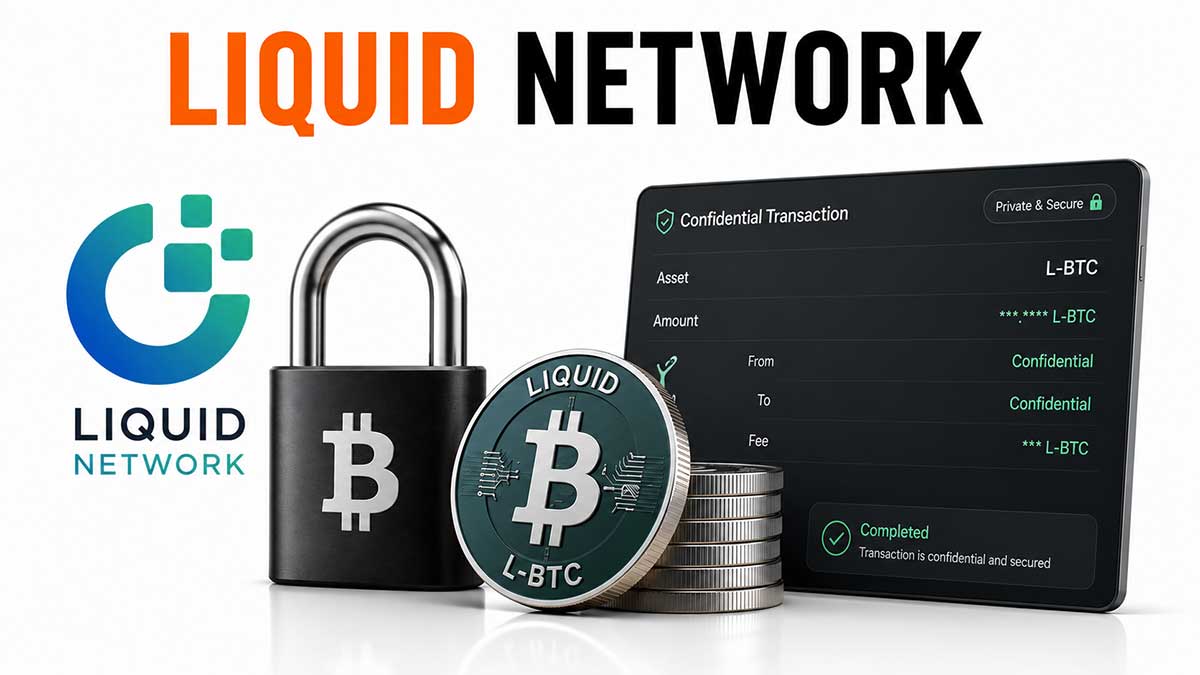
On Bitcoin Layer 1, all amounts are public : who sends what to whom is visible on the blockchainBlockchainA public, shared ledger that records every Bitcoin transaction in blocks linked together cryptographically. Each participant in the network keeps a copy.See in the lexicon →. That is the trade-off of address-based pseudo-anonymity rather than identity-based. Liquid solves that natively via Confidential Transactions (CT) : each amount is encrypted via homomorphic cryptography (Pedersen commitments), while remaining verifiable.
Concretely, an outside observer of a Liquid transaction sees : sender address, recipient address, asset type (L-BTC, USDT-Liquid, etc.), and an encrypted commitment of the amount. They do not see the plain amount. Only sender, recipient and parties authorised by them can decrypt. The cryptography guarantees that no bug can create new L-BTC without counterparty (range proofs prove each amount is in a valid range without revealing it).
Confidential Assets, the CT extension to issued assets, additionally mask the asset type itself : you cannot see if a transaction carries L-BTC, USDT, or a Microsoft stock token. It is Liquid's key advantage for OTCOTC (Over The Counter)Large-size trade executed off the order book, between two parties via a broker. Typically used for volumes above 100,000 EUR.See in the lexicon → desks wanting both amounts and asset exposure confidential. This functionality has no equivalent on Bitcoin Layer 1, and is more powerful than Lightning (where in-transit amounts are masked but channel balances remain observable to intermediate nodes).
Reference Liquid assets in 2026
L-BTC is Liquid's main asset : ~30 000 BTC in circulation on the chain in 2026 (Blockstream Liquid FederationFederation (sidechain)Group of entities (exchanges, companies) that co-sign the operations of a sidechain like Liquid. A trust model halfway between a single company and Bitcoin.See in the lexicon → figures), matching ~30 000 physical BTC in federated multisigMultisig (multi-signature)Configuration where a transaction must be signed by several independent keys to be valid (for example 2 of 3). Reduces the risk that a single key theft causes loss of funds.See in the lexicon →. By far the Bitcoin sidechainSidechainIndependent parallel chain linked to Bitcoin through a peg-in / peg-out mechanism. Liquid Network is the main Bitcoin sidechain.See in the lexicon → with most value locked. L-BTC mostly serves OTCOTC (Over The Counter)Large-size trade executed off the order book, between two parties via a broker. Typically used for volumes above 100,000 EUR.See in the lexicon → moves between exchanges (Bitfinex, Bitstamp), institutional trading desks, and confidential business-to-business transactions.
Stablecoins come next. USDT-Liquid is issued by Tether on Liquid since 2021 : ~500 million USD in circulation in 2026, used for instant confidential crypto-fiatFiat (fiat currency)State currency with legal tender status (euro, Swiss franc, dollar), issued by a central bank and not backed by a physical asset. By contrast, Bitcoin has an issuance capped at 21 million units, with no central issuer.See in the lexicon → settlement between exchanges. EURT-Liquid (Tether's EUR stablecoinStablecoinCrypto pegged to a fiat currency (USDT, USDC, EURI) or to a basket of assets, designed to stay stable around 1 USD or 1 EUR.See in the lexicon →) starts ramping up in 2025-2026 for crypto-EUR bridges in the European zone. USDC on Liquid is rarer (Circle prefers Ethereum and Solana).
Other Liquid asset categories are more experimental. Tokenised stock tokens (Microsoft, Apple, Tesla via DeFiChain/Liquid bridge), since 2022 : modest but growing volume. Custom OTC instruments : issued by desks or companies for internal settlement. User-created tokens : technically possible, marginal in practice. The Liquid asset ecosystem is more institutional than retail, consistent with its federated origin and OTC-desks focus.
Comparison : Lightning, Drivechains, Liquid
Lightning, Liquid and DrivechainsDrivechains (BIP 300/301)Proposal by Paul Sztorc: sidechains without a federation, secured by the Bitcoin miners themselves. Highly debated in the community.See in the lexicon → (BIPBIP (Bitcoin Improvement Proposal)Standard document that describes a proposed improvement to the Bitcoin protocol. Numbered (BIP 32, BIP 39, BIP 174, and so on). Open, public process on GitHub.See in the lexicon → 300) are the three big families of Bitcoin Layer 2 and sidechains. Each addresses different uses and has a distinct trust trade-off.
Lightning suits daily payments : modest amounts, instant finality, in-transit amount privacy, near-zero fees. Trade-off : decentralised peer-to-peer but requires pre-funded channels and inbound liquidityInbound liquidityCapacity of a Lightning channel to receive payments. To get paid 100,000 sats, you need at least 100,000 sats of inbound liquidity available.See in the lexicon →. No issued-asset support : only BTC circulates.
Liquid suits OTCOTC (Over The Counter)Large-size trade executed off the order book, between two parties via a broker. Typically used for volumes above 100,000 EUR.See in the lexicon → moves and institutional settlement : large amounts, 1-minute finality, strong privacy on amounts and asset types, native stablecoinStablecoinCrypto pegged to a fiat currency (USDT, USDC, EURI) or to a basket of assets, designed to stay stable around 1 USD or 1 EUR.See in the lexicon → and token support. Trade-off : trust in the ~30-entity federationFederation (sidechain)Group of entities (exchanges, companies) that co-sign the operations of a sidechain like Liquid. A trust model halfway between a single company and Bitcoin.See in the lexicon → (11 out of 15 must stay honest), no Lightning interoperability to date (peg-outPeg-in, peg-outTransfer of BTC to a sidechain (peg-in, e.g. BTC to L-BTC on Liquid) and the reverse operation (peg-out). On Liquid, the operation is signed by the federation.See in the lexicon → to BTC, then on-chain, then Lightning, takes two moves).
Drivechains (BIP 300, if activated) would offer sidechains more decentralised than Liquid, with peg validated by Bitcoin miners rather than a federation. Trade-off : potential minerMinerComputer or farm of computers that solves the cryptographic puzzle required to add a new block to the blockchain, in exchange for a bitcoin reward.See in the lexicon → centralisation risk, sidechainSidechainIndependent parallel chain linked to Bitcoin through a peg-in / peg-out mechanism. Liquid Network is the main Bitcoin sidechain.See in the lexicon → economic model to validate. Not activated in 2026 with an uncertain path (see BIP article). In the absence of Drivechains, Liquid remains the reference Bitcoin sidechain for uses requiring asset issuance and strong privacy.
Practical use and limits of the model
On the practical side, accessing Liquid requires a compatible walletWalletSoftware or device that manages your Bitcoin keys and lets you sign transactions. A wallet does not really « hold » your bitcoins, it holds the keys that prove you own them.See in the lexicon →. The 2026 options : Aqua (mobile, Blockstream, native L-BTC + USDT/EURT-Liquid), Blockstream Green (mobile and desktop), Elements Core (the reference nodeNodeComputer that runs the Bitcoin software and takes part in the network by validating blocks and transactions. A « full node » keeps a complete copy of the blockchain.See in the lexicon →, equivalent of Bitcoin CoreBitcoin CoreReference implementation of the Bitcoin software, written in C++ and maintained by an open-source community. This is the software that most nodes run.See in the lexicon → for Liquid), Sideswap (L-BTC/USDT-Liquid exchangeExchangeService that lets you buy, sell and swap cryptocurrencies against fiat money. Examples : Kraken, Coinbase, Bitstamp, Bitvavo. Most are custodial.See in the lexicon →). The Bitcoin to Liquid peg-inPeg-in, peg-outTransfer of BTC to a sidechain (peg-in, e.g. BTC to L-BTC on Liquid) and the reverse operation (peg-out). On Liquid, the operation is signed by the federation.See in the lexicon → is done from Aqua or Green in a few clicks. The peg-outPeg-in, peg-outTransfer of BTC to a sidechain (peg-in, e.g. BTC to L-BTC on Liquid) and the reverse operation (peg-out). On Liquid, the operation is signed by the federation.See in the lexicon → requires going through a functionary exchange (notably Bitfinex) or a third-party service.
Liquid model limits are structural. Trust in the federationFederation (sidechain)Group of entities (exchanges, companies) that co-sign the operations of a sidechain like Liquid. A trust model halfway between a single company and Bitcoin.See in the lexicon → : 11 out of 15 functionaries must stay honest. It is significant trust compared to pure Bitcoin Layer 1, but much less than entrusting your BTC to a single exchange. No Turing-complete programmability : Liquid is not Ethereum, scripting is extended but limited (no arbitrary smart contracts). No retail : the ecosystem remains mostly institutional/OTCOTC (Over The Counter)Large-size trade executed off the order book, between two parties via a broker. Typically used for volumes above 100,000 EUR.See in the lexicon →, few smooth mobile retail wallets.
For individual use in 2026, Liquid mainly interests two profiles. The advanced hodler wanting a confidentiality layer above Bitcoin for their large moves (BTC peg-in, masked Liquid transactions, peg-out). The OTC trader wanting to settle in USDT-Liquid stablecoinStablecoinCrypto pegged to a fiat currency (USDT, USDC, EURI) or to a basket of assets, designed to stay stable around 1 USD or 1 EUR.See in the lexicon → with confidentiality without going through Tron or Ethereum. For mainstream daily payments, Lightning remains the preferred path.
Disclaimer
Educational and informational content only: not investment, tax or legal advice. Bitcoin carries significant risks, including high volatility and the possible loss of invested capital. Each reader remains responsible for their decisions; when in doubt, consult a qualified professional in your jurisdiction.
See also
For Lightning NetworkLightning NetworkSecond-layer payment network on top of Bitcoin. Enables near-instant and near-free payments through channels opened between users.See in the lexicon → compared in this article, see Lightning Network explained simply. For the BIPBIP (Bitcoin Improvement Proposal)Standard document that describes a proposed improvement to the Bitcoin protocol. Numbered (BIP 32, BIP 39, BIP 174, and so on). Open, public process on GitHub.See in the lexicon → 300 DrivechainsDrivechains (BIP 300/301)Proposal by Paul Sztorc: sidechains without a federation, secured by the Bitcoin miners themselves. Highly debated in the community.See in the lexicon → mentioned, see Important Bitcoin BIPs. To run a Bitcoin CoreBitcoin CoreReference implementation of the Bitcoin software, written in C++ and maintained by an open-source community. This is the software that most nodes run.See in the lexicon → nodeNodeComputer that runs the Bitcoin software and takes part in the network by validating blocks and transactions. A « full node » keeps a complete copy of the blockchain.See in the lexicon → needed for secure peg-inPeg-in, peg-outTransfer of BTC to a sidechain (peg-in, e.g. BTC to L-BTC on Liquid) and the reverse operation (peg-out). On Liquid, the operation is signed by the federation.See in the lexicon →/peg-outPeg-in, peg-outTransfer of BTC to a sidechain (peg-in, e.g. BTC to L-BTC on Liquid) and the reverse operation (peg-out). On Liquid, the operation is signed by the federation.See in the lexicon →, see Running a bare Bitcoin Core node. for the overview, see Advanced Bitcoin.