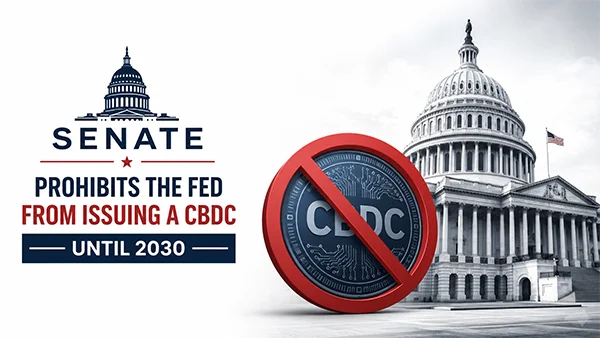
On 22 June 2026, the US Senate passed the 21st Century ROAD to Housing Act by 85 votes to 5. The bill prohibits the Federal Reserve from issuing or creating a central bank digital currency (CBDC) through the end of 2030. Private dollar-backed stablecoins are left outside the scope of the ban.
Central bank digital currencies have been debated for years in the United States: supporters see them as a tool to modernise payments, opponents as a risk of transaction surveillance and direct competition with commercial banks. The provision just adopted, inserted into a housing bill, settles that debate for several years by closing the door on any public digital dollar.
The choice charts a distinctive American path: leaving digital monetary innovation to the private sector, through dollar stablecoins now framed by federal law, rather than to the central bank. It contrasts with the euro area, where the ECB is pressing ahead with its digital euro project. For bitcoin, often presented as the decentralised alternative to state digital currencies, a landscape without a US CBDC reinforces its positioning.
Worth watching: the completion of the bill's legislative journey, how the Federal Reserve adjusts its research work, and the growth of regulated stablecoins occupying the space left open.