
This page brings together the main key figures of Bitcoin: maximum supply, bitcoins already mined, the value of a satoshi, the theoretical end date of issuance, market capitalization, and energy-related orders of magnitude.
“Market” values (price, capitalization) change constantly: when relevant, the figures are given as of February 17, 2026.
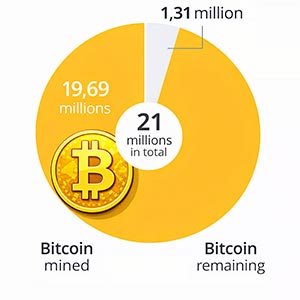
Bitcoin has a maximum supply written into its protocol: there will never be more than 21,000,000 BTC.
This fixed limit distinguishes Bitcoin from fiat currencies, whose supply can increase without a ceiling.
A satoshi (often “sat”) is the smallest unit of Bitcoin.
The value of 1 satoshi depends on the price of bitcoin. For example, if 1 BTC = $68,410, then 1 satoshi ≈ $0.00068410 (since 68,410 / 100,000,000).
This level of divisibility allows Bitcoin to be used for very small amounts, even if the price of a whole bitcoin is high.
A satoshi (often “sat”) is the smallest unit of Bitcoin.
The value of 1 satoshi depends on the price of bitcoin. For example, if 1 BTC = $68,410, then 1 satoshi ≈ $0.00068410 (since 68,410 / 100,000,000).
This level of divisibility allows Bitcoin to be used for very small amounts, even if the price of a whole bitcoin is high.
The market capitalization of Bitcoin corresponds to: BTC price × number of BTC in circulation.
As of February 17, 2026, it is approximately 1.36 trillion dollars ($1.36T), placing Bitcoin among the largest global assets by market value.
The Bitcoin network uses electricity to secure the blockchain through proof of work. Estimates vary depending on models and assumptions.
As an order of magnitude, a widely cited model (Bitcoin Energy Consumption Index) estimates annualized consumption at around 204 TWh/year.
These figures evolve with the price of bitcoin, the efficiency of mining hardware, and the geographical distribution of miners.